
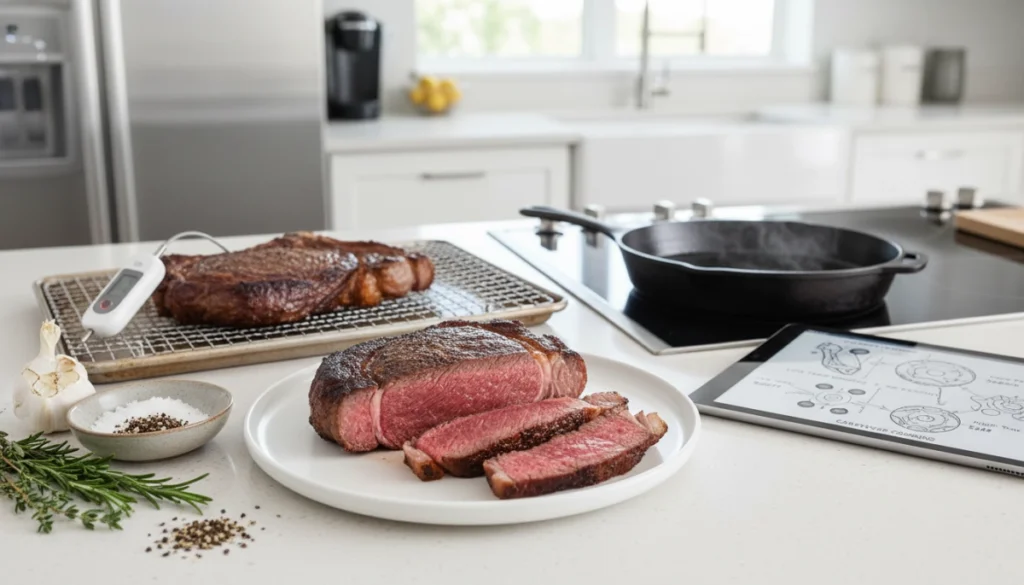
What Is the Reverse Sear Method?
If you’ve ever stressed over a ribeye—burnt outside, raw center, or that sad gray band—you’re exactly who the reverse sear method was made for.
Simple Definition: Reverse Sear for Ribeye
Reverse sear means you:
- Cook the ribeye low and slow first (usually in the oven or on the cool side of a grill).
- Then finish with a blazing-hot sear in a pan, cast iron, or over direct grill heat.
Instead of searing first and then roasting, you literally reverse the order—slow cook, then sear.
Reverse Sear vs Traditional Searing
Traditional pan sear or grill-only:
- Start with high heat, then lower the heat or move the steak to finish.
- Risk of overcooked edges and a thin band of perfect doneness in the center.
- Easy to miss your target steak internal temperature by a lot.
Reverse sear method:
- Start with low and slow steak cooking in the oven or indirect grill zone.
- Gently bring the thick cut ribeye steak close to your ideal doneness.
- Finish with a short, intense sear for that deep Maillard reaction steak crust.
- Result: even doneness steak, edge-to-edge pink, with a better crust.
Why Reverse Sear Is Ideal for Thick Ribeye Steaks
Reverse sear shines when you’re dealing with a thick ribeye steak:
- Works best on steaks at least 1.25–1.5 inches thick.
- Thick steaks need time for heat to move through evenly.
- Low heat gives you that edge to edge pink steak instead of a raw center and gray outer ring.
- Perfect for USDA Prime ribeye or any well-marbled steak where you want perfect medium rare ribeye every time.
When to Use Reverse Sear vs Pan Sear or Grill Only
Use reverse seared ribeye when:
- Your ribeye is thick-cut.
- You want very precise doneness (especially medium rare).
- You’re cooking for guests and want restaurant quality steak at home.
- You have an oven plus a cast iron pan or a two zone grilling setup.
Stick with simple pan sear or grill-only when:
- The steak is thin (under 1 inch).
- You’re in a rush and don’t care as much about edge-to-edge perfection.
How Reverse Sear Delivers Steakhouse Results at Home
Reverse sear helps home cooks hit steakhouse-style ribeye by:
- Giving you control: you monitor steak internal temperature with a meat thermometer or probe thermometer for steak instead of guessing.
- Maximizing crust and flavor: low heat first, then a focused, high-heat cast iron sear ribeye for serious browning.
- Making the process more forgiving: you’re far less likely to overshoot your medium rare steak temp.
If you’ve ever wondered how to turn a good grocery store ribeye into something that feels like a night out, the reverse sear method is the most reliable way to get there.
The Science Behind the Perfect Reverse-Seared Ribeye Steak
Reverse sear works because it lets science do the heavy lifting instead of brute-force heat.
How Heat Moves Through a Ribeye Steak
When you cook a thick ribeye steak, heat moves from the outside in:
- The outer layer heats up first
- That heat slowly conducts toward the center
- High heat from the start = overcooked outside, undercooked middle
With the reverse sear method, you warm the steak gently first, so the internal temperature rises slowly and evenly.
Why Thick Ribeye Needs a Different Approach
A thick-cut ribeye steak (at least 1.25–2 inches) behaves very differently than a thin steak:
- Thin steaks cook through so fast you don’t get control
- Thick steaks give you room to separate “cooking through” from “browning the crust”
- Reverse seared ribeye is ideal because you can nail edge-to-edge pink steak instead of a bullseye of doneness
For most home cooks in the U.S., this is the easiest way to get steakhouse-style results without guessing.
What “Low and Slow” Really Does Inside the Meat
Cooking ribeye low and slow in the oven or on a low grill:
- Lets the steak heat gradually so proteins tighten more gently
- Reduces the thick gray band of overcooked meat under the crust
- Gives you more time to react and pull it at the right steak internal temperature
You’re basically preheating the inside of the steak, not shocking it.
Balancing Crust, Doneness, and Juiciness
The reverse sear method splits the job into two steps:
-
Low heat phase (225–275°F):
- Build even doneness from edge to center
- Keep moisture in and fat slowly warming
-
High-heat sear (cast iron or grill):
- Trigger the Maillard reaction for deep brown crust and flavor
- Sear fast so you don’t overcook the inside
End result: juicy ribeye, perfect medium rare, and a killer crust all at once.
Why Reverse Sear Is More Forgiving
For beginners or anyone cooking at home:
- You rely on a meat thermometer, not guesswork
- The low temp gives you a bigger window before you overcook
- Carryover cooking is easier to predict, so you can hit your target doneness
That’s why I push reverse seared ribeye as the go-to method: it gives regular home kitchens in the U.S. a consistent, restaurant-quality steak without needing pro gear or years of practice.
Gentle Heat and Even Doneness in Reverse-Seared Ribeye
When I cook a reverse seared ribeye low and slow in the oven, I’m basically letting gentle heat creep in from the outside to the center. At 225–275°F, the temperature difference between the surface and the middle is smaller, so the steak cooks more evenly instead of shocking the outside.
Here’s what that does for your ribeye steak cooking:
- No thick gray band: That gray, overcooked ring you see with hot-and-fast grilling comes from blasting the outside way past well-done before the center catches up. Low oven heat keeps the outer layers closer to your target temp, so there’s less overcooked meat.
- Edge-to-edge pink steak: With the reverse sear method, the whole interior of a thick ribeye climbs slowly toward medium rare, giving you that even doneness steak look—pink (or red) from edge to edge, not just in the middle.
- Best oven temps:
- 225°F: Slowest, most even, best for super thick steaks (1.75–2+ inches).
- 250°F: My go-to for most thick cut ribeye steak (about 1.5 inches).
- 275°F: Faster, still controlled, good if you’re in a hurry but still want science-backed steak doneness.
Steak thickness matters for heat penetration and time:
- About 1.25 inches: expect roughly 25–35 minutes at 250°F to reach pre-sear temp.
- About 1.5 inches: usually 35–45 minutes.
- About 2 inches: 45–60 minutes or more, depending on your oven and starting temp.
That’s why I never rely on time alone. I always use a probe thermometer for steak and pull the ribeye from the oven when it’s about 10–15°F below my final target. Gentle heat plus tight temperature control is how you get that perfect medium rare ribeye with zero guesswork.
Moisture Retention and Juicy Reverse-Seared Ribeye
When I’m reverse searing a ribeye, my main goal is simple: lock in juices and get that perfectly tender, medium rare ribeye without drying it out. Moisture retention is where the reverse sear method really beats traditional high-heat-only cooking.
How High Heat Too Early Kills Juiciness
If you blast a cold ribeye with screaming high heat right away:
- The outer layer jumps in temperature fast, tightening the muscle fibers.
- Those tightened fibers squeeze out water and melted fat toward the surface.
- You see a ton of juice in the pan and less juice left in the steak.
- That’s how you end up with a gray, dry outer ring and only a small pink center.
This is why so many pan-seared-only or grilled-only thick ribeyes in home kitchens turn out drier than they should.
Protein Denaturation in Real Life Terms
You’ll hear people talk about “protein denaturation.” In plain English:
- As steak heats up, the proteins change shape and tighten.
- At higher temps, they shrink more and push out water.
- Once those proteins over-tighten, there’s no going back—that part of the steak is dry.
The reverse sear method slows this process down so the steak warms more gently, giving you better texture and more moisture inside.
Why Slow Heating Keeps Ribeye Tender and Moist
Low-and-slow oven heat (around 225–275°F) is the secret to a juicy reverse-seared ribeye:
- The ribeye warms evenly, so the outer layers don’t overcook before the center catches up.
- The muscle fibers tighten gradually, which means less moisture is squeezed out.
- Internal fat (marbling) has more time to melt and spread flavor through the meat.
- You get that edge-to-edge pink steak instead of rare in the middle and dry on the outside.
This is why the reverse seared ribeye method is my go-to for thick-cut ribeye steak at home.
How Resting Works With Reverse Sear
Resting is a big deal for moisture retention:
- As the steak cooks, juices move toward the hotter outer layers.
- When you pull the ribeye from the oven, a short rest lets those juices redistribute.
- By the time you hit it with high heat for the final sear, the inside is more stable and less likely to gush out.
Key points for resting with reverse sear:
- After low-and-slow:
- Rest 5–10 minutes before searing.
- Don’t wrap tightly in foil; if anything, lightly tent or leave it exposed so the surface stays dry for a better crust.
- After final sear:
- Rest another 5–10 minutes before slicing to keep juices in the meat, not on the cutting board.
Signs Your Ribeye Stayed Juicy vs Overcooked and Dry
You’ll know your reverse seared ribeye kept its moisture if:
- When you slice, there’s some juice, but it’s not flooding the board.
- The inside looks plump, shiny, and slightly glistening, not dull.
- The texture is tender but springy, not stringy or chalky.
- You can see little pockets of melted fat in the slices.
Signs you overshot and dried it out:
- Tons of juice pours out as soon as you cut in—you cut too soon.
- The interior looks flat, matte, and fibrous.
- The bite feels tough, chewy, or mealy instead of buttery.
If you want juicy ribeye every time, stick to low-and-slow reverse sear, use a meat thermometer, rest properly, and only then go hard with that final high-heat sear.
Enzymes and Natural Tenderizing in Reverse-Seared Ribeye
When I cook a reverse-seared ribeye steak, I’m not just thinking about heat—I’m using the steak’s own enzymes to make it more tender.
What Calpains and Cathepsins Do in Beef
Beef has natural enzymes called calpains and cathepsins. In plain English:
- They slowly break down muscle fibers and connective tissue
- They’re responsible for a lot of the natural tenderness you taste in a well-aged ribeye
- They’re most active at fridge to warm room temps, then start shutting down as the meat gets hotter
This is why a good, thick cut ribeye steak (especially USDA Choice or Prime) gets better with smart time and temperature control.
How Low, Controlled Heat Boosts Tenderness
With the reverse sear method, you cook the ribeye “low and slow” first—usually in a 225–275°F oven or indirect grill zone. That controlled heat:
- Brings the steak up gently, so those enzymes can keep tenderizing as the internal temp climbs
- Avoids shocking the meat with aggressive high heat too early
- Gives you a ribeye that’s tender edge-to-edge, not just in the center
Why Ribeye Texture Changes as It Warms Up
As your reverse-seared ribeye slowly warms:
- Below ~95°F: Enzymes are still working, meat is still soft and raw
- Around 95–120°F: Enzymes are winding down, fibers start to firm lightly but stay juicy
- Above ~120–130°F: Enzyme action is basically done, and protein tightening takes over
You feel this as the steak going from floppy to springy and plush—that’s the sweet spot for a perfect medium rare ribeye.
Using Time and Temperature to Your Advantage
To really use this “built-in tenderizer”:
- Choose thick cut ribeye (at least 1.25–1.5 inches)
- Cook low and slow until the center hits:
- 115–120°F if you want a final medium rare
- Don’t rush this stage—time at gentle heat = better texture
This is why reverse seared ribeye often beats a quick pan sear: you’re letting time and enzymes work for you.
When Enzyme Action Stops and Searing Can Start
Once the internal temp is where you want it for the low phase:
- Enzyme activity has basically tapped out
- That’s your signal to start the high-heat sear
- Now you focus on the Maillard reaction and crust, not tenderness
I pull the steak from the oven at my target “pull temp,” let it sit a few minutes, then hit it hard in a screaming hot cast iron pan or on a blazing grill. At this point, I’m no longer worried about enzymes—I’m locking in that tender texture I already built and finishing with a steakhouse-level crust.
Maillard Reaction and Crust Science on a Reverse-Seared Ribeye
What the Maillard reaction actually is
The Maillard reaction is the browning reaction that happens when the surface of your ribeye gets hot enough for proteins and natural sugars to react. In plain English:
Brown = flavor.
That deep, steakhouse-style crust on a reverse-seared ribeye steak is just the Maillard reaction done right—giving you those roasted, nutty, savory flavors everyone chases.
Why a dry steak surface is critical for browning
If the surface is wet, you’re steaming, not searing. Water has to evaporate before the pan can get hot enough for the Maillard reaction.
To get a serious crust on a reverse seared ribeye:
- Pat the steak very dry with paper towels before cooking.
- Use a wire rack in the fridge to air-dry (even 30–60 minutes helps).
- Skip heavy wet marinades right before searing.
- Visible moisture on the steak = weaker crust and less flavor.
Dry surface = faster browning, darker crust, better flavor.
How reverse sear sets you up for a better crust
The reverse sear method is basically crust insurance:
- The ribeye slow-cooks first, so surface moisture slowly dries out.
- The steak hits the pan already warm, so you spend less time in the pan and more time at true searing temps.
- Because the inside is already near your target temp, you can focus on crust without stressing about overcooking.
Result: edge-to-edge pink steak inside, hard sear and Maillard-heavy crust outside.
Best searing temperatures for ribeye crust
For steakhouse-level browning, your cooking surface needs to be very hot:
- Pan / cast iron surface temp: about 450–500°F (232–260°C)
- For most home cooks:
- Heat the pan on medium-high to high for several minutes.
- If a drop of oil shimmers and moves easily—you\’re there.
You want a fast, aggressive sear: usually 45–90 seconds per side, plus a quick sear on the fat cap and edges.
How oil, fat, and pan choice affect browning and flavor
Your gear and fat choices matter a lot for searing crust science:
Best pans for reverse sear ribeye:
- Cast iron or carbon steel – heavy, hold heat, build crust fast
- Avoid thin, lightweight pans that lose heat when the steak hits
Best oils and fats for high-heat searing:
- Canola oil, avocado oil, grapeseed oil, beef tallow – high smoke point
- Add butter at the very end for flavor (butter alone burns too fast at searing temps)
Simple setup for maximum flavor:
- Preheat cast iron until ripping hot.
- Add a thin layer of high smoke point oil.
- Sear the reverse seared ribeye hard, then optionally:
- Add a knob of butter + smashed garlic + thyme/rosemary
- Tilt and spoon butter over the steak for 20–30 seconds
That combo of high heat, dry surface, heavy pan, and the right fat is exactly how you get that steakhouse Maillard crust at home.
Carryover Cooking and Temperature Control for Reverse-Seared Ribeye
Carryover cooking is what happens after you pull your ribeye off the heat. The outside of the steak is hotter than the center, so heat keeps moving inward and the internal temperature keeps rising a few degrees. If you don’t plan for that, you blow right past perfect medium rare.
What Carryover Cooking Does to Ribeye
For a thick reverse-seared ribeye steak (1.25–2 inches):
- Expect 3–5°F of carryover after the oven
- Expect another 2–3°F after the final sear and rest
- Thicker and bone-in ribeyes usually see more carryover than thin, boneless cuts
That’s why temperature control is everything with the reverse sear method.
Why Reverse Sear Makes Doneness More Predictable
With the low and slow steak phase (225–275°F oven or indirect grill):
- The temperature climbs gradually, so it’s easier to hit your target
- You can track the exact steak internal temperature with a probe thermometer
- You’re not guessing based on time or color—you’re cooking to temp, not to hope
This is how you get edge-to-edge pink steak instead of a gray band and random doneness.
Pull Temps vs Final Temps for Ribeye Doneness
Use these pull temperatures (when you take the steak out of the oven, before searing), then expect a 5–10°F total rise by the time you’re slicing:
| Doneness Level | Pull Temp (Oven, Before Sear) | Final Temp (After Sear + Rest) |
|---|---|---|
| Rare | 105–110°F | 120–125°F |
| Medium Rare | 115–120°F | 130–135°F |
| Medium | 125–130°F | 140–145°F |
| Medium Well | 135–140°F | 150–155°F |
| Well Done | 145–150°F | 160°F+ |
For a perfect medium rare ribeye, I usually:
- Pull from oven at 118–120°F
- Sear hard in a ripping-hot cast iron pan
- Let it rest to finish around 130–133°F
How to Avoid Overshooting Medium Rare
To keep your reverse-seared ribeye in the sweet spot:
- Use a probe thermometer during the low-temp phase – don’t rely on guessing
- Set a target alarm a few degrees below your pull temp so you don’t react late
- Sear fast and hot (30–60 seconds per side) to build crust without cooking the center too much
- Rest 5–10 minutes after the final sear so carryover settles and juices redistribute
- For thinner ribeyes, lower your pull temp by 3–5°F, since they cook through faster during the sear
Nail your carryover cooking and temperature control, and your reverse seared ribeye goes from “good” to steakhouse-level consistent every single time.
Choosing the Right Ribeye Steak for Reverse Sear
Ideal Thickness for Reverse-Seared Ribeye
For the reverse sear method, thickness matters more than anything.
- Aim for 1.5–2 inches thick for the best edge-to-edge pink steak
- Anything under 1.25 inches cooks too fast and is better for a simple pan sear
- Thicker ribeyes (2+ inches) are perfect for low and slow steak and staying juicy
Prime vs Choice vs Select (Marbling & Flavor)
Marbling is king for a perfect medium rare ribeye.
- USDA Prime: Heavy marbling, steakhouse-level flavor and tenderness, best for reverse seared ribeye
- USDA Choice: Solid marbling, great value, my go-to for everyday ribeye steak cooking
- USDA Select: Leaner, easier to dry out, only use with careful temp control and extra butter/oil
If you want that restaurant-quality steak at home, grab Prime when you can or the best-marbled Choice you see.
Ribeye Cap, Eye, and Fat – What to Look For
Visually scan the steak before you buy:
- Ribeye cap (spinalis): The outer “crescent” muscle – look for it to be thick, well-marbled, and well-defined
- Ribeye eye: The center section – should have fine white marbling, not big bare red patches
- Fat:
- Look for even intramuscular marbling (tiny white lines throughout)
- Avoid huge, thick exterior fat caps that won’t render well
- A small fat “kernel” between cap and eye is normal and flavorful
More marbling = better flavor, better moisture retention, and a more forgiving cook.
Dry-Aged vs Wet-Aged Ribeye
Reverse sear works beautifully for both, but they eat differently:
- Dry-aged ribeye:
- Deeper beef flavor, nuttier and more intense
- Slightly drier surface = better Maillard reaction steak crust
- Costs more but shines with the reverse sear method
- Wet-aged ribeye:
- More common in US grocery stores
- Juicy, clean beef flavor, a bit milder
- Still fantastic for oven reverse sear or grill reverse sear
If you’re cooking for a crowd, I usually go wet-aged Choice or Prime for a balance of cost and consistency.
Bone-In vs Boneless Ribeye for Reverse Sear
Both work, but they behave differently:
- Boneless ribeye:
- Cooks faster and more evenly
- Easier to sear all sides in a cast iron pan
- Best pick for beginners dialing in steak internal temperature
- Bone-in ribeye (cowboy or tomahawk):
- Bone slows heat on that side, so it may be slightly rarer near the bone
- Looks impressive, great for grill reverse sear or special nights
- Expect a bit longer low and slow time before searing
If your goal is precision doneness (perfect medium rare, 130–135°F), go boneless. If your goal is showpiece steakhouse style ribeye, bone-in is worth it.
Ribeye Prep: Seasoning and Setup
Pat the ribeye dry first
For a perfect reverse-seared ribeye, I always start with paper towels.
- Pat the ribeye steak completely dry on all sides, including the fat cap and edges.
- A dry surface means:
- Better Maillard reaction and crust
- Less steaming in the pan
- More control over browning instead of burning
Moisture is the enemy of a great sear. Get that steak as dry as you reasonably can.
Simple, effective seasoning for reverse-seared ribeye
You don’t need a complicated rub for a steakhouse-style ribeye.
- Baseline seasoning:
- Kosher salt (coarse)
- Freshly cracked black pepper
- Optional add-ons:
- Garlic powder or granulated garlic
- A little onion powder
- Smoked paprika if you want a light smoky note
I keep it simple so the ribeye fat and beef flavor stay front and center. This works great for both oven reverse sear and grill reverse sear.
When to salt: right before vs dry brine
Both work – it just depends on your schedule.
1. Salt right before cooking (same-day, quick option):
- Season generously with kosher salt and pepper right before the ribeye goes in the oven.
- Pros: Fast, easy, great for weeknights.
- Cons: Slightly less deep seasoning inside the meat.
2. Dry brine in the fridge (best flavor and crust):
- Salt the ribeye at least 1–24 hours before cooking.
- Place it uncovered on a wire rack in the fridge.
- Benefits:
- Salt pulls out moisture, then reabsorbs it, seasoning deeper
- Surface dries out, giving you an even better reverse seared crust
- More forgiving if you slightly overshoot temp
If you have the time, dry brining is the move for serious home cooks who want steakhouse-level reverse seared ribeye.
Wire rack and baking sheet setup
For the “low and slow” phase, setup matters.
- Use a rimmed baking sheet (like a half sheet pan).
- Set a wire rack on top and place the ribeye on the rack.
- Why this matters:
- Air can move all around the steak for even doneness
- No soggy bottom from sitting in its own juices
- More consistent edge-to-edge pink steak in the oven
This setup works perfectly with a probe thermometer stuck into the thickest part of the ribeye.
Room temperature myths vs reality
You’ll see people say “let your steak come to room temp.” In real life, especially in US kitchens, that’s mostly a myth.
- A thick-cut ribeye (1.5–2 inches) won’t actually reach room temp in 30–45 minutes.
- The center might warm up a few degrees, but not enough to make a big difference in cooking time.
- What does matter more:
- Proper internal temperature control with a meat thermometer
- Your oven temp for the reverse sear method
- How dry and well-seasoned the surface is
If you want, you can leave the steak on the counter for 20–30 minutes while the oven preheats, but don’t overthink it. Focus on drying, salting, and a good rack setup for the best reverse-seared ribeye results.
Low and Slow Phase: Oven or Grill (Reverse Sear Method)
Step-by-Step: Reverse Sear in the Oven
Here’s the low-and-slow phase I use to set up the perfect reverse-seared ribeye:
-
Preheat the oven
- Set to 225–250°F (ideal range for even doneness steak).
- Use convection if your oven has it for more consistent heat.
-
Set up the steak
- Place the ribeye on a wire rack set over a baking sheet.
- This lets hot air circulate for edge-to-edge pink steak.
-
Insert the probe thermometer
- Use a probe thermometer for steak, not guesswork.
- Slide the probe into the side of the steak, into the thickest center, avoiding fat pockets and bone.
- You want the tip exactly in the middle for accurate steak internal temperature.
-
Slow-roast in the oven
- Put the tray on the middle rack.
- Let it cook low and slow until it hits your target internal temp before sear (see table below).
Using a Grill or Smoker for the Low-Temperature Phase
If you’d rather stay outside, the reverse sear method works perfectly on a grill or smoker:
-
Set up two-zone grilling
- One side: low/indirect heat around 225–250°F.
- Other side: hot direct heat (for the final sear later).
-
For a gas grill
- Turn one burner on low, keep the others off.
- Place the ribeye over the unlit side (indirect zone).
-
For a charcoal grill or smoker
- Bank coals to one side.
- Add a small wood chunk if you want a smoked reverse sear steak.
- Place the steak on the cool side, lid closed, thermometer inserted.
-
Probe placement on the grill/smoker
- Same rule: insert the probe from the side into the center of the ribeye.
- Keep the cable away from direct flame and super-hot grates.
Target Internal Temperatures Before the Final Sear
For a perfect medium rare ribeye, you don’t cook to final temperature in this phase. You stop early to leave room for the sear and carryover cooking:
Pull-from-oven/grill temps before sear:
| Desired Final Doneness | Target Before Sear (°F) | Typical Final After Sear (°F) |
|---|---|---|
| Rare | 95–100°F | 120–125°F |
| Medium Rare | 100–105°F | 130–135°F |
| Medium | 110–115°F | 140–145°F |
You’ll finish the last 15–25°F during the high-heat cast iron sear.
Time Estimates by Thickness and Starting Temp
These are ballpark numbers at 225–250°F for a fridge-cold steak (around 38–40°F) going to 100–105°F before sear:
- 1.25-inch ribeye: ~25–35 minutes
- 1.5-inch ribeye: ~35–45 minutes
- 2-inch ribeye: ~45–60 minutes
If your ribeye sits out on the counter for 20–30 minutes first, knock ~5–10 minutes off. Still, I never rely on time alone; the meat thermometer guide rules everything.
Probe Thermometer Placement for Accuracy
To nail restaurant-quality reverse seared ribeye at home, probe placement is non-negotiable:
- Go from the side, not the top
- Easier to hit the exact center of the thick cut ribeye steak.
- Avoid fat seams and bone
- Fat heats differently and can lie to your thermometer.
- Keep the tip centered
- If it’s too close to the surface, you’ll read high and overcook.
- Check once with an instant-read
- If you’re unsure, confirm with a fast instant-read thermometer in the same center spot.
Get this low-and-slow phase right, and the final sear becomes easy: perfect medium rare steak temp, juicy ribeye, and an even doneness steak from edge to edge.
Resting Before the Sear (Reverse Seared Ribeye)
Why a Short Rest Helps the Steak
After the low-and-slow phase, a reverse seared ribeye needs a short rest before hitting high heat. That pause lets the heat inside the steak even out so you don’t blow past your target internal temperature the second it hits the blazing hot pan or grill.
Juice Distribution Before the Sear
During the low-temp cook, juices move toward the center. A quick rest (5–10 minutes) lets them relax and spread back out, so when you sear, you’re not forcing all the moisture to the middle and drying out the edges. It’s a small step that pays off in more even doneness and better moisture retention.
How Long to Rest Between Oven and Pan
For most thick cut ribeye steaks (1.5–2 inches):
- Rest: 5–10 minutes after the oven or grill low phase
- Keep your thermometer in the steak to watch carryover cooking
- Start searing when the temp has mostly stabilized and stopped climbing
You don’t want a long rest here—you just want the steak to “settle,” then go straight into the sear.
Tent with Foil or Leave Exposed?
For reverse sear method, I leave the steak exposed, not tightly tented:
- Leave exposed: helps the surface dry out more = better Maillard reaction and deeper crust
- Avoid tight foil: traps steam, softens the surface, and fights against that steakhouse-style sear
If you’re worried about it cooling too much, you can very loosely drape foil, but don’t seal it.
What the Steak Should Look and Feel Like Before Searing
Right before the high-heat sear, your reverse seared ribeye should:
- Look dull and slightly dry on the surface (that’s good for browning)
- Feel slightly warm but not screaming hot to the touch
- Be at 10–15°F below your final target temp (for medium rare ribeye, around 110–120°F)
- Have no visible wet patches—if needed, pat it dry again with paper towels
Once it’s rested, dry, and at the right internal temperature, it’s ready for a hard, fast sear in a ripping-hot cast iron pan or grill to finish that perfect edge-to-edge pink steak.
High-Heat Sear: Pan, Cast Iron, or Grill
When I’m finishing a reverse seared ribeye, this is where the magic happens: fast, brutal heat for a killer crust without wrecking that perfect medium rare center.
Best pans for searing ribeye
For a reverse seared ribeye, your pan matters more than you think:
- Cast iron – My go-to. Heavy, holds heat, insane crust.
- Carbon steel – Heats fast, great sear, a bit lighter than cast iron.
- Avoid thin nonstick – They lose heat and can’t handle high-temp searing safely.
If you’re using a grill, set it to high heat or use the hottest part of your two-zone grill for the sear.
How hot the pan or grill should be
You want serious heat for that Maillard reaction:
- Pan test: Preheat on high until a drop of water skitters and evaporates in 1–2 seconds.
- Infrared thermometer (if you use one): Aim for about 450–500°F on the pan surface.
- Grill: As hot as it’ll reasonably go, typically 500–600°F at the grates.
If it barely sizzles when the ribeye hits, it’s not hot enough.
Best oils and fats for searing
Use high smoke point oils so you can crank the heat:
- Avocado oil
- Refined canola or vegetable oil
- Grapeseed oil
- Beef tallow (fantastic flavor for ribeye)
Add butter later (last 30–60 seconds) if you want to baste. Butter alone burns too fast at searing temps.
How long to sear each side
Your reverse seared ribeye is already close to your target internal temp. The sear is just for color and flavor:
- Each side: About 45–90 seconds
- Edges/fat cap: Another 30–60 seconds, holding it with tongs
You’re looking for deep brown, not black. If it’s smoking like crazy and darkening in under 30 seconds, your heat is too high.
How to avoid burning but still get deep color
To nail that crust without scorching:
- Start dry: Steak surface must be very dry before it hits the pan or grill.
- Don’t move it: Let each side sit to build crust; flipping constantly kills color.
- Control heat:
- If the oil is screaming and turning dark immediately, lower the burner slightly.
- On a grill, move to a slightly cooler zone if flare-ups get wild.
- Use enough fat: A thin, even film of oil helps brown the surface evenly.
- Watch the fat: The ribeye’s own fat can burn—if a spot looks too dark, rotate or flip.
Done right, your reverse seared ribeye steak will have a restaurant-level crust with edge-to-edge pink inside and no gray band.
Finishing Touches and Final Rest for Reverse-Seared Ribeye
Butter Basting vs Dry Sear
Both work for a reverse-seared ribeye steak—you just use them for different goals:
-
Dry sear (no butter at first)
- Best when you want a deep, aggressive crust.
- Ideal for very hot cast iron or carbon steel.
- Use a thin layer of high smoke point oil (avocado, canola, grapeseed).
- Add butter only in the last 30–45 seconds if you want flavor without burning.
-
Butter basting
- Best when you want a richer, steakhouse-style flavor.
- Works great once the crust is mostly set.
- Add 1–2 tablespoons of butter after the first flip, tilt the pan, and spoon the foaming butter over the ribeye.
- Keep an eye out for burning milk solids—if the butter starts to smoke hard, pull the pan off heat for a few seconds.
Aromatics: Garlic, Rosemary, Thyme
To give your reverse-seared ribeye that steakhouse smell and flavor:
- Add crushed garlic cloves (skin on), fresh rosemary, and fresh thyme when you add butter.
- Let them sizzle in the butter so it picks up the aromatics, then baste the steak with that flavored fat.
- Don’t leave herbs in direct contact with super-hot metal for too long—they can burn and taste bitter.
How Long to Rest After the Final Sear
With a reverse sear method, the steak is already gently cooked, so you don’t need a long rest:
- Typical rest time: 5–10 minutes for a thick-cut ribeye.
- Place the steak on a warm plate or cutting board, not over direct heat.
- You don’t need a tight foil tent—if you cover it, keep it very loose so the crust doesn’t steam and soften.
How to Slice Ribeye for the Best Bite
Presentation and texture matter just as much as the perfect medium rare ribeye temperature:
- If your ribeye is boneless, slice it:
- Across the grain into ½-inch thick slices.
- If it’s bone-in, you can:
- Cut the steak off the bone first, then slice the meat.
- Serve the bone on the side for looks (and for the person who wants to gnaw on it).
- Use a sharp carving or chef’s knife so you don’t tear the meat and lose juices.
Seasoning Right Before Serving
This is where you dial in final flavor:
- After resting and slicing:
- Sprinkle a small pinch of flaky sea salt on top of the slices to wake up the flavor.
- Add a light crack of black pepper if needed (pepper can burn in the pan, so finishing with fresh pepper keeps it bright).
- Optional finish:
- A thin slice of compound butter (garlic, herbs, or blue cheese) on top of the hot reverse-seared ribeye so it melts right before serving.
These finishing touches are what take a reverse-seared ribeye from “good” to full steakhouse-at-home level, with a crisp crust, juicy center, and dialed-in flavor from first bite to last.
Ribeye Temperature and Doneness Guide
Getting the perfect medium rare ribeye (or any doneness you like) comes down to tight control over steak internal temperature, not guesswork. With reverse sear, pull temps and final temps matter a lot because of carryover cooking.
Pull Temps vs Final Temps (Chart)
When you reverse sear ribeye, you pull it from the oven a few degrees below your target, then finish in a ripping hot pan or grill.
| Doneness | Pull Temp (after low & slow) | Final Temp (after sear + rest) |
|---|---|---|
| Rare | 110–115°F | 120–125°F |
| Medium Rare | 115–120°F | 125–130°F |
| Medium | 125–130°F | 135–140°F |
| Medium Well | 135–140°F | 145–150°F |
| Well Done | 145–150°F | 155–160°F+ |
Use a reliable meat thermometer (ideally a probe thermometer for steak) and place it in the thickest part of the ribeye.
Target Temps for Each Doneness
Here’s where you want that reverse seared ribeye to land after the final rest:
- Rare: 120–125°F – cool red center, very soft
- Medium Rare: 125–130°F – warm red center, soft but springy
- Medium: 135–140°F – warm pink center, firmer bite
- Medium Well: 145–150°F – mostly brown with a hint of pink
- Well Done: 155–160°F+ – fully brown/gray, very firm
Why Medium Rare Is King for Ribeye
For well marbled steak like ribeye (especially USDA Prime ribeye and high-end Choice):
- The fat (marbling) starts to render properly around 125–135°F.
- At medium rare, you get:
- Edge to edge pink steak
- Melted fat that boosts flavor
- Juicy, tender texture without drying the meat
That’s why most steakhouses and serious home cooks in the U.S. aim for medium rare ribeye.
If Your Final Temp Is Off
If you miss your target:
-
You overshot (too high):
- Slice thicker pieces to keep some moisture.
- Add compound butter or a quick pan sauce to boost richness.
- Next time:
- Pull from oven 5°F earlier.
- Shorten the sear by 15–30 seconds per side.
-
You undershot (too low):
- Pop it back in a 300°F oven for 3–5 minutes and recheck.
- Or give each side another 30–45 seconds in the pan.
- Next time:
- Let it ride in the oven until 2–3°F closer to target before sear.
Always trust the thermometer, not the clock.
Signs of Correct Doneness (Beyond the Thermometer)
Use feel and visuals along with your steak doneness chart:
- Rare: Very soft, squishy; deep red center when sliced.
- Medium Rare: Soft with light spring; bright warm red center, thin browned crust.
- Medium: Noticeable bounce; rosy pink center, more opaque.
- Medium Well: Firm with little give; mostly brown inside with faint pink.
- Well Done: Very firm; fully brown/gray, juices are clear, not rosy.
With the reverse sear method, a properly cooked ribeye will be:
- Evenly colored edge to edge (minimal gray band)
- Juicy when sliced, but not flooding the board
- Crisp, browned crust from the Maillard reaction, not black or bitter
Dialing in these reverse seared ribeye temps is how you get consistent, restaurant-quality steak at home.
Essential Tools for Reverse-Seared Ribeye
When I’m dialing in a perfect reverse-seared ribeye at home, I rely on a few key tools. You don’t need a commercial kitchen, but the right basics make steakhouse-level results a lot easier and more repeatable.
Meat Thermometer: Non-Negotiable
If you care about perfect medium rare ribeye or any precise doneness, a meat thermometer isn’t optional—it’s the whole game.
Why it matters:
- Ribeye doneness is about exact internal temperature, not guesswork
- Avoids overcooking a pricey USDA Prime ribeye by “going by feel”
- Lets you control carryover cooking and hit your target every time
If you’re cooking thick-cut, reverse seared ribeye and not using a thermometer, you’re gambling with an expensive cut.
Best Thermometers for Reverse Sear
For reverse sear method, I like having both of these:
-
Probe thermometer (leave-in)
- Ideal for the low and slow steak phase in the oven or grill
- Tracks temp in real time, so you know exactly when to pull at 115–125°F
- Great for two-zone grilling and smoked reverse sear steak
-
Instant-read thermometer
- Fast checks right before and after the sear
- Confirms steak internal temperature without overcooking
- Handy if you’re cooking multiple ribeyes at once
Even budget models work, as long as they’re accurate and consistent. I’d invest here before anything else.
Heavy Pan vs Thin Skillet for Searing
For the high-heat finish, a heavy pan is critical for a serious Maillard reaction steak crust:
- Cast iron or carbon steel > thin, lightweight skillets
- They hold heat better, which means:
- More even browning
- Better crust on thick cut ribeye steak
- Less temperature drop when the steak hits the pan
Thin pans scorch easily, heat unevenly, and give you a weak crust. A solid cast iron sear ribeye is the move for restaurant-quality steak at home.
Optional Gear That Makes Life Easier
You can absolutely reverse sear with just a pan, oven, and thermometer. But these help a lot:
-
Wire rack + rimmed baking sheet
- Keeps the ribeye elevated in the oven
- Promotes even cooking and a drier surface for better browning
-
Good tongs
- Easy flipping and edge searing
- More control than a fork (and you’re not stabbing the meat)
-
Tray or sheet pan
- For resting, moving multiple steaks, and keeping things clean
These small upgrades streamline the whole process, especially if you’re cooking for more than one or two people.
Budget vs Premium Gear: What Actually Matters
You don’t need a fancy setup to nail a reverse seared ribeye in a typical U.S. kitchen. Here’s where to spend and where to save:
-
Spend a bit more on:
- Reliable thermometers (accuracy matters more than brand)
- A heavy cast iron or carbon steel pan
-
Save money on:
- Basic wire racks, trays, and tongs—cheap versions work fine
- Non-essential specialty gadgets you’ll rarely use
The bottom line: if you’ve got a good thermometer and a heavy pan, you’re set up to cook thick ribeye like a steakhouse—whether you’re using an oven reverse sear, grill reverse sear, or a smoked reverse sear steak setup.
Pro Tips for Better Reverse-Seared Ribeye
Air-dry for a next-level crust
If you want a steakhouse-style crust on your reverse seared ribeye:
- Unwrap and pat dry with paper towels.
- Set on a wire rack over a sheet pan, uncovered in the fridge.
- Air-dry for 12–24 hours (even 4–6 hours helps).
- This dries the surface so the Maillard reaction hits harder and gives you that deep, even searing crust.
Salting strategies for deeper flavor
Salt is your biggest flavor upgrade for ribeye steak:
- Dry brine: Salt generously with kosher salt and let it rest in the fridge at least 1 hour, up to 24 hours.
- Add pepper and other seasonings right before searing so they don’t burn.
- For thicker reverse seared ribeye (1.5–2 inches), don’t be shy with salt—well marbled steak needs more seasoning.
Cooking multiple ribeyes evenly
If you’re cooking for a crowd and want every reverse seared ribeye to hit the same doneness:
- Use similar thickness steaks (within ¼ inch).
- Arrange on a rack with space between them so hot air circulates.
- Use a probe thermometer in the thickest steak and spot-check others with an instant-read.
- After the low and slow phase, sear in batches so you don’t overcrowd the pan and kill the crust.
Timing your sides with the steak
To serve everything hot and fresh:
- Plan backwards from your final sear (the fastest part).
- Do oven or grill sides (roasted potatoes, veggies, mac and cheese) while the ribeye is in the low-temp phase.
- Use the pre-sear rest and final rest to finish quick items like salads, warmed bread, or pan sauces.
- Keep sides in a warm oven (around 170–190°F) while you sear.
Small tweaks that turn good into great
A few simple moves push your reverse seared ribeye into restaurant-quality:
- Use cast iron or carbon steel for a powerful, even sear.
- Sear in a high smoke point oil (avocado, grapeseed, canola), then finish with butter basting in the last 30–60 seconds if you like.
- Toss in garlic, rosemary, and thyme during the butter baste for steakhouse flavor.
- Always slice against the grain and taste a small piece before serving to adjust with a pinch of salt or flaky finishing salt.
Common Mistakes with Reverse-Seared Ribeye
Starting with a Steak That’s Too Thin
Reverse sear is built for thick-cut ribeye steaks.
Avoid:
- Steaks under 1.25–1.5 inches thick – they cook through too fast and can dry out
- Thin ribeyes on the grill or oven for “low and slow” – they end up overcooked before you ever get a good crust
If your ribeye is thin, pan sear only is usually the better move.
Using Wet or Damp Steak Before Searing
Moisture kills your crust and slows the Maillard reaction.
Always:
- Pat the ribeye completely dry with paper towels before searing
- Skip searing straight out of the package or marinade
- If you dry brined, wipe off excess surface moisture but leave the seasoning
Dry surface = better browning, deeper flavor, steakhouse-level crust.
Relying on Time Instead of Internal Temperature
Reverse seared ribeye is all about internal temp, not guesswork.
Avoid:
- Cooking “20 minutes per side” or following TikTok times
- Skipping a meat thermometer or probe thermometer
Do this instead:
- Use a reliable instant-read or probe thermometer
- Track steak internal temperature and pull at your exact target for doneness
This is how you hit a perfect medium rare ribeye consistently.
Overcrowding the Pan or Grill During the Sear
If the pan is packed, the steak steams instead of sears.
Avoid:
- Cramming 3–4 ribeyes into one small cast iron
- Letting steaks touch while searing
Do this:
- Sear 1–2 ribeyes at a time in a hot cast iron or on the hot side of a two-zone grill
- Leave space around each steak so the crust can really develop
More space = better crust, more flavor, less gray, more brown.
Over-Resting or Cutting Into the Steak Too Soon
Resting matters, but you can overdo it.
Avoid:
- Letting reverse-seared ribeye sit so long it cools off
- Slicing right away and watching all the juices run out
Instead:
- After the final sear, rest 5–10 minutes (loosely tented or uncovered)
- Slice against the grain right before serving
The result: juicy ribeye, not dry, and no waste on the cutting board.
Troubleshooting Steak Problems
Fixing a weak crust or pale sear on reverse seared ribeye
If your reverse seared ribeye comes out pale, it’s usually a surface moisture or heat issue. I fix it by tightening up the basics:
- Pat the steak bone-dry with paper towels before searing. Any moisture kills the Maillard reaction.
- Chill briefly, uncovered, in the fridge (10–20 minutes) after the low-and-slow phase to dry the surface even more.
- Use a ripping-hot pan (cast iron or carbon steel) or screaming-hot grill. If it’s not smoking a bit before the steak goes down, it’s not hot enough.
- Use a high smoke point oil (avocado, canola, grapeseed) and just a thin film—don’t shallow-fry.
- Don’t move the ribeye for 45–60 seconds per side at first. Let that crust form before flipping.
If you want even more color, do quick edge sears and, if needed, one more 20–30 second pass per side.
What to do if you overshoot your target steak temp
Overshooting the perfect medium rare ribeye happens, even with a meat thermometer. Here’s how I salvage it:
- Pull it immediately from heat and don’t sear longer than absolutely necessary.
- Add butter basting with aromatics (garlic, rosemary, thyme) in the pan to boost flavor and richness.
- Let it rest a bit shorter so it doesn’t cook further from carryover.
- Slice thinner and serve with a sauce (pan sauce, chimichurri, compound butter) to bring back some perceived juiciness.
For next time:
- Lower your oven temp (225°F instead of 275°F) for more control.
- Pull 5°F earlier than your target pull temp; your ribeye will coast on carryover cooking.
Handling uneven doneness in one ribeye steak
If one side’s more done than the other, or the eye and cap don’t match, I treat the steak like zones:
- Slice it and plate the more done slices for guests who like medium/medium-well.
- Keep the more rare section for medium-rare fans.
- When cooking next time:
- Rotate the ribeye halfway through the oven phase.
- Use a probe thermometer in the center (not touching fat or bone).
- For bone-in ribeye, expect the bone side to cook slower—face that side toward the hotter part of the oven or grill.
Uneven thickness = uneven doneness. If your steak is tapered, put the thicker end toward the hotter zone during reverse sear.
Dealing with flare-ups on the grill during the sear
Flare-ups can wreck a perfect reverse seared ribeye if you don’t control them fast:
- Always set up two-zone grilling: one hot side, one cool side.
- When flames jump up:
- Move the ribeye to the cool zone immediately.
- Close the lid for a few seconds to starve oxygen.
- Trim large exterior fat chunks before cooking to cut down on drips.
- Keep the grill grates clean—old grease is flare-up fuel.
Once the flames calm down, bring the steak back over high heat just long enough to finish the crust.
Fixing flat or bland flavor on ribeye
If your reverse seared ribeye tastes flat, it’s almost always a salt, crust, or fat issue. Here’s how I fix it:
- Salt aggressively enough: for most thick ribeye steaks, I’m in the ¾–1 teaspoon kosher salt per pound zone.
- Use freshly cracked black pepper and a simple steak rub (salt, pepper, maybe garlic powder) to keep flavors bold.
- Make compound butter (garlic-herb, blue cheese, or steakhouse-style) and melt a slice on top right as it rests.
- Build a quick pan sauce from the sear drippings:
- Deglaze with a splash of wine or stock
- Add a knob of butter
- Reduce until glossy
For future cooks, choose well-marbled ribeye (USDA Choice or Prime) and dry brine in the fridge (salt 12–24 hours ahead). Reverse sear already sets you up for restaurant-quality flavor—proper seasoning finishes the job.
Reverse Sear Variations and Methods
Oven-Only Reverse Sear (Step by Step)
This is the simplest way to nail a reverse seared ribeye at home.
-
Prep the ribeye steak
- Pat dry, season well with salt and pepper (or your favorite simple steak rub).
- Place on a wire rack over a baking sheet for even low and slow cooking.
-
Low and slow in the oven
- Set oven to 225–250°F.
- Insert a probe thermometer for steak into the center from the side.
- Cook until the steak internal temperature hits:
- ~110–115°F for rare
- ~115–120°F for medium rare
-
High-heat sear
- Heat a cast iron pan for steak over high heat until just smoking.
- Add a bit of high smoke point oil for searing (avocado, canola, grapeseed).
- Sear 45–90 seconds per side, plus edges, for that Maillard reaction crust.
-
Rest and serve
- Rest 5–10 minutes, then slice and serve your perfect medium rare ribeye.
Grill-Only Reverse Sear with Two-Zone Cooking
If you’ve got a grill, this method gives you steakhouse flavor with serious smoke.
-
Set up two zones
- One side hot and direct, the other side cool and indirect.
- You’re basically turning your grill into an oven plus a searing station.
-
Low and slow on the cool side
- Place the thick cut ribeye steak on the indirect side.
- Lid closed, aiming for 225–250°F grill temp.
- Use a meat thermometer guide and pull the steak at your target pull temp (like 115–120°F for medium rare).
-
Sear over direct heat
- Move the ribeye to the hot side.
- Sear 45–60 seconds per side, watch for flare-ups on the grill.
- Rotate once if you want crosshatch grill marks.
Smoked Reverse Seared Ribeye
For extra flavor, smoked reverse sear ribeye is tough to beat.
- Use a smoker or grill with wood chunks (oak, hickory, cherry).
- Hold temp around 225°F for the low and slow phase.
- Smoke until the steak internal temperature is 10–15°F below your final target.
- Finish with a cast iron sear ribeye inside, or a ripping-hot grill sear outside.
- You’ll get smoked reverse sear steak with edge to edge pink and a deep, smoky crust.
Sous Vide vs Reverse Sear
Sous vide and reverse sear are cousins, but they’re not the same play.
Similarities:
- Both use low and slow steak cooking first.
- Both aim for even doneness steak and edge to edge pink steak.
- Both finish with a high-heat Maillard reaction steak sear.
Differences:
-
Sous vide:
- Uses a water bath at a precise temp (like 129°F for medium rare).
- Super consistent but needs extra gear and time.
- Surface can come out wet; you need to dry it hard before searing.
-
Classic reverse sear method (oven or grill):
- Uses air heat; slightly less precise but faster and simpler.
- Easier for most home cooks with a basic probe thermometer for steak.
- Gives great flavor from the oven or grill environment itself.
When to Choose Each Method
Here’s how I’d decide, based on gear, time, and how hands-on you want to be:
-
Oven-only reverse sear
- You’re in an apartment or small kitchen.
- You want restaurant quality steak at home without extra gadgets.
- Weather outside sucks, but you still want a perfect ribeye.
-
Grill reverse sear with two-zone cooking
- You already fire up the grill on weekends.
- You want a little smoke and that classic grilled flavor.
- You’re cooking multiple bone in ribeye reverse sear steaks at once.
-
Smoked reverse seared ribeye
- You love big, bold smoke flavor.
- You don’t mind a longer cook time.
- You’ve got a smoker or solid charcoal setup and want a “steakhouse plus BBQ” hybrid.
-
Sous vide + sear
- You own a sous vide circulator and like tech-forward cooking.
- You want ultra-repeatable science of steak doneness.
- You’re okay planning ahead and doing the final cast iron sear ribeye right before serving.
No matter which route you choose, the core reverse sear method stays the same: low and slow to your target steak internal temperature, then a blazing hot sear for a killer crust.
Flavor Upgrades and Serving Ideas for Reverse-Seared Ribeye
Compound Butter for Ribeye Steak
I always finish a reverse-seared ribeye with compound butter. It melts into the crust and boosts flavor fast.
Easy compound butter ideas:
- Garlic-Herb Butter
- Soft butter + minced garlic
- Chopped parsley, chives, or thyme
- Salt, black pepper, squeeze of lemon
- Blue Cheese Butter
- Soft butter + crumbled blue cheese
- Black pepper, touch of Worcestershire
- Steakhouse Butter
- Butter + garlic + smoked paprika
- Fresh thyme or rosemary + black pepper
Roll the butter in plastic wrap, chill, then slice a disk onto your hot reverse seared ribeye right before serving.
Simple Pan Sauces from Sear Drippings
If I’ve got a good cast iron sear on my ribeye, I never waste the browned bits.
Quick pan sauce ideas:
- Deglaze hot pan with red wine or beef broth
- Scrape the fond (browned bits) with a wooden spoon
- Add butter for richness and a splash of cream if you want it silky
- Season with salt, pepper, garlic, Dijon, or a bit of soy/Worcestershire
Spoon over the reverse seared ribeye or serve on the side so people can control how saucy they want it.
Best Sides for Reverse-Seared Ribeye
For a true “steakhouse at home” setup, I lean into simple, classic sides that match a rich, juicy ribeye steak:
- Potatoes: baked potato, mashed potatoes, crispy roasted potatoes
- Veggies: roasted asparagus, green beans, Brussels sprouts, creamed spinach
- Salads: wedge salad with blue cheese, Caesar salad
- Carbs: garlic bread, dinner rolls, buttered sourdough
Keep sides simple so the reverse seared ribeye stays the star.
Wine and Drink Pairings for Ribeye
The fat and marbling in a thick ribeye loves bold drinks that can stand up to it.
Great pairings:
- Red wine: Cabernet Sauvignon, Malbec, Syrah, Zinfandel
- Beer: stout, porter, amber ale, IPA if you like hops
- Cocktails: Old Fashioned, Manhattan, bourbon on the rocks
- Non-alcoholic: sparkling water with citrus, iced tea, non-alcoholic red blends
Match the richness of the reverse-seared ribeye with something that has structure and a little bite.
Turning It into a “Steakhouse at Home” Night
If I’m turning reverse seared ribeye into an experience, not just dinner, I do this:
- Pre-slice the ribeye against the grain and fan it out on a warm platter
- Top with a slice of compound butter and a light flake salt finish
- Serve with one potato side + one green veg + one salad
- Set the table with real napkins, proper steak knives, and wine glasses
- Bring everything out hot and plated like a steakhouse, not family-style chaos
Do that, and your reverse-seared ribeye doesn’t just taste restaurant-quality — the whole night feels like a steakhouse at home.
Scaling Reverse-Seared Ribeye for Any Situation
Cooking Reverse-Seared Ribeye for a Crowd
When I’m feeding a crowd, reverse sear is my go-to because it’s predictable and easy to batch.
How I handle multiple reverse-seared ribeyes:
- Same thickness only: Keep ribeyes around 1.5–2 inches for even cooking.
- Use two racks: Space steaks on wire racks over sheet pans so hot air circulates.
- Stagger start times:
- Big group? Start the first tray 20–30 minutes earlier, then rotate.
- Sear in waves:
- Oven all at once,
- Sear 2–3 ribeyes at a time in cast iron or on a hot grill.
| Crowd Size | Oven Phase | Sear Strategy |
|---|---|---|
| 2–4 steaks | 1 rack, 1 pan | 1 pan, 1–2 at a time |
| 6–8 steaks | 2 racks, 2 pans | 2 pans or grill zones |
Reverse Sear on Apartment Stoves and Small Ovens
You don’t need a massive kitchen to nail a reverse-seared ribeye.
- Use a small sheet pan + rack in the oven at 225–250°F.
- Run the hood fan and crack a window before searing.
- Use cast iron or carbon steel for a fast, controlled sear.
- If smoke is an issue, sear:
- Short and hot (45–60 seconds per side),
- Finish with butter basting off the heat.
Adapting to Different Ribeye Sizes and Shapes
Every ribeye steak cooks a little differently. I adjust by thickness and shape, not by the label.
Rough guide (225–250°F, from fridge):
| Thickness | Low & Slow Time | Target Pull Temp (pre-sear) |
|---|---|---|
| 1 inch | 20–30 min | 105–110°F |
| 1.5 inch | 35–45 min | 105–115°F |
| 2 inch | 45–60+ min | 110–115°F |
Tips:
- Thick fat caps / bone-in ribeye:
- Face fat or bone toward hotter oven spots.
- Sear fat edges on their side in the pan.
- Uneven shapes:
- Place the probe thermometer in the thickest point.
Reverse Sear in Different Climates and Seasons
Whether it’s winter in Minnesota or summer in Texas, the reverse sear method still works—you just use different tools.
- Hot summers (no AC):
- Do low-and-slow on a grill or smoker (225–250°F, two-zone setup).
- Finish with a grill sear over direct high heat.
- Cold winters:
- Oven phase inside,
- Sear on cast iron or a ripping-hot grill if you don’t mind the cold.
- High altitude:
- Ovens can run weaker; expect slightly longer times.
- Rely on internal temperature, not the clock.
Make-Ahead Strategies Without Losing Crust or Doneness
This is where most people mess up. You can absolutely pre-cook reverse-seared ribeye and still keep it steakhouse-quality if you control temps.
Smart make-ahead plan:
- Low-and-slow in the oven until ribeyes hit 100–105°F internal.
- Cool uncovered 10–15 minutes at room temp.
- Store loosely covered in the fridge up to a few hours.
- Bring out, let sit 10–20 minutes, then hard sear right before serving.
Rules I follow:
- Never fully cook, chill, then reheat a ribeye—that’s how you lose juiciness.
- Keep “pre-cooked” steaks below your final pull temp so the pan sear finishes the job.
This way, you can cook for a crowd, work around small kitchens, and still serve edge-to-edge pink, perfectly reverse-seared ribeye every time.