
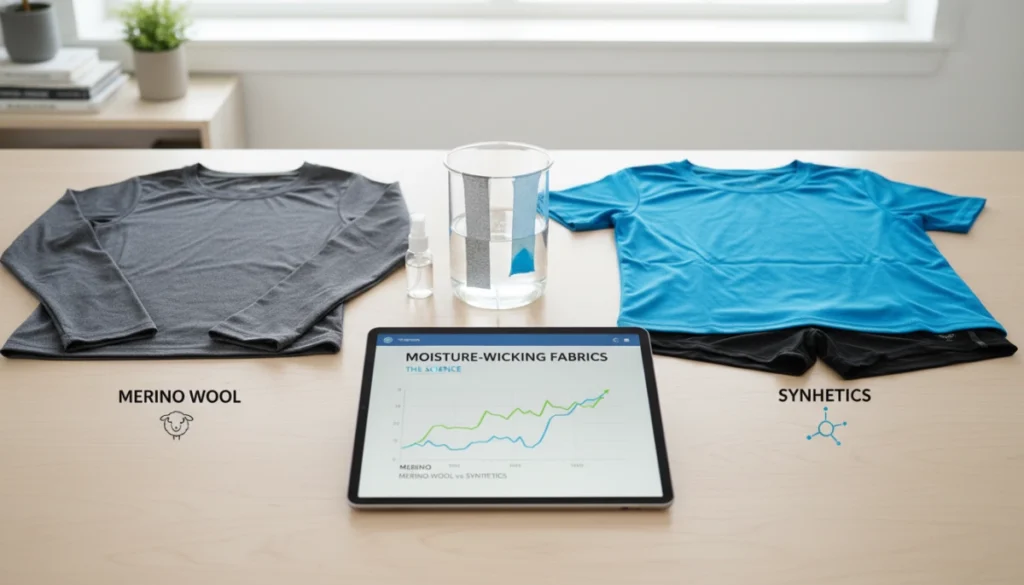
You’re halfway up a climb, sweating hard… and suddenly you’re either soaked and freezing or overheating in a plastic bag. The difference? Your base layer’s fabric.
When it comes to moisture-wicking, the real showdown is Merino wool vs synthetics—and the winner isn’t about hype, it’s about science.
In this guide, you’ll see exactly how Merino wool moisture wicking (through hygroscopic fibers that absorb vapor) stacks up against synthetic fabrics like polyester and nylon (which rely on hydrophobic surfaces and capillary action). We’ll break down how each fiber handles sweat, evaporation, odor, insulation when wet, and thermo-regulation—using what’s actually happening at the fiber level, not just marketing claims.
If you’ve ever wondered which fabric keeps you drier, warmer, and less smelly on real-world adventures, this deep dive into the science of moisture-wicking fabrics is for you.
Understanding Moisture-Wicking Science in Merino Wool vs Synthetics
When you’re grinding up a climb, skinning before sunrise, or pushing pace on a humid trail, moisture-wicking can be the difference between feeling focused or totally miserable. To choose between merino wool vs synthetic moisture-wicking layers, you need to understand what’s actually happening on your skin.
What “Moisture-Wicking” Really Means
In plain language, moisture-wicking is how a fabric handles your sweat from the moment it leaves your skin until it evaporates into the air. That process has three key steps:
-
Sweat transport:
- Sweat appears on your skin as liquid.
- A good moisture-wicking base layer pulls that sweat off your skin and into the fabric.
-
Vapor movement:
- Some fibers (like merino wool) absorb sweat as vapor inside the fiber itself (hygroscopic behavior).
- Others (most synthetic fabrics like polyester and nylon) keep moisture on the surface (hydrophobic behavior) and spread it out using capillary action.
-
Evaporation:
- The fabric exposes that moisture to air so it can evaporate.
- Faster evaporation = a drier, cooler, less clammy feel.
This “sweat transport → vapor handling → evaporation” chain is the core of technical fabric moisture management.
Your Skin Microclimate: Humidity, Heat, and Airflow
Right against your skin, there’s a tiny environment called the microclimate. That’s where comfort or misery starts. Three things matter most:
-
Humidity next to your skin
- Too much trapped moisture = sticky, clammy, and chafing.
- Good breathable performance fabrics keep this zone drier by moving sweat away and letting vapor escape.
-
Temperature and heat buildup
- In hot conditions, you want fabrics that dump heat fast and dry quickly.
- In cold or mixed weather, you still sweat, but you need thermal regulation so you don’t get chilled the second you stop.
-
Airflow through the fabric
- Airflow speeds up evaporation and cooling.
- The knit structure and fiber type (merino vs polyester) change how easily air and vapor move through your base layer.
How well a fabric manages that microclimate is what you actually feel as comfort, breathability, and dryness.
Why Moisture Management Matters for Active People
If you hike, run, ski, bike, hunt, or train outdoors, moisture management isn’t a nice-to-have—it’s performance and safety gear:
-
For hikers and backpackers
- Staying drier reduces chafing, blisters, and cold chills when you stop moving.
- On multi-day trips, poor moisture-wicking turns into foul odor, skin irritation, and heavy, damp clothing.
-
For runners and high-intensity workouts
- Efficient evaporation rate and fabric drying speed help keep your core temperature under control.
- A bad shirt feels heavy, soaked, and sticks to your skin; a good one stays light and dries quickly between efforts.
-
For skiers, snowboarders, and winter athletes
- You sweat on the uphills and cool off on lifts or transitions.
- If your base layer holds too much liquid sweat, you’ll get cold fast, even inside an insulated shell.
-
For all outdoor athletes
- Better sweat control means less energy wasted dealing with discomfort and temperature swings.
- Good activewear moisture management keeps you focused on your line, your pace, or your route—not your soggy base layer.
Understanding this science is how I design and choose moisture-wicking base layers that actually work in real U.S. conditions—humid summers, dry high-altitude trails, cold continental winters, and everything in between.
Fiber Structures: Merino Wool vs Synthetic Fabrics
Merino wool fiber structure
When we talk merino wool vs synthetic moisture wicking, the fiber shape is where the real difference starts.
- Crimp: Merino fibers are naturally wavy. That crimp traps tiny air pockets, which helps with insulation when wet and keeps the fabric breathable instead of plastered to your skin.
- Scales: Each wool fiber has microscopic scales on the surface. They help move sweat vapor away from your skin and into the fabric, instead of letting it sit and feel clammy.
- Keratin core: Merino is made of keratin (a protein), which is hygroscopic—it pulls in moisture vapor into the fiber itself. That’s a big part of the merino wool moisture wicking mechanism and why it keeps a more stable microclimate next to skin.
Synthetic fiber structure: polyester, nylon, polypropylene
On the synthetic side—polyester, nylon, polypropylene—everything is designed, not grown.
- Polyester: Smooth, strong, and naturally hydrophobic. It doesn’t absorb moisture into the fiber; instead it spreads liquid sweat across the surface using capillary action.
- Nylon: Slightly more absorbent than polyester, but still mostly hydrophobic. It’s tough, great for durable activewear, but can feel a bit clammy if the knit is too tight.
- Polypropylene: Extremely hydrophobic. It barely holds any water, so it dries very fast but can trap odor quicker than merino.
These synthetics depend on engineered cross-sections (like trilobal or hollow fibers) and textured surfaces to boost technical fabric moisture management.
Hygroscopic vs hydrophobic: how it changes sweat movement
The hygroscopic vs hydrophobic fibers difference is what you feel on a hike, run, or ski lap:
-
Merino (hygroscopic):
- Pulls sweat vapor into the fiber, not just along the surface
- Evens out humidity swings, so you feel less hot–cold cycling
- Keeps a bit of warmth even when damp, ideal for mixed or cold conditions
-
Synthetics (hydrophobic):
- Push liquid sweat along the surface and out toward the air
- Dry very fast and boost evaporation rate for a stronger cooling effect
- Can feel cooler and almost “plastic” if there’s wind and you’re soaked
How fiber shape and surface affect sweat on your skin
Fiber geometry is a big deal in performance fabrics comparison:
- Round, smooth fibers (basic polyester) move sweat, but can feel slick and stick to your skin when you’re drenched.
- Engineered shapes (channels, grooves, multi-lobed) in synthetics spread sweat faster for better quick dry performance.
- Merino’s natural crimp and scales create little air gaps and channels that:
- Reduce that sticky, clingy feel
- Help with breathability merino vs polyester in cool or variable weather
- Make merino feel drier against the skin even when it’s holding more total moisture
For U.S. runners, hikers, and skiers picking moisture wicking base layers, this fiber-level design is why merino usually wins on comfort and microclimate, while synthetics win on drying speed and aggressive cooling.
Merino Wool Moisture-Wicking Mechanism
How Merino Wool Handles Sweat Vapor
Merino wool doesn’t work like a typical synthetic moisture-wicking fabric. Instead of just pushing liquid sweat across the surface, merino wool absorbs sweat vapor directly into the fiber core.
- Each wool fiber is hygroscopic, meaning it can pull in up to about 30% of its weight in moisture vapor without feeling wet.
- That vapor is stored in the keratin core of the fiber, then slowly released as conditions around your skin change.
- This “wool vapor absorption and slow release” evens out humidity next to your skin and keeps your microclimate more stable during stop-and-go activity.
For hikers, skiers, and hunters in the U.S., that means less of that “chilled the minute I stop moving” feeling.
Merino Wool Insulation When Wet + Thermo-Regulation
One of the biggest merino wool base layer benefits is how it behaves when it’s damp or even wet:
- The fiber structure traps air, so merino wool insulation when wet stays surprisingly warm compared to most fabrics.
- As merino absorbs vapor, it releases a small amount of heat (a natural thermo-regulation bonus), which helps take the edge off chills in cold or mixed weather.
- This makes merino a strong pick for cold weather base layer fabrics, shoulder-season missions, and unpredictable mountain or backcountry conditions.
If you’re out on a multi-hour hike in the Rockies or a wet ski day in the Northeast, that stable warmth matters.
Breathability and Comfort in Real Conditions
In real-world use, breathability merino vs polyester feels different:
- Merino fibers have natural crimp and tiny air pockets that help the fabric breathe and move moisture vapor away from your skin.
- In cold, damp, or mixed conditions, merino stays less clammy and more comfortable than a lot of purely synthetic moisture-wicking base layers.
- You’ll feel drier and more “neutral” against the skin instead of that sticky, plastic feel some polyester pieces have when you sweat hard then cool down.
For U.S. trail runners, backpackers, and ski tourers, that translates into fewer chills when the wind picks up or the sun drops.
Antimicrobial and Natural Odor Resistance
Merino also wins hard on base layer odor resistance:
- The complex wool fiber structure and natural antimicrobial properties of natural wool make it tough for odor-causing bacteria to build up.
- Lanolin and the unique surface of the fiber help slow down bacteria growth, so merino wool vs synthetic moisture wicking often means far less stink over time.
- You can usually wear a merino wool moisture wicking base layer for multiple days—perfect for backpacking, hunting camps, and travel—without smelling like a gym bag.
If you’re trying to pack light for a multi-day trip across U.S. national parks or just want fewer washes between runs or ski days, merino’s natural odor resistance is a clear edge.
Synthetic Moisture-Wicking Fabrics Explained
How synthetic fabrics move sweat (capillary action)
Synthetic moisture-wicking fabrics like polyester and nylon are built to pull liquid sweat off your skin fast. Instead of soaking it up, they use:
- Capillary action: tiny gaps between fibers draw sweat across the fabric surface
- Spread + evaporate: sweat spreads into a thin film, then dries in the air
- Stay off your skin: less cling, less dripping, less “soggy” feeling during hard effort
That’s why a good synthetic running shirt or gym top feels dry again just a few minutes after you stop moving.
Hydrophobic fibers and surface wicking
Unlike wool, synthetic fibers are hydrophobic, so they don’t want to hold water inside the fiber:
- Polyester: very common in activewear, strong surface wicking, light, cheap
- Nylon: softer and tougher, good for abrasion, still hydrophobic
- Behavior: sweat sits on the surface of the fibers, not inside them
This surface wicking is what gives synthetics that classic “quick-dry” performance fabric feel you see in most U.S. activewear and team uniforms.
Polyester drying time vs merino wool
In real-world use, especially in the U.S. climate where humidity and heat can swing like crazy, polyester usually dries faster than merino wool:
- Polyester base layer:
- Dries very fast once you stop sweating
- Feels dry to the touch sooner
- Merino wool base layer:
- Holds more moisture in the fiber
- Feels comfortable but can stay slightly damp longer
If you’re doing short, high-intensity workouts, runs, or gym sessions, synthetics win on pure drying speed almost every time.
Evaporation rate and cooling effect
Because synthetics push sweat to the surface, the evaporation rate is high, which means:
- More cooling effect: great for hot-weather runs, HIIT, and summer hiking
- Better for heavy sweaters: if you soak shirts quickly, synthetics dump moisture faster
- Feels cooler: the rapid evaporation can give that light “AC on your skin” vibe
If you’re training hard in a U.S. summer heat wave, the cooling from synthetic performance fabrics is a big advantage.
Modern synthetic treatments and fabric engineering
Today’s synthetic moisture-wicking base layers are way more advanced than old-school gym tees:
- Engineered knit structures:
- Zoned mesh panels in high-sweat areas (back, armpits, chest)
- Different knit densities for better airflow and support
- Chemical treatments:
- Wicking finishes to boost capillary action
- Odor-control coatings (silver ions, antimicrobial finishes)
- Blended yarns:
- Polyester + elastane for stretch
- Polyester + nylon for durability and comfort
As a brand owner, I lean on these engineered synthetic fabrics for customers who need lightweight, tough, quick-dry gear—especially runners, CrossFit athletes, team sports players, and anyone training hard in warm U.S. climates looking for maximum sweat control and fast-drying performance.
Merino Wool vs Synthetic Moisture Wicking
When I compare merino wool vs synthetic moisture wicking in real use, I look at how they actually behave on trail runs, ski days, and long hikes— not just lab charts.
Absorption Capacity: Vapor vs Surface
- Merino wool is hygroscopic – it pulls sweat vapor into the fiber itself.
- Great when you’re in cool, damp air or switching between effort and rest.
- Feels drier against the skin because moisture is “hidden” in the fiber core.
- Synthetics (polyester, nylon) are hydrophobic – they don’t absorb much.
- Sweat sits more on the surface and between fibers.
- Better when you sweat heavily in hot, dry conditions and just need fast dump-and-dry.
Drying Speed & Evaporation Rate
- In pure drying speed, synthetics win most lab tests and real-world use:
- Polyester generally dries faster than merino once both are soaked.
- Higher evaporation rate on the surface means quicker cooling and a “fresh shirt” feel after a hard interval.
- Merino dries slower, but:
- It still feels comfortable while damp because the wool vapor absorption spreads moisture and avoids cold, wet patches.
- For most day hikes and steady runs, the slower drying isn’t a dealbreaker.
Wet Insulation & Warmth When Soaked
- Merino wool insulation when wet is the big win:
- The fiber structure traps air even when damp, so you stay noticeably warmer if you get caught in rain, snow, or sweat-stop-chill cycles.
- That’s why I reach for merino on cold ski tours, hunting trips, and winter hikes in the Rockies or Northeast.
- Synthetics lose more warmth when soaked:
- They don’t hold much water, but when they’re saturated and wind hits, they can feel cold and clammy.
Breathability: Merino vs Polyester
- Merino breathes really well in cool to mixed conditions:
- Allows slow, steady thermo-regulation, especially when you’re changing pace a lot.
- Feels less “plastic” and more stable in comfort, even when you stop moving.
- Polyester base layers breathe better at high intensity in warm to hot weather:
- Quick sweat transport + fast evaporation rate gives stronger cooling.
- Great for gym sessions, sprints, and humid Southern or Mid-Atlantic summers.
Comfort Over Time on Multi-Day Trips
On multi-day hikes, ski trips, or travel, pure moisture-wicking isn’t the only factor:
- Merino wool base layers:
- Stay more comfortable over multiple days thanks to odor control and stable microclimate.
- Even when not bone-dry, they don’t feel nasty or sticky.
- Synthetic base layers:
- Feel awesome on day one, especially in hot weather.
- By day two or three, sweat + bacteria build up fast, and they feel clammy and smelly unless you can wash and fully dry them.
If you want peak drying speed and cooling for short, hard efforts, synthetics win.
If you want steady comfort, warmth when damp, and better feel over several days, merino wool wins the moisture management battle in real outdoor life.
Odor, Comfort, and Skin Feel in Merino Wool vs Synthetic Base Layers
Base layer odor resistance
When I compare merino wool vs synthetic moisture wicking base layers, odor is the biggest real-world difference.
-
Merino wool base layer benefits:
- Natural antimicrobial properties from the wool fiber and residual lanolin
- Slows down bacteria buildup that causes funk
- Stays wearable for multiple days of hiking, ski touring, or travel
-
Synthetic fabrics (polyester, nylon):
- Hydrophobic fibers hold on to skin oils and bacteria
- Even with “anti-odor” treatments, they usually start to smell after one hard workout
- Great for gym runs, not great for multi-day backpacking clothing choices
If I’m on a three-day backpacking trip or hunting camp with no laundry, I pick merino every time.
Itch, softness, and next-to-skin feel
Modern merino wool moisture wicking layers are way softer than old-school wool.
-
Merino wool:
- Fine fibers (usually 16–19.5 micron) feel soft, not scratchy
- Warmer, cozier next-to-skin feel in cold or mixed weather
- Some very sensitive skin types may still feel a hint of itch with cheaper wool
-
Synthetics (polyester vs nylon activewear):
- Usually very smooth and slick
- Zero itch, but can feel plastic-y compared to natural wool
- Nylon blends feel a bit softer and more premium than pure, cheap polyester
For most people in the U.S., a 145–200 gsm merino base layer feels soft enough for all-day wear.
Clammy, sticky, or dry during hard efforts
During high-intensity workouts, the microclimate next to skin really shows the difference.
-
Merino wool:
- Absorbs sweat vapor into the fiber (hygroscopic behavior)
- Feels drier against your skin, even when the shirt is damp
- Less “cold and clammy” feeling when you stop moving or get hit by wind
-
Synthetic moisture wicking base layers:
- Use capillary action to move liquid sweat across the surface
- Can feel slick and a bit sticky when you’re really sweating
- Feel cool when wind hits because of fast evaporation rate fabrics science, but can get clammy if humidity is high
For interval runs, summer trail runs, or hot gym sessions, synthetics win on fast cooling. For stop-and-go winter sports, merino feels more stable and comfortable.
How often you can wear merino vs synthetics before washing
Here’s how I realistically treat each fabric in my own activewear rotation:
-
Merino wool base layer:
- 2–5 days of hiking, skiing, or travel with no serious odor
- Air it out overnight, it’s usually good to go again
- Perfect for carry-on travel, hut trips, and Western backpacking where water is limited
-
Synthetic running shirt or gym top:
- Usually 1 intense workout, then it smells
- Sweat + bacteria + skin oils hang around in hydrophobic fibers
- Needs frequent washing, especially in hot, humid U.S. climates (Southeast, Gulf Coast, Midwest summers)
If you want fewer pieces, worn more days, merino wool is the clear winner. If you want cheap, tough, quick-dry shirts you don’t mind washing constantly, synthetics make more sense.
Durability, Care, and Cost: Long-Term Trade-Offs
Abrasion resistance and lifespan in activewear
When I compare merino wool vs synthetic moisture-wicking gear for long-term use, here’s how it plays out:
-
Synthetics (polyester, nylon)
- Handle abrasion, pack straps, trail brush, gym machines better.
- Great for running shirts, gym tops, and rough trail days.
- Better shape retention for tight base layers and compression fits.
-
Merino wool
- Softer fibers = can wear through faster under shoulder straps, hip belts, repeated rubbing.
- For U.S. hikers and skiers using packs a lot, I usually recommend:
- Merino-synthetic blends for high-friction zones.
- Pure merino for lighter wear or as a base layer under other pieces.
Pilling, snagging, and shape retention
-
Merino wool base layers
- Can pill at elbows, under pack straps, and around waist belts.
- Fine knits can snag on branches, velcro, or buckles.
- Can relax a bit over time, especially if you size too big.
-
Synthetic moisture-wicking fabrics
- Less pilling if you stick to performance lines from known outdoor brands.
- Better elastic recovery—they keep their fit after years of workouts.
- Snags still happen, but usually don’t spread like they can in fine merino.
Washing, drying, and care tips
For U.S. customers who want easy care, synthetics are simpler—but merino doesn’t have to be high-maintenance if you treat it right.
Merino wool care (moisture-wicking base layers):
- Wash cold on gentle with mild detergent.
- Skip fabric softener and bleach (they wreck the fibers and moisture management).
- Air dry or tumble low; avoid high heat to keep the wool fiber structure intact.
- Wash less often thanks to antimicrobial properties and natural odor resistance.
Synthetic base layer care:
- Machine wash warm or cold, regular cycle.
- Can usually tumble dry low–medium, making them ideal for busy training weeks.
- Use sport wash occasionally to cut built-up sweat and odor bacteria.
- Expect more odor buildup over time vs merino, especially in hot, humid U.S. climates.
Price comparison and long-term value
-
Merino wool base layers
- Higher upfront price—especially from premium outdoor brands.
- Payoff:
- You can wear them multiple days on backpacking trips, ski tours, or travel without smelling.
- You need fewer pieces in rotation.
- Best value for:
- Multi-day backpacking, ski trips, hunting, and travel where low-wash, odor-resistant gear matters.
-
Synthetic performance fabrics
- Lower initial cost and easy to find at big-box and outdoor retailers across the U.S.
- Great value for:
- High-intensity workouts, frequent washing, and daily training.
- People who are hard on gear and prefer quick-dry, tough activewear.
If I’m building a smart U.S. kit for hiking, running, and travel, I usually treat merino wool as my premium, fewer-washes base layer and synthetics as my durable, budget-friendly workhorses for heavy training and rough use.
Temperature Regulation and Layering Strategies
Thermo-regulation: Merino Wool in Hot, Cold, and In‑Between Weather
Merino wool shines as a temperature-regulating base layer because of how it handles sweat vapor and airflow.
-
Cold weather (below ~40°F):
- Merino traps warm air in the fiber crimp, so you stay warm even if you sweat.
- It still insulates when damp, which is huge for skiing, hunting, and winter hiking.
-
Mild/shoulder season (40–65°F):
- A light or midweight merino wool base layer keeps your skin microclimate stable as temps swing.
- It smooths out hot–cold cycles when you’re climbing uphill then stopping to rest.
-
Hot weather (65°F+):
- A lightweight merino wool shirt (150–170 gsm) breathes well, pulls sweat vapor off your skin, and avoids that plastic-y cling.
- It doesn’t feel icy or sticky when you move from AC to humid heat, which matters a lot in many parts of the U.S.
Synthetic Base Layers for High-Intensity Workouts
Synthetic moisture‑wicking fabrics (mainly polyester and nylon) are built to dump liquid sweat fast using capillary action. That’s a win for high-output days, but it comes with trade‑offs.
Pros for intense workouts (running, CrossFit, cycling, team sports):
- Extremely fast drying speed on the surface.
- Strong and abrasion‑resistant for gym and trail use.
- Often cheaper, so easy to stock multiple shirts for weekly training.
Cons vs merino wool:
- Can feel clammy when you pause after a hard effort.
- Less natural thermo-regulation, so you notice cold drafts more when you stop moving.
- Builds odor faster on multi-day use, especially in warm, humid U.S. climates.
Best Layering Combos: Winter, Shoulder Seasons, Summer
To keep moisture management dialed in, I build systems around how much I’ll sweat and how cold it’ll get.
Winter sports (skiing, snowboarding, cold-weather hiking):
- Base: Midweight merino wool (200–260 gsm) for vapor absorption + insulation when wet.
- Mid-layer: Synthetic fleece or active insulation (Polyester) for extra warmth and fast drying.
- Shell: Waterproof/breathable jacket to dump excess heat and block wind.
Shoulder season (fall/spring backpacking, trail runs, hunting):
- Cool and variable:
- Merino base layer + light synthetic mid-layer (grid fleece or light softshell).
- Warmer but windy:
- Lightweight merino or synthetic shirt + wind shirt.
Summer (running, hiking, biking, hot-weather travel):
- High intensity / sweaty:
- Synthetic running shirt for maximum quick dry and airflow.
- Travel and multi-day trips:
- Lightweight merino wool t‑shirt for odor resistance and comfort in AC, airports, and heat.
Choosing Fabric Weight and Thickness by Climate and Sweat Rate
Here’s how I match merino wool vs synthetic moisture-wicking to real-world use in the U.S.:
By climate:
- Hot & humid (Southeast, Gulf Coast):
- Lightweight merino (150–170 gsm) OR ultra-breathable synthetic for daily runs.
- Cold & dry (Mountain West, Upper Midwest winters):
- Midweight to heavy merino (200–260+ gsm) as a base, plus synthetic insulation on top.
- Mixed climates (Northeast, Pacific Northwest):
- Light merino or merino-synthetic blend for shoulder seasons and trips where weather swings.
By sweat rate and effort:
- Heavy sweaters / HIIT / fast runs:
- Thin synthetics or merino‑synthetic blends for maximum evaporation rate and cooling.
- Moderate sweaters / stop‑and‑go days:
- Merino base layer for stable skin microclimate and less chill when you stop.
If I’m building a small, smart rotation, I want:
- 1–2 lightweight merino wool base layers for travel, hiking, and cooler runs.
- 2–3 synthetic performance shirts for gym and hot-weather training.
- 1 warmer merino long sleeve for winter layering and cold mornings.
Sustainability: Merino Wool vs Synthetic Fabrics
Renewable and biodegradable merino wool
When I look at merino wool vs synthetic moisture-wicking fabrics from a sustainability angle, merino has a real edge:
- Merino comes from a renewable resource – sheep – not oil.
- High-quality merino fibers are biodegradable, breaking down in soil and water over time instead of turning into permanent trash.
- A good merino wool base layer can be worn for years, which cuts down on how often you need to replace gear.
For U.S. customers who care about eco-friendly performance clothing, merino checks a lot of boxes right out of the gate.
Petroleum-based synthetics and microplastics
Most synthetic moisture-wicking fabrics like polyester and nylon are petroleum-based:
- They’re essentially plastics made from fossil fuels.
- Every wash can shed microplastics into waterways, contributing to long-term pollution.
- Even “recycled polyester” still sheds microfibers, so it’s better but not a perfect fix.
If you’re loading up on quick dry synthetic shirts and washing them often, those microfibers add up over time.
Longevity vs footprint
From a business and user standpoint, I focus on longevity as much as material:
- A durable merino or synthetic piece you wear 100+ times has a better footprint than a cheap shirt you toss after one season.
- Merino’s odor resistance means you can wear it more and wash it less, which saves water, energy, and wear on the fabric.
- With synthetics, I push tough, well-built activewear so customers aren’t constantly replacing torn or stretched-out gear.
Wearing fewer pieces for longer is one of the most underrated sustainability moves.
Eco-conscious gear buying
If you’re trying to buy more eco-conscious moisture-wicking base layers in the U.S., here’s how I’d think about it:
- Choose merino wool when you want renewable, biodegradable, and low-wash performance.
- Choose synthetics when you need maximum durability at a lower price, but look for recycled fabrics and wash with a microfiber-catching laundry bag.
- Build a small rotation of merino, synthetics, and blends you actually use every week instead of a big drawer of “meh” gear.
Your fabric choice is basically a vote: for natural, renewable wool, or for high-durability synthetics you commit to using hard and keeping for years.
When to Choose Merino Wool for Moisture-Wicking Performance
If I’m planning for comfort, not just minutes but days, I reach for merino wool moisture-wicking base layers first. Here’s when merino clearly beats synthetics.
Best Use Cases for Merino Wool vs Synthetic Moisture Wicking
Merino wins when:
- Multi-day trips & backpacking (2–7+ days)
- Stays fresh longer with strong base layer odor resistance
- Handles sweat, cool nights, and camp downtime with one shirt
- Hunting & backcountry glassing
- Quiet fabric, low shine, and odor control that helps with scent
- Keeps working when you’re hiking hard, then sitting still in the cold
- Ski touring & snow sports
- Merino wool insulation when wet keeps you warm on sweaty climbs and cold descents
- Balances thermo-regulation in storms, wind, and changing temps
- Travel & one-bag trips
- Can wear multiple days without washing
- Packs light, works in A/C, planes, and random weather swings
Merino for Variable Weather, Cold, and Low-Wash Use
Merino’s hygroscopic fibers pull sweat vapor into the wool core, buffer your skin microclimate, and release moisture slowly. That matters when the weather can’t make up its mind.
Choose merino wool base layers when:
- You’re in variable weather (sun → rain → wind)
- Temps swing from 30s–50s°F (mountain mornings and nights)
- You might not wash gear every day (hunting camp, backcountry hut, van life)
- You need one layer that’s warm when damp, not clammy
Who Benefits Most from Merino’s Odor Control and Wet Warmth
Merino is a game-changer if any of this is you:
- Heavy sweaters who hate that sticky, cold synthetic feel once you stop moving
- Hikers, hunters, and skiers out all day or multi-day, no laundry
- Travelers who want 2–3 pieces to cover a week or more
- Anyone with odor concerns who wants natural antimicrobial properties instead of chemical treatments
Quick Guide: When Merino Beats Synthetics
| Situation | Best Pick | Why |
|---|---|---|
| 3–7 day backpacking, no laundry | Merino wool base layer | Odor resistance, wet warmth, stable microclimate |
| Cold, damp, or mixed mountain weather | Merino wool vs polyester | Warmer when damp, better comfort at low intensity |
| Backcountry hunting / ski touring | Merino wool | Quiet, warm when wet, manages sweat over long days |
| One-bag travel, limited washing | Merino moisture-wicking | Can wear multiple days; resists stink and feels clean longer |
When I’m building gear for U.S. customers who actually live in their clothes—backpacking the Rockies, hunting whitetail, skiing Utah, or flying cross-country with one carry-on—merino is my go-to for moisture-wicking performance in real-world, multi-day, low-wash life.
When Synthetic Moisture-Wicking Fabrics Win
When it’s all about speed, heat, and abuse, synthetic moisture-wicking fabrics usually beat merino.
Best use cases for synthetics
I reach for synthetics over merino when:
- Sprint workouts & HIIT: You’re dumping sweat fast and need maximum evaporation rate and cooling.
- Gym sessions & CrossFit: Lots of friction with benches, barbells, and straps – you want tough, abrasion-resistant polyester or nylon.
- Hot, humid weather runs: Lightweight, quick-dry synthetic running shirts keep you from feeling swampy and heavy.
- Team sports & rec league nights: Frequent washes, turf contact, and rough play favor durable synthetic activewear.
Why synthetics shine: fast drying, durable, budget-friendly
Synthetic performance fabrics are hydrophobic fibers (usually polyester or nylon), which means:
- They move liquid sweat with capillary action across the surface for fast drying.
- You get a strong cooling effect as moisture evaporates quickly off the fabric.
- They handle constant washing, rough gym use, and heavy backpacks better than most merino.
- You can build a full moisture-wicking activewear rotation (tees, tights, shorts) on a smaller budget.
If you’re sweating hard every day and washing gear after each session, synthetics are the value play.
Who benefits most from quick-dry synthetic activewear
Synthetic moisture-wicking gear is usually the smarter call if you’re:
- A runner or cyclist in hot states (Texas, Florida, Arizona, Southeast) needing ultra-fast drying.
- Hitting the gym 4–6 days a week and don’t want to baby your clothes.
- On a tight budget but still want solid performance fabrics for training.
- Someone who prefers a light, slick, non-itchy feel next to skin instead of wool.
If your priority is lightweight, tough, quick-dry performance at a good price, synthetics win.
Blends and Hybrid Moisture-Wicking Systems
Merino-synthetic blends for balanced moisture management
When it comes to merino wool vs synthetics moisture wicking, I lean hard into blends for everyday activewear and travel pieces. A good merino-synthetic blend (usually merino + polyester or nylon) gives you:
- Moisture-wicking balance:
- Merino pulls in sweat vapor and balances your skin microclimate
- Synthetics move liquid sweat across the surface using capillary action
- More durability than 100% merino for running, gym, and pack rub
- Better shape retention and less sagging when the fabric gets damp
- Faster dry time than pure wool, but less clammy than pure polyester
For U.S. customers who go from trail to town or gym to errands, blends are usually the most practical moisture wicking base layers for daily use.
How fabric blends change drying, odor, and durability
Blended performance fabrics are basically tuning knobs between merino and synthetics. Here’s how the mix usually plays out:
-
Drying time
- Higher synthetic (60–80%): faster drying, great for hot-weather runs and high-intensity workouts
- Higher merino (60–80%): slower than full synthetic, but still dries reasonably fast with better comfort when damp
-
Odor control
- More merino: stronger natural odor resistance, fewer stink issues on multi-day backpacking or travel
- More synthetic: needs antimicrobial treatments, still tends to smell faster in sweaty gym use
-
Durability
- More synthetic: better for abrasion resistance, pilling control, and long-term shape
- More merino: softer, better skin feel, but needs more care and can wear out quicker under hard use
For most U.S.-based runners, hikers, and travelers, I usually suggest a 50/50 to 70/30 merino-synthetic blend for the best mix of moisture management, odor resistance, and lifespan.
Layering merino and synthetics for different adventures
You don’t have to pick a team; you can stack both. I like to treat merino wool vs synthetic base layers as tools:
-
High-intensity summer runs / gym sessions
- Base layer: lightweight synthetic running shirt for quick-dry and high evaporation rate
- Backup: merino or merino-blend tee for lower-odor days and travel
-
Fall hikes, shoulder seasons, and mixed weather
- Base layer: merino or merino-blend for thermal regulation and comfort when damp
- Mid layer: synthetic fleece for fast drying and extra warmth
-
Winter sports: skiing, snowboarding, cold hunting
- Base layer: merino or merino-heavy blend for wet warmth and merino wool insulation when wet
- Mid layer: synthetic (or synthetic-heavy blend) for breathable performance and durability under packs and shells
If you want a small, smart rotation, I’d build it around:
- 1–2 merino wool base layers or merino-blends for cold, travel, and low-wash use
- 1–2 synthetic moisture wicking shirts for hot weather, sprints, and gym work
- 1–2 hybrid pieces (merino + polyester/nylon) for everyday training and weekend trips
Blends and hybrids let you tap into the merino wool moisture wicking mechanism and the quick-dry synthetic advantages in one setup, which is exactly what most U.S. outdoor athletes and travelers actually need.
How to Choose Between Merino Wool and Synthetic Base Layers
Key questions before you buy
Ask yourself these before picking merino wool vs synthetic moisture wicking base layers:
- What’s the activity?
- Long, steady days (hiking, hunting, backpacking, travel) → Merino or merino blends
- Short, intense workouts (HIIT, CrossFit, track, spin) → Synthetics
- How much do you sweat?
- Heavy sweater / run hot → Light synthetic or merino-synthetic blend
- Moderate sweater → Merino or blend, weight depends on temp
- What’s the climate?
- Hot & humid (Southeast, Texas summer) → Thin synthetics
- Cold & dry (Rockies, Midwest winter) → Midweight merino
- Mixed / shoulder seasons (PNW, Northeast fall) → Blends or layered merino + synthetic
- How often can you wash?
- Daily laundry → Synthetics are fine
- Multi-day trips / van life / travel → Merino base layers win for odor
Simple decision paths by activity
Use this as a quick, US-focused cheat sheet:
| Activity (USA use) | Best Pick | Why it wins |
|---|---|---|
| Daily gym, HIIT, CrossFit | Synthetic running shirt | Fast drying, tough, cheap, handles heavy sweat |
| Road running in heat (FL, TX, SoCal) | Ultra-light synthetic | Maximum evaporation rate and cooling |
| Trail running / mixed weather | Merino-synthetic blend | Better odor control + quicker dry than 100% merino |
| Multi-day backpacking / thru-hikes | Merino wool base layer | Odor resistant, comfy, better microclimate next to skin |
| Skiing / snowboarding (CO, UT, VT) | Merino base + synthetic midlayer | Warm when damp, then fast-dry outer layers |
| Hunting, glassing, long sits | Mid/heavy merino wool | Merino wool insulation when wet, quiet, excellent odor control |
| Air travel / business trips | Light merino tee or long sleeve | Wear multiple days, less stink, easy to hand-wash and dry overnight |
Building a small, smart rotation
You don’t need a closet full of performance fabrics. I’d build a tight rotation like this:
Baseline kit (most people in the US):
- 2 merino wool base layer tops (light or midweight)
- 2 synthetic moisture wicking shirts (for hard workouts & hot days)
- 1 merino-synthetic blend (all-rounder for shoulder seasons and travel)
How I think about it:
- Merino wool = multi-day wear, odor control, better comfort when damp, cooler mornings/nights
- Synthetics = pure performance, fast drying, higher durability, best for max sweat days
- Blends = balanced moisture management, improved drying, decent odor resistance
Keep it simple:
- If you care most about odor and comfort over time → lean merino wool base layers
- If you care most about drying speed and durability → lean synthetic activewear
- If you want one do-it-all setup → grab merino-synthetic blends and layer smart around them