
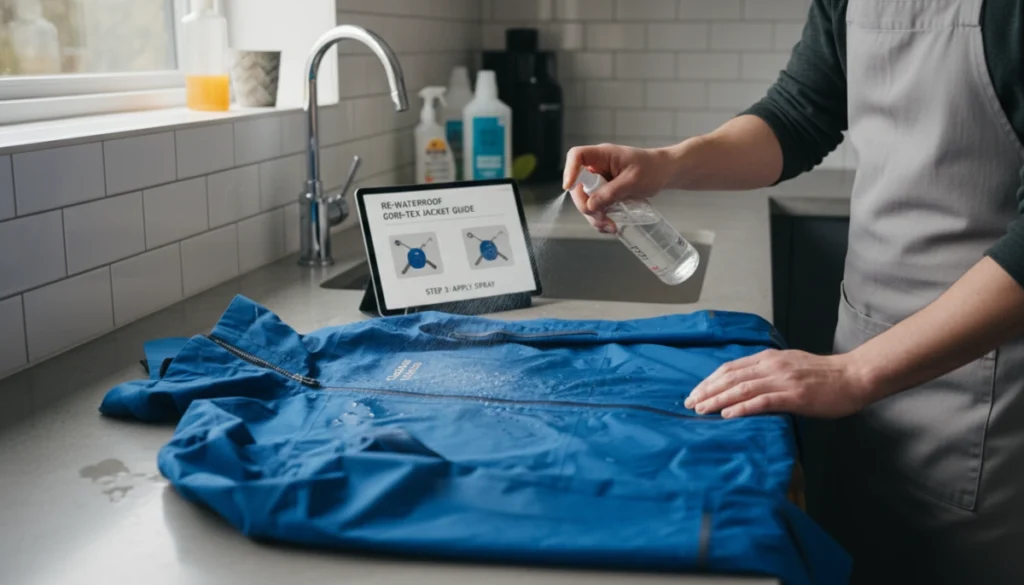
Your Gore-Tex jacket used to shrug off storms. Now it soaks up water, clings to your mid-layer, and \”wet out\” kills your comfort in minutes.
You don’t need a new shell—you need to restore the DWR (Durable Water Repellent) the way the pros do.
In this guide, you’ll learn exactly how to re-waterproof your Gore-Tex jacket like a professional—from proper cleaning (without damaging the Gore-Tex membrane) to heat reactivation, full DWR reapplication, and long-term care tips that keep water beading on your Gore-Tex instead of soaking in.
You’ll see the difference between a quick fix and a real Gore-Tex wet out fix, which DWR products (like Nikwax, Grangers, and Gear Aid Revivex) actually work, and how to choose eco-friendly DWR treatments that still deliver peak performance.
If you want to revive your waterproof shell jacket, avoid expensive service fees, and get that “like-new” rain performance back, this step-by-step breakdown is for you.
Understanding DWR on Gore‑Tex Jackets
If your “waterproof” Gore‑Tex jacket is soaking up rain, feeling clammy, and looking dark and wet, the problem is almost never the membrane—it’s the DWR (durable water repellent) on the outer fabric.
What DWR Actually Does on a Gore‑Tex Shell
DWR is a clear treatment on the face fabric that makes water bead up and roll off instead of soaking in.
In simple terms:
| Layer | What It Is | What It Does |
|---|---|---|
| Gore‑Tex membrane | Microporous waterproof/breathable film | Keeps liquid water out, lets vapor escape |
| Outer fabric + DWR | Nylon/poly shell coated with DWR | Sheds rain, stops fabric from soaking up water |
When the DWR is healthy, water forms tight beads and runs off. That keeps the outer fabric light, dry, and breathable.
DWR vs Gore‑Tex Membrane: What’s Really Waterproof
You’re dealing with two separate systems:
-
Gore‑Tex membrane
- Permanently waterproof under normal use
- Hidden inside the jacket (you don’t see it)
-
Outer DWR coating
- Not truly “waterproof”—just water repellent
- Lives on the outside of the shell and wears off over time
Your jacket can still be technically waterproof (membrane intact) but feel soaked and cold because the DWR has failed.
Why Gore‑Tex Jackets “Wet Out” But Are Still Waterproof
“Wet out” is when the outer fabric soaks up water instead of shedding it. This doesn’t usually mean the Gore‑Tex is ruined—it means the DWR is shot.
Common causes of wet out:
- Body oils, sweat, sunscreen, bug spray
- Dirt, road grime, campfire smoke, salt
- Backpack straps and repeated abrasion
- Normal aging and repeated washing
When the fabric is saturated:
- Breathability tanks—moisture can’t escape
- You feel clammy and humid inside
- It looks like it’s leaking, even if it’s not
Clear Signs Your Gore‑Tex Needs Re‑Waterproofing
Use these quick checks to know it’s time to restore Gore‑Tex DWR and reproof your Gore‑Tex jacket at home:
- No water beading: Rain spreads out and soaks into the fabric instead of forming beads.
- Dark, wet patches: The face fabric darkens and looks “wet” in rain or under a faucet.
- Clammy inside: The jacket feels damp and sticky even though there are no visible leaks.
- Heavy, soggy feel: The shell feels heavier in rain because it’s holding water.
- Cold spots: You feel cold where the jacket is visibly soaked, especially at shoulders and sleeves.
If you’re seeing these signs, the Gore‑Tex membrane is probably fine—but the durable water repellent needs reactivation or a full re‑waterproofing to bring back proper water beading and comfort.
When to Reactivate vs Reapply DWR on Gore‑Tex
Simple water test on your Gore-Tex jacket
Here’s how I decide if I should reactivate or reapply DWR on a Gore-Tex jacket:
- Hang the jacket and do a spray or drip test:
- Use a spray bottle, shower, or light hose.
- Lightly mist the face fabric, especially shoulders, hood, and cuffs.
- Watch what the water does:
- Beads up and rolls off = DWR is still alive.
- Soaks in, darkens, or “wets out” = DWR is tired and needs help.
This quick test works on hiking shells, ski jackets, and everyday rain coats.
When a wash + heat reactivation is enough
If the fabric is just a little dull but not fully soaking through, I restore Gore-Tex DWR with a simple routine:
- Wash with a proper tech wash (no regular detergent).
- Tumble dry Gore-Tex to reactivate DWR:
- Warm (low/medium) heat
- 20–30 minutes
- Test again with a spray bottle:
- If water starts beading strongly, you’re good.
- This is usually enough for jackets that are just dirty or slightly clogged with body oils and trail dust.
This “wash and reproof waterproof jacket” routine is usually my first move before I touch any new DWR product.
When you need a full DWR reproofing
You need to reproof a Gore-Tex jacket at home with a fresh DWR treatment when:
- Water immediately wets out after heat reactivation.
- Shoulders, hood, or cuffs soak up water fast.
- The jacket feels clammy inside even though the Gore-Tex membrane is still technically waterproof.
- You’ve already washed and dried it properly and it still looks soaked.
At that point, I grab a DWR spray for Gore-Tex or a wash-in waterproofing product (Nikwax, Grangers, Gear Aid Revivex) and do a full durable water repellent reactivation + reapplication cycle.
How often to re-waterproof a Gore-Tex jacket
For most people in the U.S., this is the realistic reproofing schedule:
- Light use (city, commuting):
- Wash every 6–12 months
- Re-waterproof about once a year, or when it stops beading.
- Regular hiking / weekend warrior:
- Wash every 3–6 months
- Reproof 1–2 times a year, depending on how often it wets out.
- Heavy use (guides, ski patrollers, daily rain use):
- Wash every 1–2 months
- Spot-treat with DWR spray vs wash-in on high-wear zones (shoulders, backpack strap areas) and do a full reproof a few times a season.
If you’re seeing no water beading on Gore-Tex fabric, or your jacket darkens fast in the rain, that’s your signal: it’s time to restore waterproofing on that Gore-Tex shell.
Gear and Products You Need to Re‑Waterproof Gore‑Tex
If you want to re-waterproof your Gore-Tex jacket like a professional, the gear you use matters more than the “hack” you saw on social. Here’s what actually works in real-life U.S. use—rain, snow, ski trips, and muddy trail days.
Tech Wash for Gore‑Tex Cleaning
Skip regular detergent. It kills DWR and clogs the membrane.
Use a tech wash made for waterproof shells before you restore Gore‑Tex DWR:
- Nikwax Tech Wash – Easy to find at REI, Amazon, Backcountry. Great all-around cleaner for hiking shells and ski jackets.
- Grangers Performance Wash – Cleans well in harder water and rinses fast.
- Gear Aid Revivex Pro Cleaner – Strong option if your jacket is really grimy or salty.
Look for:
- Label that says “for waterproof/breathable” or Gore‑Tex safe
- No fabric softeners, no brighteners, no scent boosters
Best DWR Sprays and Wash‑In Treatments for Gore‑Tex
After cleaning, you reproof Gore‑Tex at home with either a spray-on or wash-in treatment:
Top DWR sprays for Gore‑Tex shells:
- Gear Aid Revivex Durable Water Repellent Spray – My go‑to for hard shells and high‑wear zones (shoulders, hood, cuffs).
- Nikwax TX.Direct Spray‑On – Easy to control, solid for 2.5- and 3‑layer shells.
- Grangers Performance Repel Plus (spray) – Good performance and eco focus.
Best wash‑in waterproofing products:
- Nikwax TX.Direct Wash‑In – Fast for multiple jackets and pants in one load.
- Grangers Clothing Repel – Good if you want a simple wash‑and‑dry workflow.
For most U.S. users:
- Everyday rain jacket: wash‑in is fine
- Technical hiking/ski shell: spray-on on the outside only works better, especially over Gore‑Tex membranes.
Washer and Dryer Setup for Gore‑Tex
Your laundry setup affects how well you can revive waterproof shell jackets:
- Front‑loader washer (or top‑loader without an agitator)
- Gentler on taped seams and the Gore‑Tex membrane
- Better, even rinsing for tech wash and DWR
- Avoid classic top‑loaders with the center agitator
- They twist and stress the fabric, especially older shells
Dryer:
- Standard U.S. tumble dryer with low to medium heat
- Must have a delicate or permanent press setting
- You need heat to tumble dry Gore‑Tex to reactivate DWR and cure new treatments
Optional Tools That Make It Easier
These aren’t mandatory, but they help you reproof a Gore‑Tex jacket at home cleanly and evenly:
- Soft brush – To knock off dried mud, grit, and salt before washing
- Microfiber cloths – For wiping zippers, cuffs, and small spot cleanups
- Hanger – For drip dry or resting between spray-on passes
- Clean sink or tub – For hand‑washing older Gore‑Tex or shells you don’t trust in the machine
- Dryer balls/tennis balls – For insulated ski jackets to keep loft while you heat‑reactivate DWR
Eco‑Friendly, PFAS‑Free DWR for Gore‑Tex
If you want an eco-friendly DWR treatment for shells without trashing performance:
Look for:
- “PFAS‑free” or “PFC‑free” on the bottle
- Specifically labeled for waterproof breathable fabrics
- Brands like Nikwax and Grangers push hard on eco-friendly formulas
Practical tips for the U.S. customer:
- Go PFAS‑free if most of your use is commuting, day hikes, and resort ski days.
- If you’re guiding, doing big backcountry missions, or living in constant rain, choose a top-tier spray (Gear Aid Revivex, Nikwax, Grangers) and maintain your jacket more often instead of overloading it with product.
With the right cleaner, the right DWR, and a proper washer/dryer setup, you can revive a Gore‑Tex shell jacket at home and keep it beading water like new.
How to Clean a Gore-Tex Jacket Before Reproofing
If you want to re-waterproof your Gore-Tex jacket like a professional, the cleaning step matters more than the DWR product you buy. Here’s exactly how I clean a Gore-Tex shell before I restore the DWR.
1. Prep Your Gore-Tex Jacket
Before you wash anything:
- Read the care label on your Gore-Tex jacket (some brands tweak temp and dryer settings).
- Close all zippers (front zip, pockets, pit zips).
- Seal Velcro tabs and tighten/secure drawcords.
- Loosen hood and cuff adjustments so water and cleaner can reach everything evenly.
This keeps hardware from snagging and helps the jacket wash evenly.
2. Brush Off Dirt, Mud, and Road Salt
Never throw a filthy Gore-Tex jacket straight into the washer.
- Shake it out outdoors.
- Use a soft brush or clean cloth to remove:
- Dried mud
- Grit and sand
- Dried sweat marks and salt lines (common in US winter cities with road salt)
- If it’s really dusty (desert, trail use), a quick cold-water hose or shower rinse first helps a lot.
The cleaner the surface, the better your DWR reproofing will bond.
3. Spot-Treat Grease and High-Wear Areas
Oil and grime kill water beading on Gore-Tex fast, especially in American everyday use (commutes, driving, backpacks).
Focus on:
- Collar and hood opening (sunscreen, hair products, sweat)
- Cuffs (skin oils, dirt from grabbing things)
- Hem and pockets (hands, belts, car seats, packs)
Use:
- A tech wash concentrate (like Nikwax Tech Wash or Grangers Performance Wash) directly on greasy spots.
- Gently work it in with your fingers or a soft brush.
- Let it sit 5–10 minutes before the main wash.
Skip dish soap or stain sticks—they can leave residue that blocks DWR and breathability.
4. Correct Wash Settings for Gore-Tex
To clean a Gore-Tex jacket properly before you restore waterproofing:
- Washer type: Front-loader is best. Avoid top-loaders with a center agitator if you can; they’re rough on seams and membranes.
- Water temp: Warm water (usually around 86–104°F / 30–40°C) unless the care label says cold only.
- Cycle: Gentle / Delicate or Permanent Press.
- Spin speed: Low to medium spin to protect the Gore-Tex membrane and taped seams.
Use only one tech wash product per cycle—don’t mix brands or products.
5. Avoid Regular Detergent and Softeners
If you want your Gore-Tex DWR to actually work, this part is non‑negotiable:
Do NOT use:
- Regular laundry detergent (even “free & clear”)
- Fabric softener (liquid or dryer sheets)
- Bleach or whiteners
- Scent boosters, pods, or laundry beads
These leave behind residue that:
- Stops water beading on the surface
- Makes your Gore-Tex jacket feel clammy
- Clogs the breathable membrane and hurts performance
Only use a dedicated tech wash made for waterproof shells.
6. Use a Double-Rinse to Strip Old Detergent
Most US washers hold onto soap, especially if you normally use heavy detergent or scent boosters. That leftover detergent wrecks DWR.
Do this:
- Run the jacket through one full wash cycle with tech wash.
- Then run one extra rinse cycle (no cleaner added).
- If you see suds or feel any slipperiness on the fabric, run a second extra rinse.
You want the Gore-Tex fabric clean, “grippy” to the touch when wet, and free of any soap film. That’s the perfect base for re-activating or reproofing your Gore-Tex DWR.
Pro-Level Washing Routine for Gore-Tex Shells
Step-by-step: wash and reproof waterproof jacket
Here’s exactly how I machine-wash a Gore-Tex jacket with a dedicated tech wash (Nikwax Tech Wash, Grangers Performance Wash, Gear Aid Pro Cleaner, etc.):
-
Prep the jacket
- Close all zippers, Velcro, and snaps.
- Loosen drawcords and release tension straps.
- Turn pockets inside out.
-
Set up the washer
- Use a front-loading washer if you can (top-loaders with agitators are rough on Gore-Tex).
- Run an empty rinse cycle first to flush out regular detergent.
-
Add tech wash
- Pour the tech wash into the detergent drawer (never use regular detergent or softener).
- Skip fabric softener, scent beads, and bleach completely.
-
Choose settings
- Water temp: cold to warm (around 86–104°F / 30–40°C).
- Cycle: gentle or synthetics.
- Spin: low to medium to avoid stressing seams.
-
Rinse
- If your machine allows, add an extra rinse.
- If not, just run a second rinse-only cycle. This helps restore Gore-Tex DWR performance.
This routine restores Gore-Tex DWR performance and sets you up for proper reproofing.
How much cleaner to use (realistic guide)
For most U.S. homes, water hardness + load size matters. I use this as a baseline:
| Load / Water | Tech Wash Amount (Liquid) |
|---|---|
| 1 jacket, soft/normal water | ~1.5–2 fl oz (1 cap) |
| 1–2 jackets, hard water | 2–3 fl oz |
| Full load of shells | Follow bottle “full load” line (usually 3–4 fl oz) |
Tips:
- When in doubt, don’t over-pour. Too much cleaner can leave residue and reduce water beading.
- If your city has hard water (common in many U.S. areas), lean toward the higher end of the range and always do a double rinse.
Insulated vs uninsulated Gore-Tex jackets
You wash both the same way, but you treat them slightly differently:
Uninsulated Gore-Tex shells (3-layer, 2.5-layer):
- Handle more easily in the washer.
- Spin speed can be medium without much risk.
- Dry lighter and faster.
Insulated Gore-Tex jackets (ski jackets, parkas):
- Use gentle cycle + low spin to protect insulation and baffles.
- Avoid heavy, mixed loads; wash them alone or with one other light item.
- Add dryer balls or clean tennis balls in the dryer later to keep loft even.
If you’re washing an expensive ski jacket or a high-end hard shell, treat it like technical gear, not a hoodie.
When to hand-wash Gore-Tex instead
I switch to hand-washing in these cases:
- Older Gore-Tex jackets with thin or fragile face fabric
- Jackets with early signs of delamination or seam tape lifting
- No access to a front-loading machine (only an old-school top-loader with a central agitator)
Hand-wash routine:
- Fill a clean tub or sink with lukewarm water.
- Add a small amount of tech wash (about 0.5–1 fl oz).
- Gently agitate with your hands, focusing on dirty zones (collar, cuffs, hood, shoulders).
- Rinse thoroughly 2–3 times until the water runs clear.
- Press water out by hand—do not wring or twist.
This protects the Gore-Tex membrane and face fabric while still letting you restore Gore-Tex DWR later.
Drying Gore-Tex: hang dry vs tumble dry
Drying is where you either protect or wreck a good shell.
Option 1: Hang dry (safest)
- Hang on a wide plastic or wooden hanger.
- Let it drip-dry in a shaded, ventilated area.
- Once it’s fully dry, you can tumble dry on low later to reactivate or cure DWR.
Option 2: Tumble dry (what I usually do)
I tumble dry most of my Gore-Tex shells in the U.S. because it’s faster and helps with heat-activated DWR:
- Settings: low heat, gentle or delicates cycle.
- Time: 20–30 minutes, then check.
- For insulated jackets: toss in 2–3 dryer balls or tennis balls to break up clumps.
My routine:
- Hang dry for 20–30 minutes to drip off the worst water.
- Then tumble dry on low heat to kick in the durable water repellent reactivation.
This combo gives you pro-level Gore-Tex cleaning and care at home, keeps the membrane safe, and sets up the jacket perfectly for re-waterproofing.
Reactivating Existing DWR on Gore‑Tex with Heat Like a Pro
Why Heat Reactivates Gore‑Tex DWR
Factory DWR on a Gore‑Tex jacket is heat-activated. It doesn’t “wear out” as fast as it just gets flattened by dirt, oils, and abrasion. After a proper wash:
- Heat helps the durable water repellent (DWR) molecules stand back up
- This restores water beading on Gore‑Tex fabric without adding more product
- It’s the first thing I do before reaching for a new DWR spray
If the jacket is clean and the membrane is still solid, heat reactivation can bring a “dead” shell back to life.
Safe Dryer Settings to Reactivate Gore‑Tex DWR
You can tumble dry Gore‑Tex to reactivate DWR, but you’ve got to respect the care tag. My baseline for most U.S. dryers:
- Heat setting: Low to medium (no “high” or “sanitize” cycles)
- Cycle type: Delicate or permanent press
- Time: 20–30 minutes once the jacket is already mostly dry
- Check: Fabric should feel warm, not hot or crispy
If your label says “tumble dry low”, follow that over anything else. When in doubt, go lower heat for longer time.
Using Tennis Balls or Dryer Balls for Puffy Gore‑Tex Jackets
For insulated Gore‑Tex jackets and puffy ski shells, I always use dryer balls:
- Toss in 2–3 clean dryer balls or tennis balls
- They break up clumps, keep insulation lofted, and help heat spread evenly
- This protects the Gore‑Tex membrane and avoids hot spots
This is the same move I use when I revive waterproof ski jackets and insulated parkas at home.
Iron Method: Heat Reactivation Without a Dryer
If you don’t want to use a dryer, you can reactivate Gore‑Tex DWR with an iron:
- Set iron: Low to medium, no steam
- Lay a thin cotton cloth or pressing cloth over the face fabric
- Lightly press, keep the iron moving, 3–5 seconds per section
- Focus on high-wear areas: shoulders, hood, sleeves, front
You’re aiming for gentle, even warmth, not pressing like you’re ironing a dress shirt.
Testing Water Beading After Heat Activation
Right after heat reactivation, I always test the DWR:
- Use a spray bottle, faucet, or shower to mist the surface
- Healthy Gore‑Tex DWR looks like:
- Tight, round water beads
- Drops that roll off easily with a shake
- No dark, soaked-looking patches
If water sheets out and the fabric darkens quickly, that section isn’t repelling well.
When Heat Reactivation Isn’t Enough
Sometimes reactivating durable water repellent just isn’t enough:
- The jacket is clean, you’ve tumble dried or ironed, but:
- Water still soaks in, especially on shoulders, cuffs, or front
- Beading only lasts a minute then disappears
- That means the factory DWR is worn down, not just flattened
At that point, you’re past simple reactivation. You need to reproof the Gore‑Tex jacket with fresh DWR (spray-on or wash-in) to truly restore performance and fix Gore‑Tex wet out.
Full Reproofing: How to Re-Waterproof a Gore-Tex Jacket Step by Step
When heat reactivation isn’t cutting it, you need a full reproofing. Here’s exactly how I re-waterproof a Gore-Tex jacket at home so it performs like new in real rain, not just in a marketing video.
Start With a Clean, Damp Gore-Tex Shell
For any Gore-Tex DWR restoration, the jacket has to be:
- Freshly washed with tech wash, not regular detergent
- Rinsed well (double rinse is ideal)
- Damp, not dripping before you apply any DWR product
If the jacket is dirty or bone dry, the new durable water repellent won’t bond right and you’ll see Gore-Tex wet out again fast.
Using Wash-In DWR Products (TX.Direct, Grangers, Revivex Wash-In)
Wash-in is the easiest way to reproof a Gore-Tex jacket at home if you want full-coverage treatment.
How I do it:
- Products that work well:
- Nikwax TX.Direct Wash-In (PFAS-free, very common in the US)
- Grangers Performance Repel Wash-In
- Gear Aid Revivex Wash-In Water Repellent
- Dosage (always check the bottle, but roughly):
- 1 jacket = ~3.4 fl oz (100 ml)
- Hard water or very dirty gear sometimes needs a bit more
- Machine settings:
- Front-load washer
- Cold or warm water
- Gentle cycle
- No extra detergents or softeners
- Process:
- Put the clean, damp Gore-Tex jacket in the washer.
- Add the wash-in DWR to the detergent drawer or directly into the drum (per label).
- Run one gentle cycle to let the product soak and bond.
- Drying:
- Tumble dry on low to medium heat for 30–40 minutes to heat-activate the DWR.
- Or hang dry, then finish with a short low-heat tumble if you’re cautious.
Wash-in is fast and ideal if you want to restore waterproofing on a ski jacket or hiking shell all over, inside and out.
Using Spray-On DWR Products for Gore-Tex
If you want more control, especially on 3-layer Gore-Tex shells or jackets with soft linings, I like spray-on DWR:
Products I trust:
- Gear Aid Revivex Durable Water Repellent Spray
- Nikwax TX.Direct Spray-On
- Grangers Performance Repel Plus Spray
How to spray it like a pro:
- Prep:
- Lay the clean, damp jacket flat on a table, towel, or hang it on a hanger.
- Distance:
- Spray from about 6–8 inches away.
- Coverage & overlap:
- Work in small sections (shoulder, chest, sleeves, hood).
- Use smooth, overlapping passes so you don’t miss spots.
- Focus extra on shoulders, hood, cuffs, and front zipper area (common wet-out zones from pack straps and rain).
- Remove excess:
- After a couple of minutes, wipe off any shiny or wet build-up with a clean microfiber cloth so it doesn’t feel greasy.
Spray-on is ideal when you want the DWR only on the outer face fabric, not on the liner or mesh pockets.
Work in Sections to Avoid Patchy Water Repellency
Patchy beading is usually from rushed application. To avoid that:
- Treat front, back, sleeves, and hood as separate zones.
- After spraying each section, check for a uniform sheen—no dark/dry patches.
- Gently massage the product in with your hand if needed to even it out.
This is key if you’re restoring water beading on Gore-Tex fabric for serious use—backpacking, guiding, or wet East Coast storms.
Heat-Curing the New DWR for Better Durability
Whether you used wash-in or spray-on, heat-activating the DWR is what really locks it in.
My go-to dryer setup:
- Tumble dry low to medium heat
- 20–40 minutes depending on fabric weight
- For insulated or puffy Gore-Tex jackets, throw in 2–3 dryer balls or clean tennis balls to keep loft and avoid clumping
If you don’t want to use a dryer:
- Iron method (face fabric only, no direct contact):
- Set iron to low/synthetic (no steam).
- Place a thin towel or pressing cloth over the jacket.
- Press lightly, keep moving—no long holds on one spot.
Heat is what finishes the durable water repellent reactivation and makes the finish last longer in real-world use.
How Many Coats to Apply (And When a Second Pass Helps)
You don’t always need multiple coats, but sometimes it’s worth it:
- One coat is enough if:
- The jacket was just slightly wetting out
- You still had some beading in lighter rain
- Do a second coat if:
- The jacket fully soaked through the face fabric before
- You’re restoring a heavily used Gore-Tex hiking rain jacket or ski shell
- Shoulders, hood, or cuffs still darken quickly in a water test
If you’re doing a second coat with spray-on DWR, focus on high-wear zones instead of the whole jacket again. You want it protected, not greasy.
After everything’s cured, do a quick sink or spray bottle test. If water beads and rolls off cleanly, you’ve successfully re-waterproofed your Gore-Tex jacket like a pro.
Spray-On vs Wash-In DWR for Gore-Tex: What I Actually Recommend
When I re-waterproof a Gore-Tex jacket like a professional, I don’t just grab any product. I pick between spray-on DWR and wash-in DWR based on the jacket type, how hard it’s used, and whether I want eco-friendly, PFAS-free treatment.
Pros & Cons: Spray-On DWR for Gore-Tex Jackets
Spray-on DWR (like Gear Aid Revivex, Nikwax TX.Direct Spray-On, Grangers Performance Repel) is what I reach for most:
Pros (why I use it a lot):
- Targeted zones: I can hit high-wear areas (shoulders, hood, cuffs, front panel) and skip spots that don’t need much.
- Outer-only treatment: It stays on the face fabric, not on the lining, zippers, or mesh pockets.
- Best for 2-layer & lined shells: Great for ski jackets, everyday rain shells, and Gore-Tex jackets with hanging liners.
- Easy touch-ups: Perfect for quick “Gore-Tex wet out fix” on problem zones.
Cons:
- Takes more time: You need to work in sections and check for full, even coverage.
- Easy to miss spots: If you rush, you’ll get patchy water beading.
- Can oversaturate: If you soak the fabric, it can feel greasy or tacky until it fully cures.
For most people in the U.S. reproofing a hiking rain jacket or ski shell at home, spray-on DWR is the safer, more controlled option.
Pros & Cons: Wash-In DWR for Gore-Tex
Wash-in DWR (like Nikwax TX.Direct Wash-In or Grangers Clothing Repel) treats the whole jacket in one shot.
Pros:
- Fast & simple: Toss your clean Gore-Tex shell in the washer with the reproofing product, done.
- Full coverage: No risk of missing panels; the entire outer fabric gets treated.
- Good for heavy-use shells: Nice for guide-level, PNW, or Northeast users who live in their hardshells.
Cons:
- Coats everything: Lining, mesh, zippers, pockets—everything gets some treatment, which can:
- Make the lining feel slightly slicker
- Reduce wicking in backer fabrics
- Less precise: You can’t “back off” high-friction areas or interior panels.
- Not ideal for 2-layer with loose lining: You don’t really need DWR on that inner fabric.
I usually only recommend wash-in DWR for unlined 2.5-layer and 3-layer Gore-Tex shells when you want fast, full-body reproofing.
When to Combine Spray-On and Wash-In
If you use your Gore-Tex jacket hard—guiding, ski patrolling, daily commuting in wet states like Washington, Oregon, or the Northeast—you can combine both:
- Step 1 – Wash-in DWR: Base layer of coverage on the whole jacket.
- Step 2 – Spray-on DWR: Extra passes on:
- Shoulders and upper back (pack straps)
- Hood and front chest
- Cuffs and lower sleeves
This combo is my go-to for pro-level performance and heavy-use shells where wet out shows up fast in the usual spots.
Best Approach for 2-Layer vs 2.5-Layer vs 3-Layer Gore-Tex
Here’s how I break it down:
-
2-layer Gore-Tex (with hanging liner)
- Best: Spray-on DWR only (outer shell).
- Avoid wash-in unless you’re okay with some treatment on the inner liner.
-
2.5-layer Gore-Tex (light backpacking/hiking shells)
- Best: Wash-in for fast, full coverage, then spray-on on shoulders/hood if needed.
- These jackets usually don’t have a soft liner, so wash-in works well.
-
3-layer Gore-Tex (true hardshells, alpine, mountaineering)
- Best: Either method works.
- For “professional” performance: wash-in + targeted spray-on on high-wear zones.
Eco-Friendly, PFAS-Free DWR: Which Method Wins?
If you want eco-friendly, PFAS-free DWR (which I strongly prefer for our customer base in the U.S.):
- Look for labels like:
- “PFAS-free”
- “PFC-free”
- Bluesign-approved or OEKO-TEX certified
- Brands doing PFAS-free well:
- Nikwax (entire line is PFC-free)
- Grangers with their PFC-free formulas
- Some Gear Aid Revivex options labeled as PFC-free
Method vs eco angle:
- Spray-on gives you less waste and more control, so you use only what you need.
- Wash-in may use more product overall, but it’s simple and consistent.
If you want the most eco-friendly and controlled approach, I lean toward:
- PFAS-free spray-on DWR on a clean, damp Gore-Tex shell
- Light, even application
- Then low/medium heat tumble dry to heat-activate the durable water repellent
Bottom line:
- For most U.S. users trying to restore Gore-Tex DWR at home, I recommend spray-on DWR first.
- Use wash-in for 2.5-layer and 3-layer shells when you want fast, full-jacket reproofing, and combine both for heavy-use, professional-level waterproofing.
Avoid These Common Gore-Tex Re-Waterproofing Mistakes
When you re-waterproof your Gore-Tex jacket at home, a few bad moves can ruin the DWR fast or even damage the shell. Here’s what I always avoid when I restore Gore-Tex DWR like a pro:
1. Using Regular Detergent or Fabric Softener
If you wash your Gore-Tex jacket with normal laundry soap, scent beads, or softener, you’re basically coating the fabric with residue that kills water beading.
Skip these every time:
- Regular liquid or powder detergent
- Fabric softener or dryer sheets
- Bleach or “whitening” products
- Scent boosters
Use a tech wash made for waterproof shells (Nikwax Tech Wash, Grangers, or similar) to keep the membrane and DWR working right.
2. Skipping the Cleaning Step
Reproofing over a dirty jacket just seals in sweat, body oils, and trail grime. That grime is exactly what causes Gore-Tex wet out in the first place.
Always:
- Brush off mud, dust, and dried salt
- Wash the jacket with a proper Gore-Tex cleaning and care routine
- Double-rinse to remove old detergent and buildup
If the jacket isn’t clean, no DWR spray or wash-in product will stick well or last.
3. Using Too Much Heat
High heat can damage the face fabric, warp logos, or stress the membrane. You want moderate, controlled heat to reactivate DWR, not blast it.
Avoid:
- “High” or “Sanitize” dryer settings
- Leaving it in the dryer for an hour on max heat
- Ironing directly on the fabric with no pressing cloth
Use low to medium heat, short cycles, and follow the Gore-Tex jacket washing instructions on the care tag.
4. Over-Saturating with DWR Product
More DWR is not better. If the jacket feels greasy, sticky, or waxy, you’ve overdone it. That can hurt breathability and make the shell feel clammy.
To reproof a Gore-Tex jacket at home the right way:
- Apply light, even coats of DWR spray
- Wipe off any obvious excess with a clean microfiber cloth
- Don’t soak the jacket to the point it’s dripping product
You’re aiming for a thin, even layer that lets water bead—not a heavy coating.
5. Ignoring Seams, Zippers, and High-Wear Zones
Shoulders, cuffs, hood, front zipper area, and where your backpack straps sit are the first places to fail. A lot of people spray the big panels and forget these.
When you restore waterproofing on a ski jacket or hiking shell:
- Pay extra attention to shoulders, hood, cuffs, and pockets
- Hit taped seams and zipper flaps with a careful pass of spray
- Touch up those zones more often than the rest of the jacket
This is where Gore-Tex wet out shows up first, especially in U.S. regions with heavy rain or wet snow.
6. Ignoring the Care Tag and Warranty
Every Gore-Tex shell has specific instructions. If you ignore those and cook the jacket or use the wrong chemicals, you can void brand warranties and shorten the life of the membrane.
Always:
- Read the care label before you wash and reproof
- Match dryer and iron settings to what the tag allows
- Stick with Gore-Tex–approved DWR products (Nikwax, Grangers, Gear Aid Revivex, etc.)
That way you avoid damaging the Gore-Tex membrane and keep your waterproof breathable jacket performing like it should.
How to Test Your Re‑Waterproofed Gore‑Tex Jacket
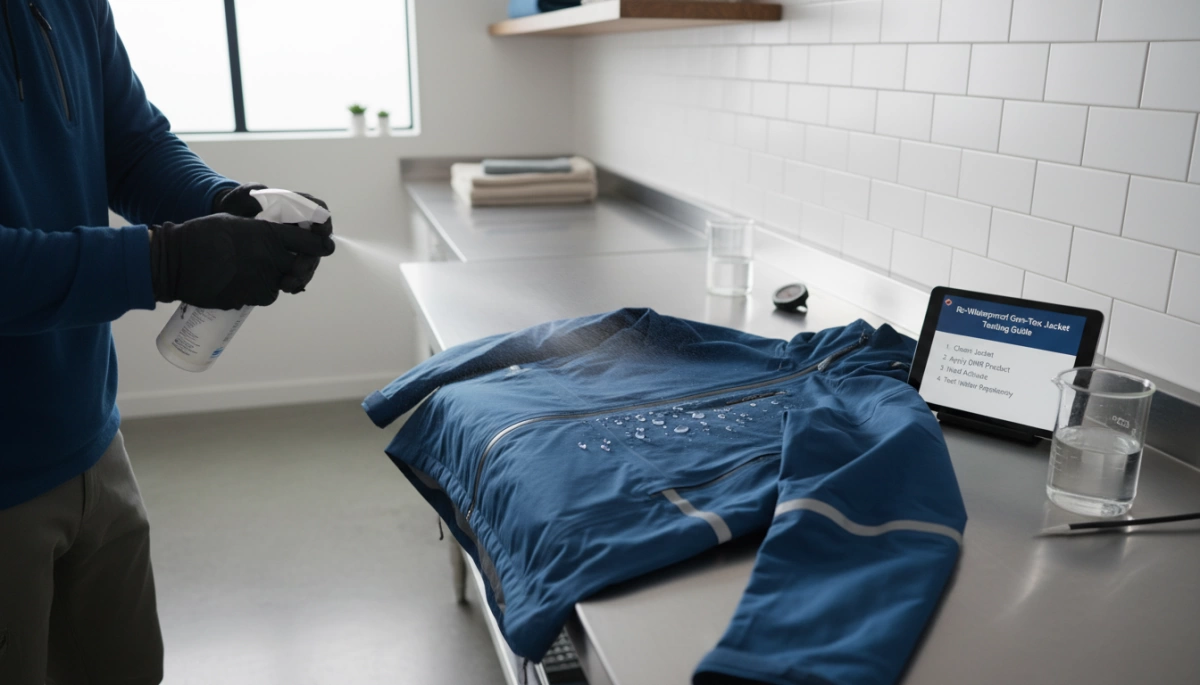
Simple at‑home tests (sink, shower, spray bottle)
To test how well you restored Gore‑Tex DWR at home, I stick to three quick checks:
-
Spray bottle test (my go‑to)
- Fill a clean spray bottle with cool water.
- Hang the jacket, zip it up, and spray the shoulders, chest, sleeves, and hood.
- Watch what happens for 30–60 seconds.
-
Shower test
- Put the jacket on, fully zipped.
- Stand under a gentle shower for 1–2 minutes.
- Focus the water on shoulders, hood, cuffs, and front zip area.
-
Sink/faucet test
- Lay a sleeve or panel under a light faucet stream or use a cup to pour water over it.
- Keep the water low pressure so you’re testing DWR, not forcing water through seams.
All three are solid ways to reproof a Gore‑Tex jacket at home and confirm your Gore‑Tex wet out fix actually worked.
What healthy water beading on Gore‑Tex should look like
When the durable water repellent is doing its job, the face fabric should:
- Form tight, round beads that sit on top of the fabric.
- Let water roll off easily when you shake or lightly flick the surface.
- Stay light in color (no dark patches soaking up moisture).
- Feel dry to the touch after you wipe it with your hand or a microfiber cloth.
If water spreads out, looks “matte,” or the fabric turns darker and feels damp, the water beading on Gore‑Tex still isn’t where it should be.
How to spot weak spots after reproofing
Wet‑out almost always shows up first in high‑wear zones. During your test, check for:
- Dark, damp patches on:
- Shoulders (pack straps, seat belts)
- Hood brim and crown
- Cuffs and lower sleeves
- Hip area where a hipbelt or harness rides
- Water that sticks instead of beads, forming a sheet.
- Areas that feel cool and clammy inside quicker than the rest.
These are the spots where you need to restore Gore‑Tex DWR more aggressively.
Quick touch‑ups with spray‑on DWR
If 90% looks good and just a few panels wet out, don’t redo the whole wash and reproof. I just:
- Hang the clean, slightly damp jacket.
- Use a spray‑on DWR for Gore‑Tex (Nikwax TX.Direct Spray‑On, Gear Aid Revivex, or my own PFAS‑free spray).
- Lightly mist the problem zones only:
- Shoulders, hood, cuffs, front of the torso.
- Wipe off any excess with a microfiber cloth so it doesn’t feel greasy.
- Tumble dry low or medium (if the care tag allows) to heat‑activate the DWR.
This targeted touch‑up keeps the jacket from feeling coated or heavy while fixing the real issues.
When it’s “good enough” vs when to redo the process
Here’s how I decide if the Gore‑Tex cleaning and care work is done:
Good enough (you’re fine to stop if):
- 80–90% of the jacket beads strongly.
- Weak spots are minor and respond to a quick spray‑on touch‑up.
- The jacket doesn’t feel clammy in normal rain.
- The fabric doesn’t stay dark or heavy after a short shower test.
Redo the process if:
- Large areas fully wet out even after heat activation.
- The jacket feels soaked and heavy in light rain tests.
- Spray‑on touch‑ups don’t improve beading at all.
- You used regular detergent earlier and may need a full reset with tech wash + fresh DWR treatment.
If you’re still seeing major wet‑out after a proper reproofing and heat cure, you’re likely dealing with face fabric wear or membrane issues, not just DWR—and it may be time to repair or replace that Gore‑Tex shell instead of throwing more product at it.
Long-Term Gore-Tex Maintenance for Lasting Waterproofing
If you want your Gore-Tex jacket to keep beading water like new, long-term care matters more than any single reproofing. Here’s how I maintain and re-waterproof Gore-Tex jackets for real-world use in the U.S. (hiking, skiing, commuting, and travel).
How Often to Wash and Re-Waterproof Gore-Tex
Use this as a simple baseline:
-
Light use (city, errands, occasional rain):
- Wash: every 3–4 months or when it looks dirty.
- Reproof / restore Gore-Tex DWR: about once a year, or when water stops beading.
-
Regular outdoor use (weekend hikes, dog walks, travel):
- Wash: every 4–6 outings in wet or muddy conditions.
- DWR reactivation with heat: after most washes.
- Full reproofing: every 6–9 months or when you see wet out on shoulders and sleeves.
-
Heavy use (ski patrol, guides, daily hiking, PNW-level rain):
- Wash: every 1–3 heavy days out.
- Heat reactivation: after every wash.
- Re-waterproof with DWR spray/wash-in: every 3–6 months or as soon as water stops beading in key zones.
If your Gore-Tex wet out fix isn’t lasting more than a couple of days, you probably need more frequent washes and targeted reproofing, not less.
Everyday Habits to Keep Gore-Tex Performing
Daily habits are what keep a waterproof breathable jacket working like it should:
-
Brush off dirt and dust
- After trips, use a soft brush or dry cloth to remove mud, sand, road grime, and trail dust.
- Dirt kills DWR fast, especially on cuffs and lower hem.
-
Quick spot cleaning
- Wipe food, sunscreen, sweat, and oil spots with a damp cloth and a touch of tech wash.
- Focus on collar, cuffs, chin area, pockets, and front zipper flap.
-
Hang to dry after use
- Don’t leave your Gore-Tex stuffed in a pack, trunk, or gym bag.
- Hang it fully open so sweat and moisture can escape and the DWR doesn’t stay saturated.
These simple moves stretch the time between full wash and reproof waterproof jacket routines.
Best Way to Store a Gore-Tex Shell
Proper storage is huge for long-term Gore-Tex maintenance:
-
Store clean and dry only
- Always wash and fully dry your waterproof shell before long-term storage (off-season).
- Dirt and body oils quietly break down DWR and fabrics over time.
-
Hang, don’t compress
- Use a wide hanger in a cool, dry closet.
- Avoid vacuum bags, tight bins, or stuffing it in a backpack for months—compression and heat can speed up fabric and membrane breakdown.
-
Avoid heat and sunlight
- Keep it away from attics, hot garages, and direct sun.
- Long-term heat plus UV is the enemy of any waterproof breathable jacket.
Seasonal Gore-Tex Maintenance (Pre-Season & Post-Season)
If you ski, hike, or live somewhere wet, a seasonal Gore-Tex cleaning and care routine keeps your jacket dialed:
-
Pre-season check (fall or early winter):
- Inspect for seam tape lifting, small holes, worn cuffs, peeling logos.
- Test water beading in the sink or shower.
- If it wets out, plan a clean → heat reactivate → reproof cycle before the season starts.
-
Post-season deep clean (spring):
- Do a full wash with tech wash, then tumble dry to reactivate DWR.
- If water still doesn’t bead, reproof Gore-Tex jacket at home with a quality DWR spray or wash-in.
- Store it hanging, fully dry, ready for next season.
Simple Gear Care Routine for All Your Waterproof Jackets
I treat all my waterproof gear (Gore-Tex ski jackets, hiking shells, and everyday rain coats) with the same simple system:
-
Sort gear by use:
- One pile for heavy-duty shells (Gore-Tex hard shell jacket, ski shells, rain shells).
- One pile for lightweight stuff (wind shells, packable rain jackets).
-
Set a reminder:
- Put 2–3 care dates per year on your phone calendar: early fall, mid-winter, and spring.
- On those dates, wash and inspect all your waterproof shells at once.
-
Use the same products across the board:
- One tech wash and one eco-friendly, PFAS-free DWR treatment (spray +/or wash-in) is enough for jackets, pants, and bibs.
- This keeps your Gore-Tex cleaning and care guide simple and repeatable.
-
Touch-up reproofing as needed:
- Keep a small DWR spray on hand for quick fixes to shoulders, hood, cuffs, and pack-strap zones between full washes.
With a basic maintenance routine like this, you’ll revive waterproof shell jackets faster, avoid damaging the Gore-Tex membrane, and get a lot more seasons out of every Gore-Tex jacket you own.
Protecting the Gore-Tex Membrane While Re-Waterproofing
When you re-waterproof a Gore-Tex jacket, the real goal is to restore the DWR without beating up the membrane. If you treat the shell right, the membrane will usually outlast the zippers and fabric.
Why Gore-Tex Membranes Usually Fail
The Gore-Tex membrane almost never fails from normal wear. It usually dies from:
- High heat (scorching dryers, hot irons on the face fabric)
- Harsh detergents and chemicals (bleach, strong stain removers, fabric softeners)
- Mechanical abuse (old-school top-load agitators, rough brushes, heavy-duty cycles)
- Long-term grime (body oil, sunscreen, bug spray and dirt left in the fabric)
If you avoid these, you dramatically extend the life of the membrane.
Safe Settings and Products for Any Gore-Tex Jacket
For any Gore-Tex construction (2L, 2.5L, 3L, ski shells, hiking rain jackets):
- Washer settings (front-loader preferred):
- Cold or warm water, never hot
- Gentle / delicate cycle
- Low to medium spin
- Cleaner:
- Use a tech wash only (Nikwax Tech Wash, Grangers Performance Wash, Gear Aid Revivex Pro Cleaner)
- No regular detergent, no fabric softener, no scent booster
- Dryer:
- Medium/low heat, 20–30 minutes at a time
- Check the care tag—if it says tumble dry low, follow that
These safe settings protect the Gore-Tex membrane while you restore DWR and fix wet out.
Avoid Delamination, Peeling, and Damage
Delamination (lining peeling, bubbles, or “flaking” inside) is usually from heat and harsh washing. To avoid it:
- Don’t crank the dryer to high heat
- Never iron the face fabric directly—use a thin pressing cloth and low to medium heat if you iron to reactivate DWR
- Skip hard scrub brushes—use a soft cloth or sponge only
- Don’t wring or twist the jacket when it’s wet
- Avoid soaking the jacket for hours in hot water or detergent mixes
If you see early signs of peeling around the hood, shoulders, or cuffs, back off the heat and be extra gentle with wash and dry.
If Your Gore-Tex Jacket Leaks Through Seams or the Membrane
If your jacket still leaks after you restore Gore-Tex DWR and reproof at home:
- Check seams and tape first
- Look inside for lifting seam tape, cracks, or gaps
- Small areas can be repaired with seam repair tape or a pro repair shop
- Check face fabric vs. membrane
- If water wets out but doesn’t soak your base layers, it’s usually a DWR problem
- If you feel water coming through the fabric or seams quickly, the membrane or seam tape may be compromised
- Decide repair vs. replace
- Local gear repair shops or brand service centers (or Gore-Tex warranty) can assess delamination and seam failures
- If large panels are peeling or you have widespread leaks, it’s usually time to retire the shell and move on
Protecting the Gore-Tex membrane while re-waterproofing comes down to this: mild cleaner, gentle cycle, controlled heat, and no harsh chemicals. Do that, and you’ll get more seasons out of your ski jacket, hiking shell, and everyday Gore-Tex rain jacket.
Best DWR Products for Gore‑Tex Jackets (Real-World Picks)
When I re-waterproof Gore‑Tex jackets for customers here in the U.S., I rotate between a small group of proven DWR products. These play nice with Gore‑Tex membranes, keep water beading, and don’t trash breathability.
Top DWR Sprays for Gore‑Tex Shells
If you want to reproof a Gore‑Tex jacket at home and focus on the outside only, spray‑on is the way to go.
My top spray picks for Gore‑Tex:
-
Gear Aid Revivex Durable Water Repellent (Spray)
- Strengths:
- Designed specifically to restore Gore‑Tex DWR and other technical shells
- Excellent beading and durability for heavy rain, ski days, and backpacking
- Great for targeting shoulders, hood, cuffs, and pack‑strap zones
- Weaknesses:
- Not always the most eco‑lean formula, check label if you’re avoiding PFAS
- Slightly higher price than basic sprays
- Best for:
- People who use their hard shell jacket hard (PNW, Rockies, Northeast)
- Fixing Gore‑Tex wet out in specific high‑wear areas
- Strengths:
-
Grangers Performance Repel Plus (Spray)
- Strengths:
- Bluesign approved, strong eco profile
- Good balance of water beading + breathability
- Works well on Gore‑Tex hiking rain jackets, ski shells, and everyday rain coats
- Weaknesses:
- Not quite as aggressive as Revivex for hardcore use
- Best for:
- Everyday users, commuters, light to moderate outdoor use
- Folks prioritizing eco-friendly DWR treatment for shells
- Strengths:
-
Nikwax TX.Direct Spray-On
- Strengths:
- Easy to find in the U.S. (REI, Amazon, local outdoor shops)
- Water-based, PFAS-free, no harsh fumes
- Great for 2‑layer and 3‑layer Gore‑Tex where you only want DWR on the face fabric
- Weaknesses:
- Not as long-lasting under heavy abrasion as Revivex
- Best for:
- Home users who want simple, safe reproofing for family gear
- Strengths:
Top Wash-In Waterproofing Products for Gore‑Tex
Wash‑in DWR is the fastest way to wash and reproof a waterproof jacket in one go, especially if you’ve got multiple Gore‑Tex pieces.
Best wash‑in options:
-
Nikwax TX.Direct Wash-In
- Strengths:
- Easy one‑bottle solution: toss it in the washer after tech wash
- Great for older shells that need full‑jacket treatment
- PFAS‑free and water‑based
- Weaknesses:
- Also coats the liner, which some people feel can make the jacket a bit “clammy”
- Best for:
- Re-waterproofing ski jackets, rain pants, bibs, and multiple shells at once
- Strengths:
-
Grangers Clothing Repel (Wash-In)
- Strengths:
- Good performance + eco-friendly credentials
- Plays well with Gore‑Tex cleaning and care guidelines
- Weaknesses:
- Works best when paired with Grangers Performance Wash
- Best for:
- People who want a simple wash + reproof waterproof jacket routine with one brand
- Strengths:
-
Gear Aid Revivex Wash-In Water Repellent
- Strengths:
- Strong, durable waterproofing for hard shell jackets
- Good for gear that sees heavy mountain use
- Weaknesses:
- Less common in local grocery/box stores; mostly outdoor shops/online
- Best for:
- High-use Gore‑Tex shells that see regular storms and pack rub
- Strengths:
Nikwax vs Grangers vs Gear Aid Revivex
Here’s how I position them when helping U.S. customers choose:
| Brand | Strengths | Weaknesses | Best Use Case |
|---|---|---|---|
| Nikwax | Easy to use, PFAS‑free, widely available, budget‑friendly | Not the absolute longest‑lasting under abrasion | Everyday rain, hiking shells, family gear |
| Grangers | Strong eco profile, good balance of performance + breathability | Slightly pricier than Nikwax | Users who care about eco + solid performance |
| Gear Aid Revivex | Very durable, excellent for Gore‑Tex wet out fix | Can be more “industrial” and less eco‑oriented depending on version | Heavy mountain use, ski patrol, guides |
How I choose:
- Daily commuters / weekend hikers: Nikwax or Grangers
- Skiers, climbers, guides, PNW storm users: Gear Aid Revivex (spray)
- Eco‑focused buyers: Grangers first, then Nikwax
Budget-Friendly vs Premium DWR Treatments
If you’re trying to restore Gore‑Tex DWR without overspending:
-
Budget-friendly picks:
- Nikwax TX.Direct (spray or wash‑in)
- Some house-brand “technical DWR” sprays from REI, Backcountry, etc.
- Good enough for most U.S. climates where you’re not in constant downpours
-
Premium, long-lasting picks:
- Gear Aid Revivex Durable Water Repellent
- High-end Grangers Performance Repel / Clothing Repel
- Better choice if you’re in Seattle, coastal Northeast, Alaska, Rockies winters, or out multiple days in a row
Eco-Friendly and PFAS-Free DWR That Still Beads Well
If you want eco-friendly DWR treatment for shells and still expect solid water beading:
-
Look for:
- PFAS-free or PFC-free labels
- Water-based formulas
- Certifications like Bluesign or OEKO‑TEX where listed
-
Strong eco‑leaning options:
- Nikwax (entire line is PFAS-free)
- Grangers eco-labeled products
- Some newer PFAS-free Revivex formulas (check the specific bottle)
These newer PFAS-free DWRs might need more frequent reproofing than old-school fluorinated coatings, but for most U.S. users—especially commuters, hikers, and resort skiers—the tradeoff is worth it.
Bottom line:
If I had to set up a simple, pro-level kit for re-waterproofing Gore‑Tex jackets like a professional at home in the U.S., I’d tell you to keep:
- One tech wash (Nikwax or Grangers)
- One spray-on DWR (Gear Aid Revivex or Nikwax TX.Direct Spray-On)
- One wash-in DWR (Nikwax TX.Direct or Grangers Clothing Repel)
That combo covers everything from a wet-out ski jacket to your daily Gore‑Tex rain shell, without risking the membrane or wasting money on stuff that doesn’t bead.
Troubleshooting Gore‑Tex Wet Out After Re‑Waterproofing
Even after you re‑waterproof a Gore‑Tex jacket, it can still “wet out.” That doesn’t always mean the Gore‑Tex membrane is shot—usually it’s a DWR or dirt problem you can fix at home.
Why Your Gore‑Tex Still Wets Out After DWR
If your Gore‑Tex jacket still soaks up water after cleaning and a DWR treatment, it’s usually because:
- The fabric wasn’t fully clean – Old detergent, sweat, sunscreen, bug spray, and grime block durable water repellent reactivation.
- Not enough heat – You need proper tumble dry heat to activate most DWR on a waterproof shell jacket.
- Wrong product or too little product – Using the wrong DWR spray for Gore‑Tex or going too light with the treatment can leave weak coverage.
- Extreme conditions – All jackets will look “soaked” under all‑day PNW rain or sitting on a ski lift in wet snow. The membrane can still be waterproof while the face fabric darkens.
If water is soaking in but not leaking through to your base layers, you’re dealing with Gore‑Tex wet out, not a total waterproof failure.
How Oils, Pack Straps, and Dirt Kill DWR Fast
The fastest way to ruin durable water repellent on a Gore‑Tex shell is friction plus body oils. In the U.S., I see the same hot spots over and over:
- Shoulders – Backpack straps, camera slings, kid carriers.
- Hood and neck – Sunscreen, hair products, skin oils.
- Cuffs and lower sleeves – Grabbing chairlifts, car doors, trekking poles.
- Hips and lower back – Hipbelts and waist straps from packs.
These zones get:
- More abrasion → DWR wears off faster.
- More contamination → Oils and dirt flatten the water beading.
For heavy hikers, ski patrollers, and daily commuters with backpacks, plan to spot‑clean and spot‑reproof these zones more often than the rest of the jacket.
Only Shoulders, Hood, or Cuffs Soaking Through? Do This
If just a few areas are wetting out after you restore Gore‑Tex DWR:
-
Clean those zones again
- Use a small amount of tech wash and a soft brush or sponge.
- Rinse well to remove all soap.
-
Hit them with spray‑on DWR
- Use a best‑in‑class DWR spray for Gore‑Tex (Gear Aid Revivex, Nikwax TX.Direct Spray‑On, Grangers).
- Spray from about 6–8 inches, wipe off any excess with a microfiber cloth.
-
Heat‑activate
- Tumble dry on low/medium heat for 20–30 minutes (if the care tag allows).
- Or use a warm iron with a pressing cloth on the shoulders, hood, and cuffs.
-
Retest water beading
- Use a spray bottle or shower to check those spots. Water should bead and roll off quickly.
DWR Problem vs Worn Face Fabric vs Dead Membrane
You don’t want to throw away a Gore‑Tex jacket that just needs a simple reproof. Here’s how I separate DWR issues from real damage:
Likely a DWR problem (easy fix):
- Fabric darkens and feels wet, but your mid‑layer stays mostly dry.
- Water beads in some areas but not others.
- Jacket improves after washing and tumble drying.
Likely worn face fabric:
- The outer fabric is fuzzy, frayed, or “peached” from years of abrasion.
- Shoulders and elbows are rough and permanently dark when wet.
- DWR spray helps only briefly; wet out returns quickly in the same spots.
Likely Gore‑Tex membrane issue (hard fix):
- You feel cold water seeping through in lines, dots, or patches.
- Leakage follows seams, old repairs, or bubbles in the fabric.
- You see bubbling, peeling, or delamination on the inside of the jacket.
If water is literally coming through the jacket—not just soaking into the surface—that’s past basic re-waterproofing.
When to Patch, Repair, or Replace Your Gore‑Tex Shell
You can push a good Gore‑Tex shell far with proper care, but nothing lasts forever. Here’s how I handle it:
Patch or repair when:
- You have small cuts, crampon nicks, or edge slices.
- Seam tape is peeling in a few spots.
- The membrane damage is localized (one panel, one seam).
Use:
- Gore‑Tex repair patches or quality fabric patches.
- Professional repair services or brand warranty if it’s a newer jacket.
Time to replace when:
- Delamination is spreading across the back, shoulders, or hood.
- The face fabric is heavily worn all over and never beads, even after good DWR treatments.
- You’ve reproofed properly several times and it still wets out fast and leaks through in multiple places.
For most U.S. users (weekend hikers, ski trips, daily commuters), a well‑maintained Gore‑Tex jacket should easily last several seasons before you’re forced into replacement. The key is cleaning with proper tech wash, smart DWR reproofing, and targeted touch‑ups on high‑wear zones to keep that water beading strong.
FAQs About Re‑Waterproofing Gore‑Tex Like a Pro
Does reproofing change breathability or make Gore‑Tex clammy?
Reproofing your Gore‑Tex jacket should not make it clammy if you do it right.
- A fresh DWR treatment actually improves comfort, because the face fabric stops “wetting out,” so sweat vapor can escape again.
- Gore‑Tex breathability comes from the membrane, not the DWR. The DWR just keeps the outer fabric from soaking up water.
- Jackets feel clammy when:
- They’re dirty (body oils, sweat, sunscreen)
- The face fabric is soaked
- You’ve over-applied DWR so it feels greasy
Clean first with a proper tech wash, apply a light, even DWR coat, then heat-activate. That combo keeps your jacket dry and breathable.
How long does a fresh DWR treatment usually last?
In real U.S. conditions, here’s what I see with quality DWR (Nikwax, Grangers, Gear Aid Revivex, etc.):
- Daily city use (commutes, walking the dog): 3–6 months
- Weekend warriors (hiking, skiing a few times a month): 1 season
- Heavy use (guides, ski patrollers, PNW rain addicts): 4–8 weeks
What kills DWR faster:
- Abrasion from pack straps, chairlifts, and rock
- Dirty water (road spray, mud, salt)
- Long days in wet snow or heavy rain
Rule of thumb:
If water stops beading and the fabric darkens quickly, it’s time to wash and reproof your Gore‑Tex jacket.
Can you overdo re‑waterproofing a Gore‑Tex jacket?
Yes, you can overdo it, and it shows fast.
Signs you’ve gone too hard:
- Jacket feels waxy, tacky, or greasy
- Face fabric looks blotchy or shiny
- Breathability feels worse because the fabric is basically “sealed”
How to avoid it:
- Use the recommended amount of DWR (don’t freestyle the dosage)
- With spray‑on: apply a light, even mist, then wipe off excess with a microfiber cloth
- With wash‑in: only run one cycle unless the care tag or manufacturer specifically says otherwise
You’re not trying to “layer up” infinite DWR. You’re just refreshing a thin, even water-repellent surface.
Is the process different for ski jackets, hiking shells, and everyday rain coats?
The basics are the same—wash, then reactivate or reproof—but I tweak the approach a bit:
-
Ski jackets (insulated Gore‑Tex):
- More body oils and sunscreen around collar and cuffs
- Usually go heavier on spray-on DWR on shoulders, hood, and front
- Tumble dry low with dryer balls to keep insulation lofted
-
Hiking shells (lightweight Gore‑Tex shells):
- Usually 2.5- or 3‑layer fabrics that see pack strap abuse
- Clean more often and spot-treat shoulders, back panel, and hips
- Use spray-on for targeted high-wear zones
-
Everyday rain coats:
- More exposure to road grime and pollution
- I’ll often use a wash-in DWR for simplicity, then top off with spray on the hood and shoulders
For all of them: stick to Gore‑Tex-approved products, follow the care tag, and finish with heat activation.
Can you use the same DWR products on pants, bibs, and other Gore‑Tex gear?
Yes—you can use the same DWR sprays and wash‑in products on:
- Gore‑Tex pants and bibs
- Gore‑Tex gloves with fabric shells
- Gore‑Tex rain skirts, bike shells, and other waterproof breathable gear
My approach:
-
Pants and bibs:
- Focus spray-on DWR on knees, seat, inner ankles, and cuffs
- Wash-in works well if the whole garment is soaking out
-
Gloves:
- Use spray-on only on the fabric areas
- Avoid leather unless the product specifically says it’s leather-safe
As long as the item is a waterproof breathable shell and the care tag allows it, the same eco-friendly, PFAS-free DWR treatments for shells work across your whole Gore‑Tex kit.