
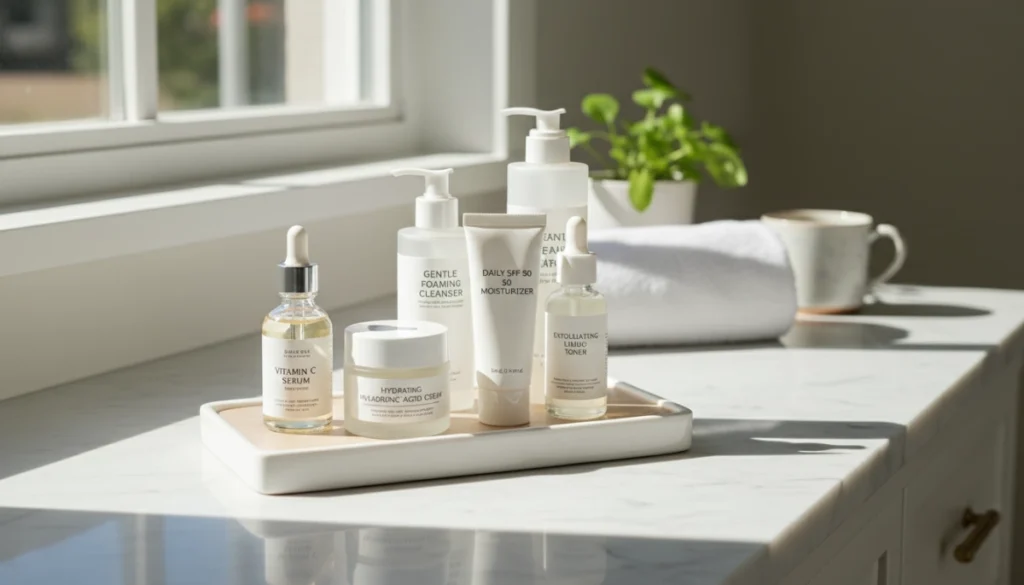
If you feel totally lost staring at shelves of serums, toners, and trendy acids… you’re not alone.
Most people don’t need a 10-step routine. What actually matters are a few essential skincare products everyone should have—the kind that dermatologists quietly recommend over and over because they simply work.
In this guide, you’ll see exactly which basic skincare routine steps are truly non‑negotiable: a gentle cleanser, a barrier‑supporting moisturizer, a daily broad‑spectrum sunscreen, and one smart treatment serum if you want extra results. That’s it. No fluff, no overhyped “miracles,” just beginner skincare essentials that fit any skin type, gender, or age.
You’ll learn how to build a simple skincare routine for 2026 that protects, hydrates, and strengthens your skin barrier—using must‑have skincare products that are easy to stick with. And along the way, you’ll see how megapickly can help you grab dermatologist‑inspired basics without wasting money on the wrong stuff.
Let’s cut through the noise and build a core skincare routine that actually earns a place on your sink.
Why Essential Skincare Products Matter
If you’ve ever stared at a shelf of 20+ products and thought, “Do I really need all this?” the answer is no. Essential skincare products everyone should have come down to a few core items that keep your skin clean, protected, and comfortable in real life — not in a 10‑step routine on social media.
A minimal skincare routine works because your skin actually wants consistency and simplicity, not constant change and overload. When you strip things back to the basic skincare routine most dermatologists agree on, you:
- Avoid irritating your skin barrier with too many actives
- Save time and money by skipping non‑essential steps
- Make it easier to stay consistent every day
Why beginners should start with core skincare
If you’re a beginner, your skin doesn’t need six serums and a peel. It needs core skincare:
- A gentle facial cleanser
- A moisturizer that fits your skin type
- A broad‑spectrum sunscreen SPF 30+ for daytime
Starting with these beginner skincare essentials lets you figure out what your skin actually likes before you add extras like exfoliants or treatment serums. You get clearer feedback and fewer breakouts, rashes, or mystery reactions.
How a simple routine beats 10-step trends
A simple skincare routine almost always beats a complicated 10‑step trend because:
- Fewer formulas = fewer chances for irritation and product conflicts
- It’s realistic to repeat every day, not just on “good” days
- You focus on what truly matters: cleansing, moisturizing, and protecting
Trendy routines look impressive, but the best skincare products everyone needs are the ones you’ll actually use daily — not the ones that sit half‑full on your counter.
What “essential skincare products everyone should have” actually means
When I say essential skincare products everyone should have, I’m talking about a minimal, dermatologist‑approved skincare routine that works for all skin types and all genders:
- Gentle, pH‑balanced face wash
- Fragrance‑free or low‑irritant moisturizer (lightweight for oily skin, richer for dry or sensitive skin)
- Daily sunscreen with broad‑spectrum SPF 30 or higher
Everything else — serums, masks, exfoliants — is optional. Helpful? Yes. Essential? No. Your skin’s real “non‑negotiables” are cleansing, hydration, and sun protection. Once those are in place, you can layer in more only if and when your skin actually needs it.
Benefits of a Minimal Skincare Routine
Less irritation, more skin barrier protection
When you focus on essential skincare products everyone should have, you instantly lower your risk of irritation. Fewer formulas mean:
- Less chance of harsh ingredient overload
- A stronger, calmer skin barrier
- Easier to spot what’s causing redness or breakouts
A basic skincare routine built around a gentle cleanser, a solid moisturizer, and daily sunscreen is usually what dermatologists recommend first.
Saving money by skipping non‑essential products
A minimal skincare routine cuts the fluff and saves cash. You’re not paying for:
- Extra toners, essences, and “boosters” you don’t really need
- Trendy products that overlap and do the same thing
- Big routines you’ll abandon in a week
| Routine Type | # of Daily Products | Cost Over Time | How Likely You’ll Stick With It |
|---|---|---|---|
| Minimal (3–4 must‑haves) | 3–4 | Low–Medium | Very high |
| Maxed‑out (8–12 products) | 8–12 | High | Low–Medium |
Building a routine you’ll actually stick to
Most of us in the U.S. are busy. A simple skincare routine you can do half-asleep is the one you’ll keep doing.
- 2–4 steps, morning and night
- Easy to travel with
- No “I’ll skip it tonight” guilt
This is the core of any beginner-friendly skincare routine that actually lasts.
Why fewer products work for all skin types
Whether you’re oily, dry, acne‑prone, or sensitive, you still need the same must‑have skincare products:
- Gentle cleanser
- Moisturizer matched to your skin type
- Broad‑spectrum sunscreen SPF 30+
Then you tweak textures (lightweight gel vs rich cream) instead of stacking 10 different items. This keeps skin barrier health front and center.
Dermatologist recommended skincare philosophy
Most dermatologist recommended skincare boils down to:
- Protect the barrier
- Keep it simple
- Use proven, non‑comedogenic skincare products
- Add treatment serums (like vitamin C, retinol, or niacinamide) slowly, only if you need them
In other words: a core skincare routine with a few everyday skincare essentials beats a cluttered shelf every time.
Core Essential Skincare Products Everyone Should Have
When I talk about essential skincare products everyone should have, I’m not talking about a 10‑step routine. I’m talking about a core skincare routine you’ll actually use every day.
Overview of must‑have skincare products
For a basic skincare routine that works for most people in the U.S., you really only need:
- Gentle facial cleanser (pH-balanced, fragrance-free)
- Everyday moisturizer (lightweight for oily skin, richer cream for dry/sensitive)
- Broad‑spectrum sunscreen SPF 30+ (non‑greasy, face-safe, used daily)
These are your must-have skincare products. Everything else is optional.
How many daily skincare products you really need
For real life, not Instagram, this is enough:
-
Morning:
- Cleanser (optional if your skin is dry/sensitive)
- Moisturizer
- Sunscreen
-
Night:
- Cleanser
- Moisturizer
That’s 2–3 daily skincare products in the morning and 2 at night. Simple and sustainable.
Prioritizing protection, cleansing, and hydration
I always build routines around three priorities:
-
Protection:
- Daily broad‑spectrum sunscreen SPF 30+ to prevent sun damage, dark spots, and early aging.
-
Cleansing:
- pH‑balanced face wash to remove oil, sweat, sunscreen, and makeup without wrecking your skin barrier.
-
Hydration:
- Hydrating skincare products like a ceramide moisturizer to keep your barrier strong and comfortable.
If a product doesn’t help with protection, cleansing, or hydration, it’s not essential.
Beginner skincare essentials vs optional extras
For beginner skincare essentials, start with:
-
Essentials (start here):
- Gentle cleanser
- Moisturizer (ceramide or hydrating formula)
- Daily sunscreen SPF 30+
-
Optional extras (add later if needed):
- Vitamin C serum for face (brightness, antioxidant)
- Niacinamide serum (oil control, pores, redness)
- Hyaluronic acid serum (extra hydration)
- Retinol for beginners / bakuchiol serum alternative (anti‑aging)
- Gentle chemical exfoliant 1–2x/week (if your barrier is healthy)
Your minimal skincare routine should always be built on those three core essentials first. Once that’s solid, you can add treatment serums and extras if your skin actually needs them.
Gentle Cleanser Essentials: Non‑Negotiable in Every Core Skincare Routine
A gentle facial cleanser is one of the most essential skincare products everyone should have. If your face wash is too harsh, nothing else in your basic skincare routine will work the way it should.
Why a Gentle Cleanser Is Non‑Negotiable
A good pH-balanced face wash should:
- Remove sunscreen, light makeup, sweat, and oil
- Keep your skin barrier intact (no tight, squeaky feeling)
- Work for daily use without causing redness, burning, or flaking
In the U.S., a lot of people over-wash with stripping cleansers. That leads to more oil, more breakouts, and more irritation. A gentle, fragrance-free cleanser keeps things balanced.
How Often to Cleanse: AM and PM
For most skin types:
- Morning (AM):
- Oily / acne-prone: cleanse once with a gentle cleanser
- Dry / sensitive: you can rinse with lukewarm water or use a tiny amount of cleanser
- Night (PM):
- Everyone: cleanse every night to remove daily SPF, pollution, and oil
- If you wear heavy makeup, do a double cleanse (oil or balm first, gentle cleanser second)
Best Cleanser Textures for Each Skin Type
Your core skincare routine should match your skin type and feel comfortable:
-
Foaming cleansers – for oily and acne‑prone skin
- Look for:
- “non‑comedogenic”
- “oil‑free”
- gentle foaming, not super stripping
- Great if you feel shiny by midday or live in a humid U.S. climate
- Look for:
-
Cream and lotion cleansers – for dry or sensitive skin
- Look for:
- “hydrating,” “soothing,” or “barrier repair”
- ingredients like ceramides, oat, glycerin
- Ideal if your skin feels tight after washing or you get red easily
- Look for:
-
Gel cleansers – for combination and normal skin
- Light, easy to rinse, perfect for a simple skincare routine
- Look for “pH‑balanced” and “fragrance‑free” when possible
pH‑Balanced and Fragrance‑Free Tips
For beginner skincare essentials and sensitive U.S. skin:
- Pick cleansers labeled “pH‑balanced” or made for the face (not body wash)
- Choose fragrance‑free or “for sensitive skin” if you’re easily irritated
- Avoid harsh sulfates (like SLS) if your skin is dry, reactive, or mature
Signs Your Cleanser Is Too Harsh
If your “must‑have skincare product” is doing this, it’s the wrong one:
- Skin feels tight, squeaky, or itchy after rinsing
- Redness, stinging, or burning right after washing
- Flaky patches, increased oiliness, or more breakouts over time
- You need to pile on heavy moisturizer just to feel normal
If you notice any of these, switch to a gentle, hydrating, pH‑balanced cleanser. In a minimal skincare routine, your cleanser should quietly support your skin—not fight it.
Moisturizer Basics for Everyday Use
Why everyone needs a daily moisturizer
Everyone needs a daily moisturizer, no matter your skin type. In the US, with AC, heating, pollution, and hard water, your skin barrier takes a hit daily. A good basic skincare routine with moisturizer keeps skin:
- Comfortable (no tight, dry feeling)
- Balanced (less excess oil overcompensation)
- Protected (stronger barrier, less irritation)
How moisturizers support your skin barrier
Your skin barrier is your first line of defense. A must-have skincare product like a moisturizer helps by:
- Hydrating: pulls water into the skin
- Sealing: locks that water in so it doesn’t evaporate
- Repairing: supports barrier lipids so skin stays calm and resilient
This is core barrier repair skincare and key to any simple skincare routine.
Key hydrating skincare ingredients to look for
When you shop, look for these essential skincare ingredients:
- Hyaluronic Acid – lightweight, draws in water; great for all skin types
- Ceramides – repair and strengthen the barrier; ideal for dry, sensitive, or over-exfoliated skin
- Niacinamide – helps with redness, pores, and oil control while supporting barrier health
- Glycerin – classic, effective humectant for deep hydration
These show up a lot in dermatologist recommended skincare for a reason.
Hyaluronic acid for lightweight hydration
A hyaluronic acid moisturizer or serum is perfect if you want:
- Hydration without heaviness
- A lightweight moisturizer for oily skin
- A base layer under sunscreen and makeup
Just make sure you always seal it in with a moisturizer, not use it alone on dry skin.
Ceramides for barrier repair and strength
A ceramide moisturizer is clutch if your skin:
- Feels tight, dry, or rough
- Stings easily from products
- Has been over-exfoliated or irritated
Ceramides rebuild your barrier so your minimal skincare routine can work better with fewer products.
Niacinamide for redness, pores, and oil control
A niacinamide moisturizer or niacinamide serum is great if you struggle with:
- Redness or blotchiness
- Visible pores
- Excess shine or mild breakouts
It’s one of the best beginner skincare essentials because it’s gentle but multitasking.
Day vs night moisturizer differences
You don’t need totally different products, but it can help:
-
Day moisturizer
- Lighter texture
- Plays well under broad-spectrum sunscreen SPF 30+
- Sometimes includes antioxidants like vitamin C
-
Night moisturizer
- Slightly richer
- Focus on repair (ceramides, peptides, soothing ingredients)
- No need for SPF
Keep it simple: one medium-weight formula can be used AM/PM if it suits your skin.
Lightweight moisturizers for oily and acne‑prone skin
For oily or acne-prone skin in the US (especially humid climates):
- Look for: gel-cream, “oil-free,” non-comedogenic, lightweight moisturizer
- Ingredients: niacinamide, hyaluronic acid, zinc, green tea
- Avoid: heavy oils, strong fragrance, thick balms during the day
The right moisturizer actually helps reduce oiliness long term.
Richer creams for dry and sensitive skin
For dry or sensitive skin:
- Look for: rich moisturizer for dry skin, “cream” or “balm” textures
- Ingredients: ceramides, cholesterol, fatty acids, shea butter, oat, centella
- Choose fragrance-free skincare products to lower irritation risk
This is essential everyday skincare if you live in colder US states or use indoor heating a lot.
How to layer moisturizer with other products
In a simple AM/PM skincare routine, think thinnest to thickest:
- Cleanser (gentle facial cleanser / pH-balanced face wash)
- Serum (optional: vitamin C in the morning, retinol/niacinamide at night)
- Moisturizer (lock everything in)
- Sunscreen in the morning (last step, SPF 30+)
If your routine is minimal skincare only, your core skincare routine can just be:
Cleanser → Moisturizer → Sunscreen (AM) and Cleanser → Moisturizer (PM).
Daily Sunscreen Importance: Essential Skincare Products Everyone Should Have
Why sunscreen is the most essential skincare product
If I had to pick one must-have skincare product, it’s sunscreen. Daily SPF is the thing that actually prevents damage instead of trying to fix it later. It protects your skin barrier, helps keep your tone even, and supports every other product in your basic skincare routine.
How SPF protects from aging and skin cancer
UV rays hit your skin every day, not just at the beach. They:
- Break down collagen → fine lines, wrinkles, sagging
- Trigger dark spots and uneven tone
- Increase risk of skin cancer (including melanoma)
A broad-spectrum sunscreen SPF 30+ blocks most UVB (burning) and UVA (aging) rays so you’re not constantly undoing your skincare.
Why you need daily sunscreen even indoors
For U.S. daily life (driving, working by windows, quick errands):
- UVA rays pass through glass → cause aging and pigmentation
- Blue light from screens is minor compared to sun, but windows are the real problem
If it’s daytime and you can see outside, you should have SPF on. It’s a core part of essential skincare for all skin types.
What broad-spectrum SPF 30+ actually means
- SPF 30: Blocks ~97% of UVB (burning) rays
- Broad-spectrum: Also protects against UVA (aging) rays
- For everyday U.S. use, dermatologists usually recommend broad-spectrum SPF 30 or higher as a daily skincare essential.
Mineral vs chemical sunscreen (simple version)
-
Mineral sunscreen (zinc oxide, titanium dioxide)
- Sits on top of skin and reflects/scatters UV
- Great for sensitive or reactive skin
- Can look a bit white on deeper skin tones if not well-formulated
-
Chemical sunscreen (avobenzone, octisalate, etc.)
- Absorbs UV and turns it into heat
- Often feels lighter and more invisible
- Good for normal, combo, oily skin if you want a “barely there” finish
Both can be safe and effective. The best choice is the one you’ll actually wear every day.
Non-greasy sunscreen for oily and acne-prone skin
For oily or acne-prone skin, look for:
- “Oil-free” and non-comedogenic on the label
- Gel, fluid, or lightweight lotion textures
- “Matte” or “velvet finish
These double as a lightweight moisturizer for oily skin, so you can keep a minimal skincare routine**.
Hydrating sunscreen for dry or mature skin
For dry, sensitive, or mature skin, choose:
- Cream or lotion textures with ceramides, hyaluronic acid, or glycerin
- Fragrance-free formulas if your skin gets irritated easily
These act like a hydrating skincare product + sunscreen in one, which fits a simple skincare routine.
How much sunscreen to apply on face and neck
Most people in the U.S. under-apply SPF. Use:
- About 2–3 finger lengths of product for face + neck
- Or a nickel-sized amount just for the face
Cover: face, ears, neck, and whatever else is exposed (top of hands too).
How often to reapply sunscreen in real life
Ideal (especially if you’re outdoors):
- Every 2 hours
- Right after swimming, sweating, or towel-drying
Real life approach for busy days:
- Apply a solid layer in the morning
- Reapply at least once mid-day if you’re outside a lot or near windows
- Use SPF sprays, sticks, or cushions over makeup to make reapplication realistic.
Common sunscreen mistakes to avoid
Avoid these if you want your core skincare routine to actually work:
- Skipping sunscreen because “I’m just in the car / office”
- Relying on SPF in makeup or moisturizer alone (usually not enough)
- Using too little product
- Not covering ears, neck, and hands
- Only wearing SPF on “sunny” days (UV is there even when it’s cloudy)
Daily SPF is one of those everyday skincare essentials I never skip. If you’re building a beginner-friendly skincare routine, a broad-spectrum SPF 30+ belongs at the very top of your list of essential skincare products everyone should have.
Targeted Treatment Serums as Optional Essentials
Do you really need a serum in a simple routine?
In a minimal skincare routine, serums are optional, not mandatory.
Your true essential skincare products everyone should have are: gentle cleanser, moisturizer, sunscreen.
You add a treatment serum only if you want to fix a specific issue like dark spots, fine lines, or redness.
Use a serum if you’re dealing with:
- Dull, uneven tone
- Fine lines or early aging
- Stubborn acne marks or redness
- Dehydration even after moisturizer
If your skin is chill and low‑maintenance, you can skip serums and stick to the basic skincare routine.
How serums boost a basic skincare routine
Serums are like “boosters” in a simple skincare routine:
- They’re packed with high‑concentration actives
- They target specific concerns (dark spots, texture, acne, dryness)
- They layer easily under moisturizer and daily sunscreen
Think of them as beginner skincare essentials 2.0—not required, but powerful if chosen right.
Vitamin C serum for brightness and protection
A vitamin C serum for face is ideal if you want:
- Brighter, more even skin tone
- Help fading dark spots and acne marks
- Extra antioxidant protection under your broad‑spectrum sunscreen SPF 30
Tips:
- Use in the morning, after cleanser, before moisturizer/SPF
- Start with lower strength (around 10%) if you’re sensitive
- Look for fragrance-free skincare products if your skin gets irritated easily
Gentle retinol and bakuchiol for anti-aging
For anti-aging skincare essentials, retinoids are the gold standard, but they need respect.
Retinol for beginners:
- Helps with fine lines, texture, and clogged pores
- Start 2–3 nights per week, not daily
- Always pair with a ceramide moisturizer and good SPF in the morning
Bakuchiol serum alternative:
- Plant-based option that’s gentler
- Good for sensitive skin or people who can’t tolerate retinol
- Still start slowly (every other night)
Hydrating serums with hyaluronic acid
A hyaluronic acid serum is great if your skin feels:
- Tight after cleansing
- Dehydrated but still oily
- Flaky in some areas
What it does:
- Pulls water into the skin for lightweight hydration
- Works for all skin types, from oily to dry
How to use:
- Apply to slightly damp skin
- Seal with a lightweight moisturizer for oily skin or a rich moisturizer for dry skin
Niacinamide serums for pores and redness
A niacinamide serum is one of the most beginner-friendly skincare routine add-ons:
- Helps with redness, enlarged pores, and oil control
- Supports the skin barrier and works with most other actives
- Great for oily, acne-prone, and sensitive skin
Look for:
- 2–5% niacinamide (you don’t need 10%+, especially if you’re reactive)
- Non-comedogenic skincare products if you tend to break out
How to patch test and introduce actives
Don’t rush. New serums can wreck your barrier if you overdo it.
Patch test steps:
- Apply a pea-sized amount behind the ear or along the jawline
- Wait 24–48 hours
- Watch for burning, rash, or intense redness
Introduce slowly:
- Start 2–3 times per week at night
- Use only one new active at a time (vitamin C, retinol, acids, etc.)
- If you feel stinging, scaling, or strong redness, back off immediately
How often to use serums without irritation
General starting guide for a core skincare routine with serums:
- Vitamin C: once daily in the morning (if well tolerated)
- Retinol: 1–2 nights per week to start, then slowly build up
- Bakuchiol: every other night or a few times a week
- Niacinamide: daily or every other day
- Hyaluronic acid: 1–2 times daily as needed
Watch for over-exfoliation signs or barrier damage: burning, tightness, stinging from water, rough texture. If that happens, pause actives and focus on barrier repair skincare (gentle cleanser + ceramide moisturizer + SPF).
Simple serum routine ideas for beginners
Keep it minimal—this is still a simple skincare routine, not a 10-step setup.
If your main goal is brightness:
- AM: Cleanser → Vitamin C serum → Moisturizer → Sunscreen
- PM: Cleanser → Moisturizer
If your main goal is anti-aging:
- AM: Cleanser → Moisturizer → Broad-spectrum sunscreen SPF 30+
- PM (2–3x/week): Cleanser → Gentle retinol or bakuchiol → Ceramide moisturizer
- PM (other nights): Cleanser → Hydrating serum (optional) → Moisturizer
If your main goal is calming redness/oil:
- AM: Gentle cleanser → Niacinamide serum → Lightweight moisturizer → Sunscreen
- PM: Cleanser → Niacinamide or hyaluronic acid → Moisturizer
Bottom line: serums are optional essentials, not must-have skincare products for everyone. Nail your cleanser, moisturizer, sunscreen first. Then, if you’ve got a clear skin goal and the budget, add one targeted serum that actually fits your life and your skin.
Simple Morning Skincare Routine (Essential Skincare Products Everyone Should Have)
A simple AM routine is where your essential skincare products really work for you. You don’t need 10 steps. You just need a basic skincare routine you’ll actually do every day.
Step‑by‑Step AM Routine with Essential Skincare
Here’s a clean, realistic simple skincare routine most people in the U.S. can stick to:
- Cleanser – gentle, pH‑balanced face wash
- Serum (optional but helpful) – vitamin C, niacinamide, or hydrating serum
- Moisturizer – lightweight or rich, depending on your skin
- Sunscreen – broad‑spectrum SPF 30+ every single morning
These 3–4 steps cover your core skincare routine: cleanse, treat, hydrate, protect.
When to Cleanse in the Morning
Not everyone needs a full cleanse twice a day:
-
Cleanse in the morning if:
- You have oily or acne‑prone skin
- You sweat at night
- You use heavier products before bed
-
Skip cleanser and just rinse with lukewarm water if:
- You have dry, sensitive, or barrier‑damaged skin
- Your face doesn’t feel greasy or sticky
Listen to your skin. If it feels tight, squeaky, or stingy after washing, your cleanser is too harsh.
Where Serum Fits in a Basic Morning Routine
In a minimal skincare routine, serums are “nice to have,” not mandatory. But they can give real results:
- Best AM serums for beginners:
- Vitamin C serum for face – brightening + antioxidant protection
- Niacinamide serum – helps with redness, pores, and oil control
- Hyaluronic acid serum – boosts hydration without heaviness
Order:
Cleanser → Serum → Moisturizer → Sunscreen
Always apply serum on damp (not dripping) skin, then seal it in with moisturizer.
How to Layer Moisturizer and Sunscreen
Think of moisturizer as your comfort step and sunscreen as your protection step:
-
Apply your moisturizer first
- Lightweight gel or lotion for oily/acne‑prone skin
- Richer cream for dry or sensitive skin
-
Follow with broad‑spectrum sunscreen SPF 30+
- Use about 2–3 finger lengths of sunscreen for your face and neck
- Let moisturizer sink in for 1–2 minutes before sunscreen so it doesn’t pill
If you use a moisturizer with SPF, you still want to make sure:
- It’s broad‑spectrum
- You apply enough product to get full SPF protection
Quick Morning Routine for Busy People
If you’re rushing out the door or juggling kids, work, and a commute, keep it ultra‑simple:
-
Oily/normal skin:
- Splash of water or quick cleanse
- Lightweight moisturizer (optional if your sunscreen is hydrating)
- Non‑greasy, broad‑spectrum SPF 30+
-
Dry/sensitive skin:
- Gentle cleanse or just water
- Hydrating moisturizer with ceramides or hyaluronic acid
- Hydrating sunscreen for dry skin
If you can only manage two steps, make it:
- Moisturizer + Sunscreen (or a good hydrating sunscreen alone)
Morning Skincare for Makeup Wearers
If you wear makeup daily, your everyday skincare essentials make a big difference in how your base looks and lasts:
- Gentle facial cleanser
- Serum (optional) – vitamin C or niacinamide works well under makeup
- Moisturizer
- Choose lightweight moisturizer for oily skin
- Choose rich moisturizer for dry skin
- Sunscreen – non‑greasy sunscreen for oily skin or hydrating sunscreen for dry skin
- Makeup – let sunscreen set for a few minutes, then apply primer/foundation
Tips:
- Look for non‑comedogenic skincare products so your base doesn’t clog pores.
- Avoid super heavy, oily creams in the morning if your makeup tends to slide off.
- If your skin gets flaky under makeup, focus on hydrating skincare products in your AM routine.
This kind of simple AM skincare routine hits all the key points: barrier support, hydration, and UV protection—using only the essential skincare products everyone should have.
Simple Night Skincare Routine (PM Essentials)
A simple night skincare routine is where your essential skincare products do the heavy lifting. You don’t need 10 steps. You just need a basic, consistent core skincare routine that works for your skin type.
Step‑by‑Step PM Routine for All Skin Types
Here’s a minimal skincare routine you can follow every night:
- Cleanse – Remove sunscreen, oil, sweat, and makeup.
- (Optional) Treatment Serum – Vitamin C, niacinamide, retinol, or hydrating serum.
- Moisturizer / Night Cream – Lock in hydration and support your skin barrier.
That’s it. Three steps. This works for oily, dry, sensitive, combination, and mature skin with small tweaks in texture.
When You Actually Need a Double Cleanse
You only need a double cleansing routine if:
- You wore water‑resistant sunscreen
- You wore medium–full coverage or long‑wear makeup
- You feel like one wash never fully removes your base products
How to double cleanse (without overdoing it):
- Step 1: Oil cleanser or cleansing balm to melt makeup and sunscreen
- Step 2: Gentle facial cleanser (pH‑balanced, fragrance‑free) to actually clean the skin
If you don’t wear much makeup and use a normal broad‑spectrum sunscreen SPF 30+, one gentle cleanse at night is usually enough.
How to Remove Sunscreen and Makeup Gently
To avoid barrier damage and irritation:
- Use lukewarm water, not hot
- Massage cleanser for 20–30 seconds, don’t scrub
- Choose a pH‑balanced face wash that’s fragrance‑free and labeled non‑comedogenic
- For eye makeup, use a separate eye makeup remover or oil cleanser and gently wipe—no tugging
If your skin feels tight, squeaky, or dry afterward, your cleanser is too harsh for a basic skincare routine.
Where to Put Serums and Treatments at Night
In a simple PM skincare routine, serums and treatments always go after cleansing, before moisturizer:
- Cleanser
- Serum / Treatment (optional but powerful)
- Moisturizer / Night cream
Good beginner skincare essentials for night serums:
- Niacinamide serum – Redness, pores, oil control
- Hyaluronic acid serum – Lightweight hydration for all skin types
- Retinol for beginners / bakuchiol serum – Anti‑aging, texture, fine lines (use 2–3x/week to start)
Always patch test and introduce actives slowly to protect your skin barrier.
Choosing a Night Moisturizer or Night Cream
Your night moisturizer is one of the true must‑have skincare products. Pick based on skin type, not trends:
-
Oily / Acne‑Prone Skin
- Lightweight gel or lotion
- Labeled non‑comedogenic
- Look for niacinamide, hyaluronic acid, oil‑controlling but hydrating textures
-
Dry / Sensitive Skin
- Rich moisturizer for dry skin with ceramides and fatty acids
- Ceramide moisturizer and barrier‑repair formulas
- Fragrance‑free, minimal ingredient list
-
Combination / Normal Skin
- Medium‑weight cream
- Or use a lightweight moisturizer for oily skin on T‑zone and a richer one on drier areas
-
Mature / Anti‑Aging Skin
- Hydrating, non‑irritating cream with ceramides, peptides, and hyaluronic acid
- Avoid heavy fragrance and harsh alcohols
Your night cream doesn’t need to be labeled “night cream” to work. A solid barrier repair skincare formula is enough.
Sample PM Routine for a Minimal Skincare Routine
Example simple PM routine (all skin types):
-
Step 1: Cleanser
- Gentle, pH‑balanced, fragrance‑free face wash
-
Step 2: Serum (2–4 nights/week)
- Night 1: Niacinamide serum
- Night 2: Hyaluronic acid serum
- Night 3: Retinol for beginners or bakuchiol serum alternative (if your skin tolerates it)
- Other nights: skip serum and just moisturize
-
Step 3: Moisturizer / Night Cream
- Lightweight gel for oily skin
- Rich ceramide cream for dry/sensitive skin
- Balanced cream for combo/normal skin
This kind of simple skincare routine focuses on essential skincare products everyone should have: a gentle cleanser, a solid moisturizer, and (if your skin tolerates it) 1–2 smart serums—not a cluttered shelf.
Weekly Skincare Add‑Ons (Keep It Optional)
Weekly add‑ons can support your essential skincare products everyone should have, but they’re extras—not the core routine.
Gentle Exfoliation Basics for Beginners
For a minimal skincare routine, think gentle and rare:
- Start with 1 time per week max
- Use a mild chemical exfoliant (like low‑strength AHA or BHA), not a harsh scrub
- Always exfoliate at night and follow with a moisturizer
- Avoid using exfoliants on broken, very irritated, or sunburned skin
Your skin should feel soft and smooth, not tight or burning.
How Often to Exfoliate (Without Killing Your Barrier)
To protect your skin barrier health:
- Normal / combo skin: 1–2x per week
- Oily / acne‑prone skin: up to 2x per week
- Dry / sensitive or rosacea‑prone: 0–1x per week (or skip)
If your skin feels rough, flaky, or dull, bump up slowly. If it feels tight or stingy, back off immediately.
Chemical vs Physical Exfoliation (Simple Version)
Use this as your quick guide:
-
Chemical exfoliant (recommended for most beginners)
- Uses acids (like glycolic, lactic, salicylic) or PHA
- Comes as toners, serums, pads
- More even, usually less risky when used correctly
-
Physical exfoliant (use with caution)
- Scrubs, brushes, gritty cleansers
- Easy to overdo and cause micro‑tears
- If you insist, choose ultra‑fine, soft scrubs and use no more than 1x week
For a basic skincare routine, I strongly prefer gentle chemical exfoliation over scrubs.
Who Should Skip or Limit Exfoliation
Be extra careful or avoid exfoliation if you:
- Have very sensitive, reactive, or eczema‑prone skin
- Are using strong retinoids or multiple actives (vitamin C, AHAs, etc.)
- Have a compromised barrier (burning, stinging from water, peeling, or rash)
In these cases, focus on barrier repair skincare: ceramide moisturizers, fragrance‑free products, and simple routines.
Face Masks and Extras Are Truly Optional
Face masks are nice, but not must‑have skincare products:
- Hydrating sheet masks or gel masks = feel‑good extras
- Clay masks = can help oily skin, but limit to 1x week
- Peel‑off masks and harsh “tingly” masks = easy to overdo
If your core skincare routine (cleanser, moisturizer, sunscreen) is solid, masks are just a bonus—not a requirement.
How to Know When Your Skin Has Had Enough
Signs you’re overdoing the extras:
- Burning, stinging, or sharp tingling
- Redness that lasts more than an hour
- Flaking, tightness, or shiny “over‑polished” skin
- Breakouts or bumps after using multiple actives
When this happens:
- Stop all exfoliants and treatment serums
- Use only a gentle facial cleanser and rich, fragrance‑free moisturizer
- Keep up your broad‑spectrum sunscreen SPF 30+ every morning
Weekly add‑ons should support your everyday skincare essentials, not replace them. If your skin feels worse after them, you don’t need them.
Customizing Essential Skincare for Oily and Acne‑Prone Skin
If you’ve got oily or breakout‑prone skin, you still only need a simple, core skincare routine—you just need the right textures and non‑comedogenic formulas.
Core Skincare Routine for Oily Skin
For oily and acne‑prone skin, a basic skincare routine looks like this:
-
AM
- Gentle pH‑balanced cleanser
- Lightweight niacinamide serum (optional but great for oil and pores)
- Oil‑free moisturizer
- Broad‑spectrum sunscreen SPF 30+ (non‑greasy, non‑comedogenic)
-
PM
- Gentle cleanser
- Salicylic acid (BHA) 2–3 nights a week if tolerated
- Light, oil‑free moisturizer
This keeps things minimal, effective, and easy to stick with.
Best Textures and Finishes for Oily or Shiny Skin
Look for lightweight, fast‑absorbing textures that dry down quickly:
- Gel or gel‑cream moisturizers
- Fluid or gel sunscreens with a matte or natural finish
- Thin, water‑based serums instead of heavy oils
On megapickly, I always flag oily‑skin picks as:
- “Oil‑free”
- “Non‑comedogenic”
- “Matte” or “shine‑control”
Non‑Comedogenic Product Tips
For oily and acne‑prone skin, pore‑safe formulas are non‑negotiable:
- Choose products labeled non‑comedogenic or won’t clog pores
- Avoid heavy, occlusive oils on the face (coconut oil, cocoa butter, etc.)
- Stick to fragrance‑free or low‑fragrance if you’re breakout‑prone and sensitive
- Keep your routine small: fewer products = less chance of congestion
Niacinamide and Salicylic Acid for Acne‑Prone Skin
Two of the best beginner skincare essentials for acne‑prone skin:
-
Niacinamide serum
- Helps with oil control, visible pores, and redness
- Gentle enough for most skin types, can be used daily
- Works well in a simple skincare routine with cleanser + moisturizer + SPF
-
Salicylic acid (BHA)
- Gets inside pores to dissolve oil and help prevent breakouts
- Use 2–3x per week at night to avoid over‑drying
- Great in a cleanser or leave‑on exfoliant, not both at once for beginners
Always patch test new actives and introduce one at a time.
How to Moisturize Oily Skin Without Feeling Greasy
Oily skin still needs a lightweight moisturizer to support your skin barrier:
Look for:
- Gel or gel‑cream textures
- Oil‑free, non‑comedogenic formulas
- Hyaluronic acid for hydration without heaviness
- A bit of niacinamide for balance (bonus)
Application tips:
- Use a pea‑sized amount for the whole face
- Let it fully absorb before sunscreen or makeup
- If your T‑zone is very oily, use slightly less there and more on the cheeks
On megapickly, I focus on lightweight moisturizer for oily skin options that feel like nothing once they dry down.
Simple Routine for Breakout‑Prone Beginners
If you’re starting from zero and your skin breaks out easily, keep it ultra basic:
Morning
- Gentle foaming or gel cleanser
- Niacinamide serum (optional)
- Oil‑free, non‑comedogenic moisturizer
- Broad‑spectrum SPF 30+ (non‑greasy sunscreen for oily skin)
Night
- Cleanser
- Salicylic acid (2–3 nights/week) OR niacinamide serum
- Lightweight moisturizer
Stick with this minimal skincare routine for 6–8 weeks before changing anything. Consistency beats complicated every time, especially for oily and acne‑prone skin.
Essential Skincare for Dry and Sensitive Skin
Core Skincare Routine for Dry Skin (AM/PM)
For dry or sensitive skin, a minimal skincare routine works best. I’d keep it to:
Morning:
- Gentle facial cleanser (or just rinse with lukewarm water if you’re very dry)
- Rich, barrier-supporting moisturizer
- Broad‑spectrum sunscreen SPF 30+ (hydrating texture)
Night:
- Creamy, pH‑balanced cleanser
- Ceramide moisturizer or barrier repair cream
That’s your core skincare routine. You can add actives later, but these are the essential skincare products everyone should have.
Barrier‑Supporting Products for Sensitive Skin
If your skin gets red, tight, or stingy easily, focus on barrier repair skincare:
Look for:
- Ceramides (restore barrier, lock in moisture)
- Cholesterol + fatty acids (support skin barrier health)
- Glycerin, hyaluronic acid (hydrating skincare products that are gentle)
- Niacinamide (2–4%) (calms redness, supports barrier)
Skip at first:
- High‑strength retinol for beginners
- Strong chemical exfoliants
- Heavy fragrance and essential oils
Creamy Cleansers and Rich Moisturizers
For dry and sensitive skin, less stripping, more cushioning:
Cleansers:
- Use a creamy or lotion cleanser
- Make sure it’s pH‑balanced and sulfate‑free
- Rinse with lukewarm (not hot) water
Moisturizers:
- Choose a rich moisturizer for dry skin
- Look for ceramide moisturizer, shea butter, or squalane
- At night, go thicker – a night cream or balm‑like texture if you’re very dry
These are the must‑have skincare products for dry, tight, or flaky skin.
Soothing Ingredients: Centella, Oat & More
When your skin is reactive, aim for soothing, not “spicy”:
Great calming ingredients:
- Centella asiatica (cica) – helps with redness and irritation
- Colloidal oat / oat extract – dry, itchy, winter‑stressed skin
- Aloe vera – light, soothing hydration
- Panthenol (vitamin B5) – strengthens and calms
I lean heavily on these in my own beginner skincare essentials for sensitive customers in the US, especially in colder, drier climates.
Fragrance‑Free and Low‑Irritant Choices
If your skin acts up easily, keep products simple and low‑irritant:
Look for on the label:
- “Fragrance‑free” (not just “unscented”)
- “For sensitive skin” or “dermatologist tested”
- Shorter ingredient lists (fewer potential triggers)
- Alcohol‑free or “no drying alcohols” when possible
Avoid:
- Strong fragrance and heavy essential oils
- Scrubby physical exfoliants (sugar, walnut, microbeads)
- Too many actives stacked in one routine
This is classic dermatologist recommended skincare logic: protect the barrier first.
How to Reduce Redness and Tightness with Basic Skincare
You don’t need a 10‑step routine to calm your face down. A simple skincare routine can do a lot:
Do:
- Cleanse once at night, and only in the morning if you need it
- Use a rich, barrier-repair moisturizer twice daily
- Add a hydrating serum with hyaluronic acid if you’re still tight
- Keep water lukewarm, not hot, in the shower and at the sink
Avoid:
- Over‑exfoliating (limit gentle exfoliation to 1× a week max, or skip if reactive)
- Trying multiple new products at the same time
- Harsh, foaming cleansers that leave your face squeaky
If your skin is burning, stinging, or peeling, stop all actives, go back to:
- Gentle cleanser
- Simple ceramide moisturizer
- Mineral or very gentle sunscreen
This kind of minimal skincare routine is exactly what helps dry and sensitive skin calm down and stay consistent, especially in US weather where heaters and AC can wreck your barrier fast.
Customizing Essentials for Combination and Normal Skin
If your skin is oily in the T‑zone but normal or even dry on the cheeks, you don’t need a complex routine—you just need smarter product choices. Combination and normal skin do great with a simple skincare routine that balances hydration and oil control without feeling heavy.
Balancing Hydration and Oil Control
For essential skincare products everyone should have with combo or normal skin, I always focus on lightweight hydration plus subtle oil control:
- Use a gentle facial cleanser that doesn’t strip (gel or light foaming is ideal).
- Go for a lightweight moisturizer for oily skin in the T‑zone and a slightly richer texture on dry areas if needed.
- Look for non-comedogenic skincare products so you don’t clog pores.
- Ingredients that work well:
- Niacinamide – helps with pores, shine, and redness
- Hyaluronic acid – adds water, not grease
- Ceramides – keep your barrier strong without feeling heavy
Layering Light Products Instead of Heavy Creams
For a minimal skincare routine, light layers beat thick creams:
- Start with hydrating skincare products (essence or light serum with hyaluronic acid).
- Follow with a medium-weight moisturizer instead of a heavy night cream.
- In the daytime, finish with a broad-spectrum sunscreen SPF 30+ that feels non-greasy.
- If your skin gets oily fast, use:
- Gel or gel-cream moisturizers
- Fluid or serum-texture SPFs
This keeps your basic skincare routine breathable and comfortable in U.S. climates that swing from humid summers to dry winters.
Zone-Based Care for T‑Zone and Dry Areas
With combination skin, zone-based care makes a big difference:
-
T‑zone (forehead, nose, chin):
- Use a pH-balanced face wash that can handle oil but doesn’t burn or over-dry.
- Choose a light, oil-controlling moisturizer (gel, oil-free lotion).
- Optional at night: a mild niacinamide serum for pores and shine.
-
Cheeks and dry areas:
- Apply a bit more ceramide moisturizer or a richer cream only where you’re dry.
- Avoid strong exfoliants here if you’re sensitive.
This way, your core skincare routine adjusts to each area instead of forcing one texture on your whole face.
Everyday Routine That Works Year‑Round
You don’t need 10 steps. For most people with combination or normal skin, these must-have skincare products are enough:
Morning (simple AM skincare routine):
- Gentle cleanser (or rinse with water only if you’re dry/normal and not greasy)
- Optional light hydrating serum (hyaluronic acid or niacinamide)
- Lightweight moisturizer (gel or lotion)
- Broad-spectrum sunscreen SPF 30+ every single day
Night (simple PM skincare routine):
- Gentle cleanser (double cleanse only if you wear heavy makeup or water-resistant SPF)
- Optional treatment serum a few nights a week (vitamin C, niacinamide, or very gentle retinol for beginners)
- Moisturizer – slightly richer than your daytime one if you feel tight
Keep it simple, stick to dermatologist recommended skincare principles (gentle, fragrance-free when possible, non-comedogenic), and your everyday skincare essentials will work for you year‑round without a crowded bathroom cabinet.
Essential Skincare for Aging Skin
When it comes to essential skincare for mature skin, I keep it simple: protect, hydrate, repair. You don’t need a 12-step routine. You need the must-have skincare products that actually slow visible aging and keep your skin comfortable every day.
Why Sunscreen and Moisturizer Matter Most
For anti-aging skincare essentials, daily sunscreen and a solid moisturizer do more than any fancy treatment:
- Broad-spectrum SPF 30+:
- Protects against wrinkles, dark spots, sagging
- Prevents UV damage that breaks down collagen
- Needed every day, even driving or near windows
- Moisturizer:
- Supports the skin barrier so it stays calm and less reactive
- Softens fine lines by plumping the surface with hydration
- Reduces that dry, tight feeling a lot of U.S. customers get from AC, heating, and dry climates
For mature skin, I always prioritize:
- A ceramide moisturizer to rebuild the barrier
- A hydrating, non-greasy sunscreen you’ll actually wear daily
When to Add Gentle Retinoids or Peptides
Once your basic skincare routine (cleanser + moisturizer + sunscreen) feels stable for a few weeks, then it makes sense to add one anti-aging active:
- Start with:
- Gentle retinol for beginners (low %, cream or serum base)
- Or a bakuchiol serum alternative if your skin is sensitive or you’re retinol-shy
- Good add-ons later:
- Peptide serums to support firmness and bounce
Rules I follow:
- Introduce only one new active at a time
- Use retinol or bakuchiol 2–3 nights a week at first
- Always watch for irritation and buffer with a rich moisturizer
Hydrating and Plumping Ingredients for Fine Lines
Mature skin usually needs more hydration and barrier repair than anything else. I look for:
- Hyaluronic acid serum – pulls water into the skin for a quick plumping effect
- Glycerin + aloe – simple, effective hydration for all skin types
- Ceramides + cholesterol + fatty acids – repair a weak barrier
- Niacinamide serum – helps with uneven tone, redness, and enlarged pores
- Peptides – support a smoother, firmer look over time
These hydrating skincare products make fine lines look softer without irritating your skin.
Simple Anti-Aging Routine Without Dozens of Products
Here’s a minimal skincare routine for mature and aging skin that actually works in real life:
Morning (AM):
- Gentle facial cleanser (or rinse with lukewarm water if you’re dry/sensitive)
- Hydrating serum (hyaluronic acid or niacinamide) – optional but helpful
- Ceramide moisturizer – barrier repair, comfort all day
- Broad-spectrum sunscreen SPF 30+ – non-greasy or hydrating depending on your skin
Night (PM):
- Gentle cleanser to remove sunscreen and makeup
- Retinol for beginners or bakuchiol serum (2–3 nights/week to start)
- Rich moisturizer for dry skin or a medium-weight cream if you’re combo/normal
That’s it. This core skincare routine hits all the essential skincare products everyone should have for anti-aging:
- Gentle, pH-balanced cleanser
- Barrier-supporting moisturizer
- Daily sunscreen
- One targeted anti-aging treatment (retinol/bakuchiol/peptides)
Fewer, smarter steps keep your skin barrier healthy, your routine affordable, and your results consistent—exactly what most people in the U.S. actually need from an anti-aging routine for beginners.
Beginner Skincare Routine Setup
If you have zero routine, don’t overthink it. A solid basic skincare routine in the U.S. really comes down to a few essential skincare products everyone should have and actually use daily.
Where to Start if You Have No Routine
Start with three must-have skincare products you can commit to every day:
- Gentle facial cleanser (pH-balanced, fragrance-free if you’re sensitive)
- Moisturizer (lightweight for oily / acne-prone, richer cream for dry / sensitive)
- Broad-spectrum sunscreen SPF 30+ for daytime
That’s your core skincare routine. No need for 10 steps, just basics you’ll stick to.
Three-Step Routine: Cleanser, Moisturizer, Sunscreen
Morning simple skincare routine:
- Cleanser – Rinse or gently wash if you’re oily/acne-prone.
- Moisturizer – Lightweight gel or lotion for oily skin; ceramide cream for dry skin.
- Sunscreen – Broad-spectrum SPF 30+ (non-greasy for oily skin, hydrating for dry skin).
Night simple skincare routine:
- Cleanser – Remove sunscreen, oil, and dirt.
- Moisturizer – Use a barrier-supporting moisturizer; go richer if your skin feels tight.
That’s your everyday skincare essentials right there.
When to Add a Serum or Exfoliant
Once your minimal skincare routine feels comfortable (no burning, stinging, or flaking):
- After 3–4 weeks, consider one extra:
- Vitamin C serum in the morning for brightness and protection
- Or retinol for beginners at night for anti-aging
- Or a niacinamide serum if you have redness, pores, or oily skin
- Exfoliant (1–2x/week): Choose a gentle chemical exfoliant (like low-dose BHA for acne-prone or AHA for dull, dry skin). Skip harsh scrubs.
Always:
- Patch test on a small area first
- Add one new active at a time
- Wait 2–4 weeks before adding another
How Long to Test Before Changing
To see if your beginner skincare essentials are working:
- Give a new basic routine 4–6 weeks (one skin cycle)
- Only change sooner if you see:
- Burning, strong stinging, or rash
- Peeling, cracking, or intense redness
- For acne, give 8–12 weeks before deciding if a product helps
Consistency beats constant switching.
Budget-Friendly Essential Skincare Tips
You don’t need luxury to build a simple skincare routine that works:
- Spend a bit more on a good sunscreen (you’ll use it daily)
- Choose affordable cleansers and moisturizers from drugstores or online
- Look for non-comedogenic, fragrance-free options if you’re sensitive or acne-prone
- Skip “extras” (masks, toners, fancy tools) until your basic skincare routine is solid
- Focus on products that are multitasking:
- Moisturizer with ceramides + niacinamide
- Hydrating sunscreen that doubles as a light moisturizer for oily skin
Start small: cleanser + moisturizer + sunscreen. Nail that first. Everything else is just add-ons, not essentials.
Common Skincare Mistakes to Avoid
Even the best essential skincare products everyone should have won’t work if you use them wrong. Here are the big mistakes I see all the time in basic skincare routines:
Skipping sunscreen and relying on makeup SPF
- Makeup with SPF is not enough as your only broad‑spectrum sunscreen SPF 30+.
- You almost never apply enough foundation or tinted moisturizer to hit real protection.
- Fix it: Use a dedicated daily sunscreen first, then makeup on top.
Over‑cleansing or using harsh face washes
- Washing more than 2x a day or using strong, foaming, stripping cleansers wrecks your skin barrier.
- Tight, squeaky, burning skin after washing = cleanser is too harsh.
- Fix it: Switch to a gentle facial cleanser, ideally pH‑balanced and fragrance‑free.
Over‑exfoliating and damaging the barrier
- Using a chemical exfoliant + scrub + cleansing brush = barrier disaster.
- Redness, stinging, flakes, sudden breakouts are classic over‑exfoliation signs.
- Fix it: Keep gentle exfoliation to 1–2 times a week max and skip if you’re sensitive.
Mixing too many actives at once
- Vitamin C + strong retinol + AHA/BHA + niacinamide in one night is asking for irritation.
- Beginners don’t need a lab‑level anti‑aging skincare routine right away.
- Fix it: Introduce one active (like a niacinamide serum, vitamin C, or retinol for beginners) at a time, and patch test first.
Chasing trends instead of your actual skin needs
- TikTok “must‑have skincare products” aren’t built for your face, your climate, or your budget.
- Buying every new serum just clutters your shelf and confuses your core skincare routine.
- Fix it: Focus on simple skincare routine essentials: gentle cleanser, ceramide moisturizer, daily sunscreen, then add targeted products slowly.
Ignoring irritation and barrier warning signs
- Burning, stinging, new bumps, extreme dryness, or tightness are your skin saying “stop.”
- Pushing through irritation doesn’t make products work better; it just damages barrier health.
- Fix it:
- Stop new actives.
- Go back to minimal skincare routine: cleanser, hydrating skincare products, sunscreen.
- Re‑introduce actives later, slowly, or switch to gentler options like bakuchiol serum alternatives.
Avoiding these mistakes makes your everyday skincare essentials work better, keeps your skin barrier strong, and saves you money and time.
How to Choose the Best Essential Skincare Products
Read ingredient lists without overthinking
Focus on a few basics, not every single line. For essential skincare products everyone should have, I look for:
For cleansers (gentle facial cleanser / pH-balanced face wash):
- No SLS (sodium lauryl sulfate) if your skin is dry/sensitive
- Fragrance-free or low fragrance for sensitive skin
- pH-balanced (around 4.5–6) if listed
For moisturizers (ceramide moisturizer / hydrating skincare products):
- Ceramides, cholesterol, fatty acids → barrier repair
- Hyaluronic acid, glycerin, aloe → hydration
- Niacinamide → redness, oil control, pores
For sunscreen (broad-spectrum sunscreen SPF 30+):
- Label should say “Broad-Spectrum” AND SPF 30 or higher
- Active filters listed clearly (zinc oxide, avobenzone, etc.)
If the first 5–10 ingredients look solid and non-irritating for your skin type, it usually passes my basic skincare routine test.
What “dermatologist recommended” usually means
Most “dermatologist recommended skincare” claims mean:
- The brand tested or surveyed dermatologists
- A board-certified derm was involved in formulation or testing
- The products are usually fragrance-free, non-comedogenic, and focus on barrier repair
It does NOT guarantee it will work for you. Use it as a green flag, not a deciding factor. Still check texture, ingredients, and your skin type.
Spotting marketing hype vs real benefits
Use this quick table when looking at must-have skincare products:
| Claim | Likely Hype? | What Actually Matters |
|---|---|---|
| “Clean / non-toxic” | Yes | Patch test + low-irritant formula |
| “Medical-grade / clinical” | Often | Actual active % and studies |
| “Poreless / wrinkle-free” | Yes | Consistent routine, SPF, retinoids |
| “Instant anti-aging” | Yes | Long-term retinol, sunscreen, moisturizer |
| “Derm-tested” | Depends | Look for sensitive-skin tested, fragrance-free |
Real benefits usually sound plain: “helps improve hydration,” “supports skin barrier,” “helps reduce dark spots over time.”
When to spend more vs when to save
For a simple skincare routine or minimal skincare routine, I divide it like this:
Save on (great affordable skincare essentials):
- Gentle cleanser (you rinse it off)
- Basic moisturizer (ceramide or hyaluronic acid-based)
- Simple niacinamide serum
Consider spending more on:
- Sunscreen you’ll actually wear daily (non-greasy sunscreen for oily skin, hydrating sunscreen for dry skin)
- Vitamin C serum for face (stable formulas cost more)
- Retinol for beginners / bakuchiol serum (good formulas are worth it)
If it’s part of your core skincare routine and you use it every single day, it’s usually worth a bit more.
Build a simple skincare capsule collection
Think of a “skincare capsule” like a small closet of everyday skincare essentials you actually use. For most people in the US, a strong capsule looks like:
- 1–2 gentle cleansers
- One for daily use (pH-balanced, fragrance-free)
- 1–2 moisturizers
- Lightweight moisturizer for oily skin or
- Rich moisturizer for dry skin / barrier repair skincare
- 1 daily broad-spectrum sunscreen SPF 30+
- Mineral vs chemical sunscreen depends on your preference and sensitivity
- 0–2 treatment serums (optional)
- Niacinamide serum (oil, redness, pores)
- Hyaluronic acid serum (extra hydration)
- Vitamin C or gentle retinol (anti-aging skincare essentials)
Keep everything:
- Non-comedogenic if you’re acne-prone
- Fragrance-free or low fragrance if you’re sensitive
- Simple enough that you can follow your basic skincare routine every day, not just on “good” days.
Starter Product Ideas and Where megapickly Fits
When people ask me for essential skincare products everyone should have, I always point them to a small set of basics. On megapickly, I’ve built everything around that idea: simple, effective, beginner‑friendly essentials that actually fit into real life.
What to Look for in Gentle Cleansers on megapickly
For a gentle facial cleanser or pH‑balanced face wash, I recommend looking for:
- Labels/claims: “gentle,” “fragrance‑free,” “sensitive skin,” “pH‑balanced”
- Texture options:
- Oily/acne‑prone: light gel or foaming cleanser, non‑comedogenic
- Dry/sensitive: cream or lotion cleanser, no strong fragrance
- Avoid: “deep scrub,” strong menthol, heavy perfume, harsh physical beads
On megapickly, I tag these clearly so you can filter by skin type, fragrance‑free, and barrier-friendly in seconds.
Moisturizers on megapickly for Different Skin Types
Your basic skincare routine needs a daily moisturizer. On megapickly, I group them by texture and concern:
- Oily / acne‑prone skin
- Lightweight moisturizer for oily skin
- Gel‑cream, oil‑free, non‑comedogenic, sometimes with niacinamide
- Dry / sensitive skin
- Rich moisturizer for dry skin
- Ceramide moisturizer, shea butter, glycerin, oat, centella
- Fragrance‑free, minimal ingredient lists
- Combination / normal
- Medium‑weight creams that balance hydration without feeling greasy
Look for tags like “barrier repair skincare”, “hydrating skincare products”, and “dermatologist recommended skincare” on the product pages.
Daily SPF Options from megapickly
If you only grab one must‑have skincare product, make it broad‑spectrum sunscreen SPF 30 or higher. On megapickly, I break down daily sunscreen by feel:
- Non‑greasy sunscreen for oily skin
- Light fluid, gel, or serum‑style SPF
- “Matte” or “oil‑control” finishes
- Hydrating sunscreen for dry or mature skin
- Creamier SPF with added moisturizers
- Works as a hydrating skincare product + SPF in one
- Mineral vs chemical sunscreen
- Mineral: zinc/titanium, better for sensitive skin
- Chemical: thinner texture, easier for deeper skin tones
All of our picks are broad‑spectrum SPF 30+ for real protection against aging and skin cancer.
Beginner‑Friendly Serums and Sets from megapickly
You don’t need a serum to start, but a simple one can upgrade your core skincare routine once your basics feel solid. On megapickly, I keep serums beginner‑safe:
- Vitamin C serum for face – brightness + antioxidant protection
- Hyaluronic acid serum – extra hydration without heaviness
- Niacinamide serum – helps with redness, pores, and oil control
- Retinol for beginners / bakuchiol serum alternative – gentle anti‑aging skincare essentials
I also put together beginner skincare essentials sets that pair:
- Gentle cleanser
- Everyday moisturizer
- Daily sunscreen
- One simple serum that fits your skin type
So you’re not guessing or mixing too many actives at once.
Why Curated Essentials Make Starting Easier
Most people in the US don’t want a 10‑step routine. They want:
- Clear picks: no endless scrolling
- Fewer, better products: each one doing real work
- Dermatologist‑approved skincare routine style: focused on barrier health
That’s why megapickly leans into everyday skincare essentials instead of trends. I choose multitasking skincare products that cover multiple needs without overcomplicating things.
How to Use megapickly to Build Your First Routine
If you’re building a beginner‑friendly skincare routine, here’s the simple flow I recommend on megapickly:
-
Pick your skin type
Use filters: oily, dry, combination, normal, sensitive, or mature. -
Grab your non‑negotiables (3 steps)
- Gentle cleanser
- Moisturizer for your skin type
- Broad‑spectrum sunscreen SPF 30+ for daytime
-
Add one optional booster later
- Hydrating serum (if you’re dry or tight)
- Niacinamide serum (if you’re oily or acne‑prone)
- Vitamin C or beginner retinol (if you’re focused on anti‑aging)
-
Save it as your “capsule routine”
Build a small skincare capsule collection: 3–4 essential skincare products everyone should have, use them daily for a few weeks, then tweak if needed.
That’s how I designed megapickly: a clean, curated place to get affordable skincare essentials without getting lost in hype, so you can build a simple skincare routine that actually fits your life.