
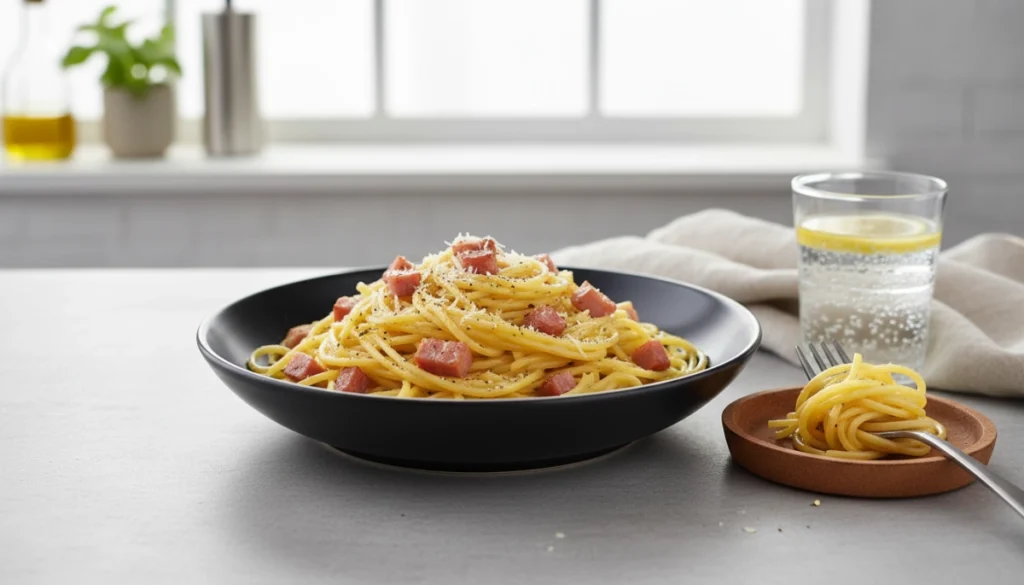
What Is Authentic Italian Pasta Carbonara The Traditional Roman Way?
If you’ve ever stared at a plate of “carbonara” swimming in cream and peas wondering, “Is this actually Italian?”—you’re in the right place. Authentic Italian pasta carbonara the traditional Roman way is a totally different dish from what most American restaurants serve.
What “authentic” carbonara really means
When Italians talk about authentic Roman carbonara, they’re talking about:
- A traditional spaghetti carbonara recipe born in Rome (Lazio), not an Americanized version
- A no cream carbonara recipe—zero cream, milk, butter, flour, garlic, or onion
- A super simple combo of:
- Guanciale (Italian cured pork jowl)
- Pecorino Romano DOP
- Eggs (usually mostly yolks)
- Freshly ground black pepper
- Starchy pasta cooking water
That’s it. No extras. No “chef twists.” Just a real Italian carbonara recipe with minimal ingredients and big flavor.
Why traditional Roman carbonara matters
If you love Italian food, learning how to make carbonara authentic is a game changer because:
- You taste what Romans actually eat at home and in trattorias
- You see how simple ingredients Italian pasta can become creamy and rich without cream
- You understand the connection between carbonara and other classic Roman pasta dishes like cacio e pepe and amatriciana
It’s one of those authentic Italian pasta dishes that shows you how Italian cooking is really about technique, not fancy ingredients.
Italian carbonara vs American-style carbonara
Most American-style versions are basically a cream sauce with bacon. Spaghetti alla carbonara original is different in just about every way:
| Authentic Roman Carbonara | American-Style “Carbonara” |
|---|---|
| No cream, milk, or flour | Heavy cream, milk, or roux |
| Guanciale for deep pork flavor | Bacon or random cooked bacon bits |
| Pecorino Romano DOP | Often Parmesan only |
| Egg yolks + pasta water create the sauce | Cream + eggs (sometimes) |
| Silky, glossy, egg-based sauce | Thick, heavy, alfredo-like sauce |
| No garlic, onion, peas, mushrooms | Often loaded with all of the above |
If you’ve only had the American version, you haven’t really had Roman carbonara yet. Once you master the original Roman carbonara method—no cream, no bacon, no extras—you’ll understand why Italians are so strict about it.
Key Rules of Authentic Italian Pasta Carbonara The Traditional Roman Way
No Cream, Garlic, Onion, or Parsley
If you’re making authentic Italian pasta carbonara the traditional Roman way, there are hard rules:
- No cream
- No garlic
- No onion
- No parsley
- No milk, flour, or butter for the sauce
Romans cut all of that out because real spaghetti alla carbonara original style gets its “creaminess” from eggs, cheese, fat, and starchy pasta water, not dairy or add‑ons. Cream and garlic make it taste like Alfredo or Americanized pasta, not a classic Roman pasta dish.
Core Ingredients That Are Non‑Negotiable
For authentic Roman carbonara no cream, these four are non‑negotiable:
- Guanciale – cured pork jowl; deeper, richer, and more savory than bacon
- Pecorino Romano DOP – sharp, salty sheep’s milk cheese made for Roman pastas
- Eggs (mostly yolks) – the base of that creamy carbonara eggs only texture
- Freshly ground black pepper – a lot of it; it’s basically the “spice” of the dish
In the US, you can swap guanciale with pancetta in a pinch, but if you want real Italian carbonara, guanciale and Pecorino Romano carbonara are what lock in that true Roman flavor.
Minimal Ingredients, Huge Flavor
The power of traditional spaghetti carbonara recipe is how little it uses:
- Just pasta, guanciale, Pecorino, eggs, black pepper, and pasta water
- No extras, no veggies, no “chef twists”
Because you’re not hiding anything under cream or sauces, every detail matters:
- Good al dente spaghetti
- High‑quality Italian cured pork jowl for pasta
- Real DOP Pecorino Romano, not pre‑shredded blend
That’s how you get a silky carbonara sauce technique that tastes big, bold, and truly Roman, while staying simple enough to cook at home on a weeknight in the States.
Traditional Roman Carbonara Ingredients (Serves 4)
When I make authentic Italian pasta carbonara the traditional Roman way, I keep the ingredient list brutally simple. That’s the point: few ingredients, big flavor.
Best Pasta For Authentic Italian Pasta Carbonara (Why Spaghetti Wins)
For a traditional spaghetti carbonara recipe, I reach for:
- Spaghetti – classic for spaghetti alla carbonara original
- The thin, round shape coats evenly with the eggy, silky sauce
- Easy to twirl and gets that perfect sauce-to-pasta ratio
You can swap in rigatoni or bucatini, but if you want authentic Roman carbonara no cream, spaghetti wins.
For 4 people:
- 12 oz (340 g) spaghetti
Guanciale For Carbonara (And What To Use If You Can’t Find It)
Real Roman carbonara is all about guanciale (cured pork jowl):
- Deep, porky flavor
- Renders plenty of flavorful fat for the sauce
- Gives those crispy, chewy bites you expect in guanciale carbonara
For 4 people:
- 4–5 oz (115–140 g) guanciale, cut into small batons or cubes
If you can’t find guanciale in the U.S.:
- #1 choice – Pancetta (unsmoked, not flavored)
- Last resort – Thick-cut bacon, but:
- Go for low-sugar, lightly smoked so it doesn’t taste like breakfast
- Understand it’s no longer carbonara without cream or bacon in the strict Roman sense
Pecorino Romano DOP (Why It Beats Parmesan Here)
For Pecorino Romano carbonara, I always use:
- Pecorino Romano DOP – sharp, salty, tangy sheep’s milk cheese
- Cuts through the richness of eggs and guanciale
- Melts into a thick, creamy paste with egg yolks
For 4 people:
- 3 oz (85 g) Pecorino Romano, very finely grated
Can you use Parmesan? Sure, but:
- You lose that true Lazio pasta recipes flavor profile
- It’s milder, less salty, and less “Roman”
- If you must, do 2 parts Pecorino, 1 part Parmesan as a compromise
Egg Yolks vs Whole Eggs In Traditional Roman Carbonara
Classic Roman carbonara technique leans rich:
- Egg yolks only = thicker, creamier, more velvety
- Whole eggs = lighter, slightly looser sauce
For a creamy carbonara eggs only feel that still works for weeknight cooking in the U.S., I like:
- 3 whole eggs + 2 extra yolks (room temperature)
That ratio gives:
- Enough yolk richness
- A bit more forgiveness so you don’t scramble the eggs
Black Pepper, Salt, And Pasta Water: The “Secret Weapons”
To get silky carbonara sauce without cream, these are non-negotiable:
-
Freshly ground black pepper
- Use a lot; carbonara should be peppery
- Grind it medium-fine so it blooms in the hot fat and sauce
-
Salt
- Light on salt in the water: guanciale + Pecorino are already salty
- I salt pasta water slightly less than usual, then adjust at the end
-
Pasta cooking water (starchy water = liquid gold)
- Helps emulsify guanciale fat + eggs + cheese
- Gives that glossy, creamy look in a no cream carbonara recipe
For 4 people, plan on:
- 2–3 tsp freshly ground black pepper (to taste)
- Kosher salt for pasta water (a bit less than your usual handful)
- About 1–1½ cups reserved pasta water, added gradually as you mix
With just spaghetti, guanciale, Pecorino Romano, eggs, black pepper, salt, and pasta water, you’ve got everything you need to make real Italian carbonara recipe at home—no cream, no garlic, no extras.
How To Make Authentic Italian Pasta Carbonara The Traditional Roman Way
Prepping guanciale, cheese, eggs, and pepper
For authentic Italian pasta carbonara the traditional Roman way, the setup matters more than anything:
- Guanciale: Slice into short, thick strips or cubes. You want meaty bites, not tiny bits.
- Pecorino Romano DOP: Grate it very fine so it melts smoothly into the sauce.
- Eggs: Use room‑temperature eggs (usually 2 whole eggs + 2–3 yolks for 4 people).
- Black pepper: Grind it fresh and generously; this is a key flavor in real spaghetti alla carbonara.
I prep everything before the water even boils so I can move fast once the pasta is cooked.
Cooking pasta al dente
For a traditional spaghetti carbonara recipe, cook the pasta like this:
- Use spaghetti in plenty of well‑salted boiling water.
- Cook just to al dente (usually 1 minute less than the box says).
- Save at least 1–2 cups of starchy pasta cooking water before draining – it’s your secret weapon for a silky sauce.
Rendering guanciale low and slow
To get that true guanciale carbonara flavor:
- Start the guanciale in a cold pan, then turn heat to medium‑low.
- Let the fat render slowly until the guanciale is crispy at the edges but not burned.
- Turn off the heat and keep all the fat in the pan – this is your “liquid gold” for the sauce.
Mixing eggs and Pecorino into a paste
While the pasta and guanciale cook, make a thick carbonara paste:
- In a bowl, whisk together the eggs, Pecorino Romano, and a big pinch of black pepper.
- Aim for a thick, scoopable paste, not a thin liquid.
- If it feels too thick, you can loosen it later with a spoonful of hot pasta water.
This base gives you that creamy carbonara with eggs only, no cream.
Combining pasta, guanciale, and egg mixture off the heat
This is where you avoid scrambled eggs:
- Add the drained spaghetti to the pan with guanciale and fat.
- Toss over low heat for 20–30 seconds so the pasta absorbs some fat, then turn the heat off completely.
- Let the pan cool for about 30–60 seconds so it’s hot, not blazing.
- Add the egg–Pecorino paste and toss quickly and constantly.
Keeping the heat off is key to true Roman carbonara technique.
Using pasta cooking water for a silky carbonara sauce
To get that silky carbonara sauce without cream:
- Add hot pasta water a little at a time (tablespoon by tablespoon).
- Toss or stir constantly until the sauce turns glossy, smooth, and clings to the spaghetti.
- You’re looking for a texture like light custard, not soup and not gluey.
If it looks too thick, add more water. Too thin? Toss over very low heat while stirring.
Serving and plating authentic Roman carbonara
For real Italian carbonara:
- Serve immediately – this sauce waits for nobody.
- Twist the spaghetti into nests on warm plates.
- Top with:
- Extra grated Pecorino Romano
- More freshly ground black pepper
- A few crisp pieces of guanciale
Eat it hot, right away. That’s how authentic Roman carbonara no cream is meant to be enjoyed at home, even here in the U.S.
Carbonara Texture: Getting That Silky Sauce Without Cream
Avoid scrambled eggs in authentic Italian pasta carbonara
To keep your authentic Roman carbonara silky instead of scrambled:
- Kill the heat before adding eggs. Pan off the burner, no flame, no residual high heat.
- Use a large mixing bowl or cool pan. Toss the hot pasta and guanciale first, then add the egg–Pecorino paste.
- Move fast. Toss constantly for 30–60 seconds so the eggs gently thicken instead of sitting and cooking in one spot.
- Use room‑temperature eggs. They set more evenly and are less likely to shock and curdle.
You’re aiming for a glossy coating, not visible bits of cooked egg.
How hot the pasta should be for Roman carbonara
For traditional spaghetti alla carbonara:
- Pasta should be piping hot but not screaming.
- If you can hold your hand on the bottom of the warm pan for 2–3 seconds, it’s hot enough to thicken eggs but not scramble them.
- If the pan is still fiercely sizzling after draining the guanciale fat, cool it a bit before adding the pasta and egg mixture.
Think “just off boiling,” not “still frying.”
How much pasta water for a glossy, creamy carbonara
Your “cream” is starchy pasta cooking water:
- Start with 2–4 tablespoons of hot pasta water added to the egg–Pecorino paste to loosen it before tossing.
- Add more in small splashes as you toss the pasta—usually ¼–½ cup total for 4 servings, depending on how starchy your water is.
- Stop when every strand is coated in a shiny, flowing sauce that slowly drips off a fork, not clumps.
Always use well‑salted, very starchy water for the best emulsion.
Fixes for thick, runny, or clumpy carbonara
Use these quick saves when your no cream carbonara goes sideways:
Too thick / gluey
- Add 1–2 tablespoons of hot pasta water at a time.
- Toss vigorously until it loosens and turns glossy again.
Too runny / watery
- Keep tossing off heat for 30–60 seconds; the egg proteins will gently thicken.
- Add a bit more finely grated Pecorino Romano to tighten the sauce.
Clumpy / starting to scramble
- Immediately splash in cool (not hot) pasta water to drop the temperature.
- Toss fast to break up clumps and smooth it out.
- If it’s badly scrambled, turn it into a “carbonara-style” scramble and try again next time with lower heat and faster tossing.
Dialing in this texture is the real Roman carbonara technique—once you nail this, you won’t miss cream at all.
Pro Tips For Perfect Authentic Roman Carbonara Every Time
Timing your steps
To get authentic Italian pasta carbonara the traditional Roman way, timing is everything:
- Start the guanciale first on medium-low heat so it slowly renders and crisps.
- Drop the pasta into boiling salted water once the guanciale is halfway crisp.
- Whisk eggs and Pecorino Romano while the pasta cooks, so the egg mixture is ready and smooth.
- Aim to have pasta al dente, guanciale hot, and egg mixture ready all at the same time. That rhythm is how Italians keep the sauce silky.
Heat control to protect the eggs
If you want real Roman carbonara with no cream and no scrambled eggs:
- Kill the heat before you add the egg and cheese mixture. The pan should be hot, not blazing.
- Toss the pasta and guanciale in the warm pan for 20–30 seconds to cool slightly.
- Add the egg mixture off the heat, then stir fast and constantly.
- If it looks too thick, loosen it with a splash of hot pasta water, not more heat.
How fine to grate Pecorino Romano
Pecorino Romano DOP is non-negotiable in authentic Roman carbonara:
- Grate it very fine (like powder) using a microplane or fine grater.
- Fine cheese melts faster and blends smoothly into a creamy carbonara sauce.
- Coarse shreds tend to clump and give a grainy texture, which feels more “American-style” than classic Roman.
Salting pasta water carefully
Guanciale and Pecorino Romano bring a lot of salt already:
- Salt your pasta water lightly, about half of what you’d normally use.
- Taste a piece of guanciale and a small pinch of cheese before salting the water.
- It’s easier to add a bit more cheese or salt at the end than fix an overly salty carbonara.
Tasting and adjusting like a Roman
Authentic Roman carbonara is bold with black pepper and cheese, but still balanced:
- Use freshly ground black pepper—add some into the egg mix and more at the end.
- After tossing the pasta with the sauce, taste before serving:
- Needs more bite? Add a little extra Pecorino.
- Needs more warmth? Finish with a good shower of black pepper on top.
- Serve immediately while it’s glossy, hot, and creamy—this is how I’d plate it in any serious US kitchen that cares about real Roman carbonara.
Traditional Carbonara Variations That Are Still Authentic
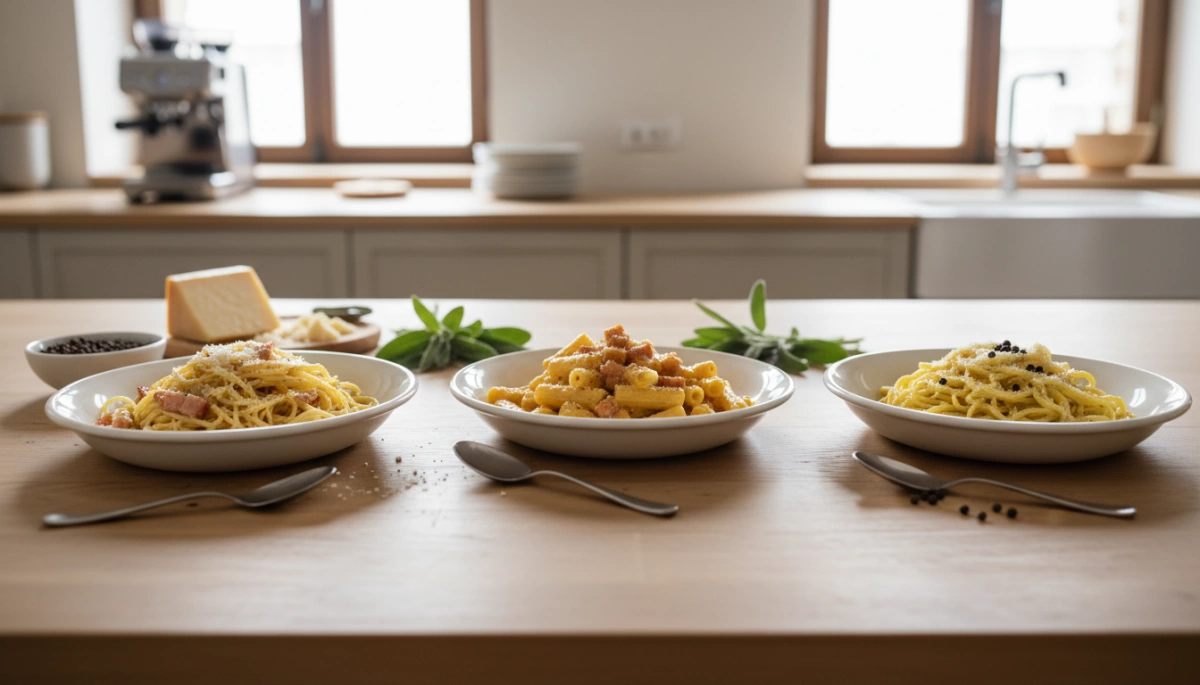
Authentic Italian Pasta Carbonara With Different Pasta Shapes
You don’t have to use spaghetti every time. In Rome, traditional spaghetti carbonara is common, but so are other shapes:
- Rigatoni alla carbonara – Great if you like bigger bites and sauce inside the tube.
- Bucatini carbonara – Similar to spaghetti but thicker and hollow, super Roman.
- Mezze rigatoni or tonnarelli – Also used in classic Roman pasta dishes.
Use what you can find easily in the U.S., but stay with dry durum wheat pasta and cook it al dente. That’s key to keeping it an authentic Roman carbonara no cream recipe.
Egg Ratios For Rich Or Lighter Carbonara
The “original Roman carbonara method” is flexible on egg ratios, as long as you stick to eggs + Pecorino Romano + guanciale + black pepper:
-
Richer, creamier carbonara (restaurant-style):
- About 1 whole egg + 3–4 yolks for 4 servings
- Super silky, great if you want that creamy carbonara eggs only vibe.
-
Lighter, more everyday carbonara:
- About 3 whole eggs + 1–2 extra yolks for 4 servings
- Still creamy, just a little less heavy.
Use room temperature eggs for carbonara so they blend smoothly and don’t seize when you toss them with the hot pasta.
Pancetta vs Bacon When You Can’t Find Guanciale
In the U.S., guanciale (cured pork jowl) isn’t always stocked at regular grocery stores. For authentic Italian pasta carbonara the traditional Roman way, guanciale wins every time, but here’s how to keep it close:
-
Best substitute: Pancetta
- Same idea: cured pork, not smoked, good fat content.
- Choose thick-cut pancetta, not pre-diced bits drowning in liquid.
-
Last resort: Bacon
- Use thick-cut, unsmoked or lightly smoked if you can.
- Go easy on added salt because bacon is already salty.
- Flavor won’t be 100% Roman, but your carbonara without cream or bacon strips can still taste great if you cook it right.
If I’m cooking for my own platform’s audience, I tell people:
Buy guanciale when you see it, slice and freeze it in small portions. Then you’re always ready for guanciale carbonara at home.
Simple Roman Sides And Wine Pairings For Carbonara Night
Authentic spaghetti alla carbonara original is rich, so I keep the rest of the meal light and very Italian:
Easy Roman-style sides:
- Simple green salad – Arugula or mixed greens with olive oil, lemon, and salt.
- Grilled or roasted veggies – Zucchini, broccoli rabe, or asparagus.
- Crusty bread – For the extra sauce on the plate (not to mix into the pasta).
Wine pairings that work in the U.S.:
-
Italian white wines:
- Frascati (from Lazio, super classic with Roman carbonara)
- Pinot Grigio or Vermentino
-
Light reds:
- Chianti, Montepulciano d’Abruzzo, or a lighter Sangiovese
Keep the wine fresh and not too heavy. The pasta is the star. Your whole setup still screams classic Roman pasta dishes even if you’re cooking in an American kitchen.
Science Behind Authentic Roman Carbonara Sauce
How fat, starch, and egg proteins make creamy carbonara without cream
In authentic Italian pasta carbonara the traditional Roman way, the “creaminess” is pure food science:
- Fat from guanciale and egg yolks coats every strand of pasta.
- Starch from the pasta cooking water thickens the mix and helps bind everything together.
- Egg proteins gently set and form a smooth, glossy sauce when warmed, not fried.
When all three come together, you get that silky carbonara sauce with zero cream, flour, or milk. This is the core of authentic Roman carbonara no cream.
Why pasta cooking water is essential
Starchy pasta water is the quiet hero of real Italian carbonara:
- The starch helps emulsify guanciale fat + egg + cheese into one smooth sauce.
- The hot water gently warms the eggs so they thicken instead of scrambling.
- A few small splashes at a time let you control the final texture—from thick and rich to slightly looser and glossy.
If you skip pasta water, you don’t get a true spaghetti alla carbonara original texture.
What happens if the temperature is off
Temperature control is everything in Roman carbonara technique:
- Too hot:
- Eggs cook too fast
- You get scrambled eggs and greasy fat instead of sauce
- Cheese clumps and the sauce breaks
- Too cool:
- Eggs don’t thicken
- Sauce stays thin, runny, and grainy
- Fat separates and doesn’t cling to the pasta
You want the pasta very hot, but the pan off the burner, so the eggs cook just enough to turn creamy.
Why Pecorino Romano and guanciale give the real flavor punch
For authentic Italian pasta carbonara the traditional Roman way, the flavor leans on two power ingredients:
-
Pecorino Romano DOP
- Sharper, saltier, and more intense than Parmesan
- Melts into the eggs to build that savory, tangy backbone classic to Lazio pasta recipes
- Its salt boosts flavor so you can go lighter on salting the water
-
Guanciale (cured pork jowl)
- Higher fat, deeper pork flavor than bacon or pancetta
- Renders out liquid gold fat that drives both taste and texture
- Crispy edges + soft centers give those signature bites in guanciale carbonara
Together, Pecorino Romano and guanciale are what separates authentic Roman carbonara from most American-style carbonara with cream and bacon.
Common Carbonara Myths And Mistakes To Avoid
No cream, milk, or flour in authentic Italian pasta carbonara
For authentic Italian pasta carbonara the traditional Roman way, cream, milk, and flour are automatic deal breakers.
Here’s why Romans skip them:
- Eggs + Pecorino Romano + guanciale fat already make a naturally creamy, silky sauce.
- Cream and milk dull the sharp Pecorino and guanciale flavor and turn it into generic “cream pasta.”
- Flour makes the sauce heavy, pasty, and gluey, not glossy.
If you want real Roman carbonara no cream, focus on:
- Proper egg ratio (mostly yolks)
- Enough starchy pasta water
- Gentle off-heat mixing for that creamy carbonara with eggs only
Skip garlic, onion, peas, and mushrooms
A traditional spaghetti carbonara recipe is minimal on purpose. When you throw in garlic, onion, peas, or mushrooms, you’re cooking a different dish.
What goes wrong:
- Garlic/onion: they overpower the guanciale and turn it into a basic American-style cream pasta vibe.
- Peas/mushrooms: add sweetness and extra moisture, so the sauce won’t cling as well and the flavor balance shifts.
In real Roman carbonara, flavor comes from:
- Guanciale (cured pork jowl)
- Pecorino Romano DOP
- Eggs and black pepper
That’s it. No extras.
Why pre-cooked bacon strips are a mistake
If you’re in the US, it’s tempting to grab pre-cooked bacon. For spaghetti alla carbonara original style, that’s a problem:
- Pre-cooked bacon is dry and smoky, but you need fat that renders out to create the sauce base.
- It doesn’t give you that “liquid gold” pork fat you emulsify with egg and cheese.
- Texture stays chewy or hard, instead of crispy outside, tender inside.
If you can’t get guanciale:
- Use slab pancetta first choice
- Use raw thick-cut bacon, cooked slowly, as a backup
- Always avoid microwaved or pre-cooked strips for real Italian carbonara vs American carbonara
How to fix broken or scrambled carbonara sauce
Sometimes the eggs scramble or the sauce splits. You can still save it. Here’s how I fix it at home:
If the eggs scrambled:
- Pull the pan off the heat immediately.
- Add a splash of hot pasta water and a little extra grated Pecorino Romano, whisk fast to smooth it out.
- If it’s still chunky, add a fresh yolk off the heat, stir quickly to re-emulsify.
If the sauce is too thick or clumpy:
- Add pasta water 1 tablespoon at a time, tossing constantly until silky.
- Keep the pan warm but not hot (you should be able to touch it briefly).
If the sauce is too runny:
- Toss the pasta over low heat for 20–30 seconds, stirring fast.
- Add a bit more Pecorino Romano and a touch of black pepper to tighten and boost flavor.
These small tweaks help you avoid scrambled eggs in carbonara and bring a “broken” sauce back to a smooth, glossy, silky carbonara sauce without ever touching cream.