
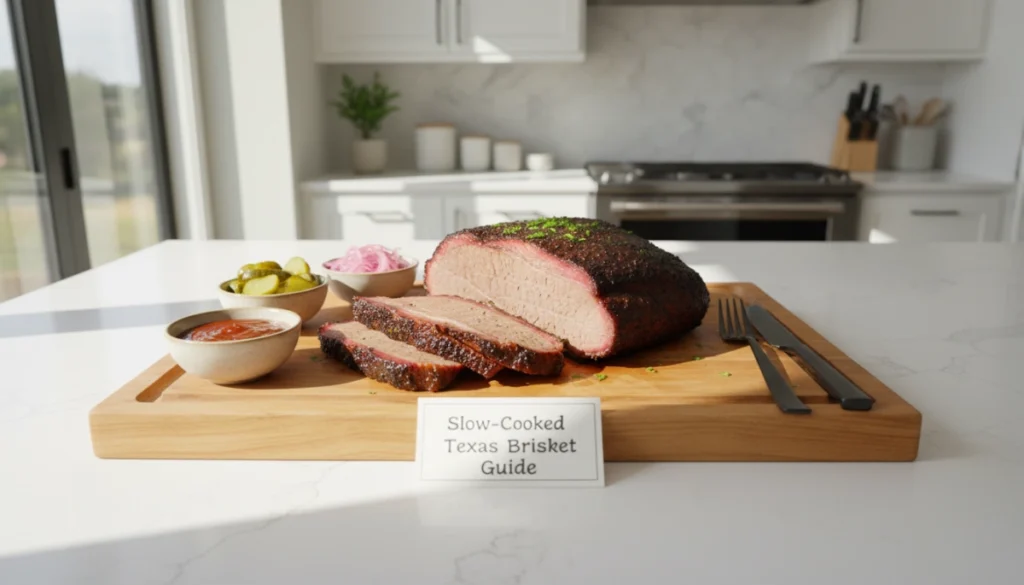
Understanding Texas-Style Brisket Basics
If you’re nervous about wasting a big hunk of meat, or you’ve had dry, tough brisket in the past, you’re not alone. Brisket is unforgiving if you guess your way through it. The good news: authentic Texas-style smoked brisket is built on simple rules. Once you understand the basics, you can repeat great results.
What Makes Texas Brisket Different
Texas brisket is all about beef, smoke, and time. No sugar-heavy rubs. No thick, sweet sauces hiding mistakes.
Texas-style smoked brisket stands out because:
- Simple seasoning, big flavor – Usually just salt and coarse black pepper (a classic Dalmatian rub 50/50).
- Heavy but clean smoke – Long exposure to post oak or similar hardwood for that deep Central Texas flavor.
- Whole packer brisket – You smoke the entire cut (point and flat together), not just a trimmed roast.
- No sauce required – The meat should be so tender and juicy that sauce is optional, not mandatory.
When people talk about authentic Central Texas brisket, this is what they mean: a full packer brisket, seasoned simply, smoked low and slow until it’s buttery and probe tender.
Packer Brisket: Point vs Flat Explained
A full packer brisket has two main muscles:
-
Flat (lean)
- Long, rectangular, and thinner.
- Slices make those classic “plank” pieces you see in photos.
- Can dry out easily if you don’t manage fat and doneness carefully.
-
Point (moist)
- Thicker, more marbled, with visible fat running through it.
- Rich, juicy, and ideal for burnt ends.
- More forgiving and stays moist even if you cook a bit longer.
Why this matters:
- The flat tells you if your cook is dialed in. If your flat is moist, you nailed it.
- The point gives you rich slices or chopped beef and is where a lot of your “wow” factor lives.
Fat, Marbling, and USDA Grade
Brisket is a tough working muscle. Fat and marbling are what transform it from shoe leather to silky slices.
Here’s how I think about it:
-
USDA Prime
- Most marbling.
- Best choice for slow-cooked Texas brisket if you want maximum tenderness and juiciness.
- Costs more, but more forgiving.
-
USDA Choice
- My go-to sweet spot for value and quality.
- Enough marbling for a great low and slow brisket smoking session.
-
USDA Select
- Leaner, less marbling.
- Can work, but you’ll need to be extra careful with trimming, wrapping, and resting.
Key points:
- More marbling = more internal moisture and flavor.
- You’re not just buying meat; you’re buying insurance against dryness.
What “Slow-Cooked” Really Means in Texas BBQ
When I say slow-cooked Texas brisket, I mean true low and slow smoking over wood or a smoker setup that mimics a wood pit.
In practice, that means:
- Brisket cooks for hours, not just “until it hits a number.”
- Smoke is thin and blue, not thick and white. Clean smoke is everything.
- Bark (the crust) develops slowly as the rub, fat, and smoke come together.
You’re not roasting. You’re smoking over indirect heat and letting time break down all that connective tissue until it’s tender enough that a probe slides in like warm butter.
Ideal Smoking Temperature and Time Expectations
For Texas BBQ brisket, there’s a practical temperature range that works across most smokers:
- 225–250°F – Classic low-and-slow zone
- Deeper smoke flavor
- Longer cook time
- 250–275°F – Hotter end of Texas-style
- Still authentic
- Shorter cook, a bit easier to manage on some pits
Here’s a simple guideline for a 10–15 lb full packer brisket:
| Smoker Temp (F) | Approx. Total Time | Notes |
|---|---|---|
| 225°F | 12–18 hours | More smoke, longer stall |
| 250°F | 10–16 hours | My usual target range |
| 275°F | 8–14 hours | Still “low and slow,” cooks faster |
Remember:
- Time is a guideline, not a promise.
- Brisket is done when it’s probe tender (usually around 195–205°F internal temp) and feels soft all over, especially in the flat.
If you go in expecting an all-day project, with plenty of rest time built in, you’ll be mentally ready for what real Texas brisket demands.
Choosing the Right Brisket for Slow-Cooked Texas Brisket
If I want authentic Texas style smoked brisket, I always start by choosing the right full packer. The meat you buy decides how easy the cook will be.
How to pick a full packer brisket
When I’m at the store or butcher, I look for:
- Full packer brisket (both point and flat attached)
- Flexible brisket: grab one end and bend it—more “flop” usually means more marbling and tenderness
- Even thickness: avoid super thin flats; thin ends dry out fast in low and slow brisket smoking
- White, creamy fat: skip briskets with dry, yellow, or crumbly fat
Prime vs Choice vs Select for Texas-style smoking
For slow cooked Texas brisket, grade matters:
- Prime brisket:
- More marbling, more forgiving
- Best for beginners and “can’t mess this up” cooks
- Choice brisket:
- Great balance of price and quality
- My default pick for authentic Central Texas brisket at home
- Select brisket:
- Lean, dries out fast
- Only use if you’re experienced or injecting/brining
Best weight: the 10–15 lb sweet spot
For home smokers in the U.S., I stick to:
- 10–15 lb full packer brisket (raw weight):
- Big enough for that real Texas BBQ brisket feel
- Small enough to cook evenly on a backyard offset smoker, pellet grill, kamado, or kettle
- Under 10 lb: often trimmed too hard or the flat is too thin
- Over 16 lb: harder to handle, longer cook times, more trimming
Flexibility, thickness, and fat cap by feel
I always do a quick “feel test”:
- Flexibility: more bend = more marbling = better slow cooked Texas brisket
- Flat thickness: aim for at least 1 inch thick at the thinnest end
- Fat cap: look for a solid cap you can trim down to about 1/4 inch
- Avoid big hard knots of fat on the surface—those won’t render well
Where to buy quality brisket in the U.S.
Here’s where I usually source Texas BBQ brisket:
- Local butcher:
- Best option for custom trimming, picking your exact packer brisket
- Costco / Sam’s Club / Restaurant Depot:
- Good prices on Prime vs Choice brisket in bulk
- Restaurant suppliers:
- Great if you’re cooking for parties or events, consistent cases of packers
- Online meat companies (Snake River Farms, etc.):
- Premium wagyu-style brisket for special cooks and holidays
Grass-fed vs grain-fed for smoked brisket
For low and slow brisket smoking:
- Grain-fed (most USDA Prime/Choice):
- More marbling, richer beef flavor, more forgiving on a long cook
- My pick for classic Texas style smoked brisket
- Grass-fed:
- Leaner, cleaner flavor, can taste “beefier” but not as rich
- Easier to dry out, needs tighter temp control and perfect trimming
If I’m cooking true authentic Central Texas brisket on an offset smoker, I want a flexible, well-marbled, 10–15 lb grain-fed Prime or high-end Choice full packer brisket every single time.
Prepping and Trimming Texas-Style Smoked Brisket
Getting a slow-cooked Texas brisket right starts with how you prep it. If you rush the trimming, you’ll fight dry slices, weak bark, and uneven cooking the whole way.
Essential Tools for Clean Brisket Trimming
I keep it simple and safe:
- Sharp 6–8\” boning or trimming knife (flexible, curved blade works best)
- Cut-resistant glove (at least on the hand holding the meat)
- Large, sturdy cutting board (with a groove if possible)
- Paper towels (for grip and drying the surface)
- Trash bowl or bin for fat and scraps
Sharp tools and a stable board matter more than anything. A dull knife is how people get hurt.
Step-by-Step Trimming for Beginners
Here’s a basic packer brisket trimming guide that works for most 10–15 lb briskets:
-
Pat dry and orient the brisket
- Lay the brisket on the board, fat side up.
- Find the point (thicker, more marbled) and flat (thinner, leaner).
-
Trim the fat cap
- Slice off any thick, hard fat until the cap is about ¼ inch across the top.
- Work in long, shallow strokes so you don’t gouge the meat.
-
Flip to the meat side
- Remove any silver skin and thin layers of hard fat.
- Stay as shallow as possible—silver skin off, red meat on.
-
Clean up the edges
- Square off thin, ragged edges of the flat that will burn or dry out.
- Round the corners slightly so heat and smoke flow evenly.
-
Shape for even cooking
- Aim for a smooth, aerodynamic shape—no thin flaps or big fat “knobs” sticking out.
- The goal is even thickness so low and slow brisket smoking stays consistent.
Removing Hard Fat and Silver Skin (Without Wasting Meat)
For authentic Central Texas brisket, you want enough fat to protect the meat, but not big hunks that never render:
-
Hard fat (especially in the thick seam between point and flat):
- Slide your knife along the fat, not into the meat.
- Take off the big, chalky chunks; leave softer, creamy fat that will render.
-
Silver skin on the meat side:
- Get the knife just under the edge, lift slightly, and shave it away in strips.
- If you see clean, red meat, stop cutting—you’ve done enough.
If you’re throwing away a lot of red meat, you’re cutting too deep. Trimming should look like white/yellow fat and thin membranes in the scrap pile, not steak.
Dialing In the Fat Cap to 1/4 Inch
For Texas style smoked brisket, the fat cap is your built-in insurance policy:
- Target thickness: about ¼ inch across the top
- Too thick: fat won’t fully render, and your bark will slide right off
- Too thin: the flat dries out, especially on hotter cookers or near the firebox
Run your fingers over the surface—if it feels mostly even, with no big mounds of fat, you’re in the right zone.
Shaping for Airflow and Even Cooking
A good trim sets you up for clean smoke and a killer bark:
- Smooth, rounded edges so smoke can flow around the brisket
- No thin, dangling pieces to burn or turn jerky-dry
- A slightly tapered, football-like shape on the flat helps it cook evenly
This helps the perfect brisket bark texture form without overcooking the thin end of the flat.
Common Trimming Mistakes to Avoid
These are the mistakes that ruin Texas BBQ brisket before it ever hits 225°F:
-
Leaving massive chunks of hard fat
- Result: greasy, rubbery fat and bark that won’t stick.
-
Over-trimming the flat
- Result: dry, crumbly slices that fall apart when you cut pencil-thick slices.
-
Scraping the meat smooth
- Overworking the surface can smear fat and rub, killing bark formation.
-
Ignoring the thin end of the flat
- If it’s super thin, trim it back a bit; otherwise it’ll burn before the rest is probe tender.
Dial in your trim once, and every slow cooked Texas brisket after that gets easier—and a lot more consistent.
Building the Classic Texas Brisket Rub
What a true Texas brisket rub is
For Texas style smoked brisket, the rub is stupid simple on purpose. I’m talking:
- No sugar
- No long spice list
- No heavy marinade
A true authentic Central Texas brisket rub is there to boost beef and smoke, not cover them up. That’s why most of us stick to the classic:
Dalmatian rub = 50/50 kosher salt + coarse black pepper
It gives you:
- Big beef flavor
- Clean smoke taste
- A legit Texas brisket bark texture
Dalmatian rub basics (50/50 salt and pepper)
For a full packer brisket (10–15 lb):
- Kosher salt (Morton or Diamond Crystal)
- 16 mesh coarse black pepper
Simple ratio:
- By volume: 1 part salt : 1 part pepper
- By weight (better): 55–60% salt, 40–45% pepper
Lightly coat the surface, don’t cake it on. You want to see meat through the rub, not a thick paste.
Best pepper grind size for great bark
Grind size matters a lot for perfect brisket bark:
- Too fine: pepper burns, harsh flavor, muddy bark
- Too big: pieces fall off, spotty bark
Aim for:
- 16-mesh black pepper (standard “restaurant grind”)
- Texture: a bit coarser than table pepper, finer than cracked pepper
That size helps build a crusty, bite-through bark when you’re smoking brisket at 225–275°F.
Optional add-ons (without losing Texas style)
If you want to tweak the rub but stay Texas-style, keep it light:
Good optional add-ons:
- Garlic powder – 1–2 tsp per cup of rub
- Onion powder – 1–2 tsp per cup
- Paprika – for color, not flavor, 1–2 tbsp per cup
- Very small amount of cayenne – if you want a little heat
Key rule:
- Salt + pepper still need to be the main thing.
- If your rub reads like a chili recipe, it’s not Texas brisket anymore.
Do you need binders (mustard, oil, etc.)?
Short answer: you usually don’t.
The brisket surface has enough moisture for rub to stick. But if you want to use a binder:
- Yellow mustard: Very thin layer; you won’t taste it once it’s smoked
- Neutral oil (canola, avocado): Works great, super light coat
- Worcestershire: Stronger flavor; use sparingly if you go this route
My take:
- On most low and slow brisket smoking cooks, I skip binders entirely.
- If your rub isn’t sticking in dry climates, a tiny bit of oil is a safe move.
When to season the brisket (and why timing matters)
For slow cooked Texas brisket, timing your rub matters:
- Best window: 1–12 hours before it hits the smoker
- Fridge, uncovered or lightly covered, after seasoning
Options:
- 1–2 hours before: Salt starts working, draws a little moisture, rub sets
- Overnight (8–12 hours): More “dry brine” effect, deeper seasoning
Avoid:
- Salting more than 24 hours ahead unless you’re very light-handed with salt
- Letting it sit wet and soupy – that hurts bark development
How to avoid over-salting or over-complicated rubs
Common mistakes that kill a Texas BBQ brisket recipe:
Over-salting:
- Don’t double-salt (injection + heavy rub) without adjusting
- Start with about 1/2–3/4 tbsp kosher salt per pound of raw brisket (total, not just in rub)
- Remember: you can’t pull salt back out
Over-complicating rubs:
- Too many spices = muddy flavor
- Sugar burns at low and slow temps and isn’t needed for bark
- Strong spices (cumin, chili powders, heavy herbs) push it away from Central Texas BBQ techniques
If you keep it mostly 50/50 salt and pepper, nail your clean blue smoke fire management, and control temps, you’re already 90% of the way to real Texas style smoked brisket.
Smoker Setup and Wood Choice for Slow-Cooked Texas Brisket
Getting the smoker and wood right is where Texas-style smoked brisket really happens. Here’s how I set things up for consistent, low and slow brisket smoking at home.
Best Smoker Types for Texas-Style Brisket
For authentic Central Texas brisket, any of these can work if you run them right:
- Offset smoker (stick burner)
- Best for classic Texas BBQ brisket flavor
- Strong smoke, great bark, full control over fire and airflow
- Pellet grill
- Easiest for beginners and busy folks
- Set-it-and-forget-it temp control, milder smoke flavor
- Kamado grill (Big Green Egg, etc.)
- Super fuel efficient, great for 225–275°F cooks
- Needs a careful setup for clean airflow and indirect heat
- Electric smoker
- Simple to use, good for small spaces
- Lighter smoke, but still solid for smoked brisket for beginners
If you’re chasing authentic Central Texas brisket, I lean offset first, then pellet or kamado.
Offset vs Pellet vs Kamado vs Electric
Offset smoker brisket method
- Firebox on the side, burning wood splits
- Great if you enjoy tending a fire and dialing in that clean blue smoke
Pellet grill Texas brisket
- Wood pellets auto-fed by an auger
- Very steady temps, just add a smoke tube or stronger wood blend for more smoke flavor
Kamado brisket setup
- Lump charcoal base + a few wood chunks
- Use heat deflectors/plates, keep vents barely open for 225–250°F
Electric smoker
- Electric heat + wood chips
- Easy, but don’t overload chips or you’ll get dirty white smoke
Clean Thin Blue Smoke vs Dirty White Smoke
Clean smoke is non-negotiable for Texas style smoked brisket:
- Aim for thin, almost invisible blue smoke
- Avoid thick, rolling, white or gray smoke (that’s bitter and acrid)
To get clean blue smoke:
- Preheat the smoker fully before adding meat
- Use seasoned, dry wood (no green or wet splits)
- Keep your exhaust vent fully open so smoke can flow, not choke
- Add wood in small, frequent splits, not big logs that smolder
Choosing Wood: Post Oak and Other Options
For authentic Central Texas brisket, the go-to is:
- Post oak wood for brisket
- Medium smoke, clean flavor
- Classic Texas BBQ taste, not harsh, great bark
If you can’t get post oak, I use:
- Hickory – stronger smoke, use a bit lighter hand
- Mesquite – bold and intense, mix with oak or fruit wood so it doesn’t get bitter
- Fruit woods (apple, cherry, peach) – sweeter, milder; great in blends for pellet grills or kamados
Good rule:
- Offset: mostly oak (post oak if possible)
- Pellet grill: oak or hickory pellets with some fruit wood
- Kamado: 3–5 chunks of oak plus 1–2 chunks fruit wood
Fire Management Basics: Splits, Airflow, Smoke Control
The key to low and slow Texas brisket is steady fire management:
- Wood split size
- Stick burner: wrist-sized splits for stable heat
- Don’t overload; add 1 split at a time as the coal bed drops
- Airflow
- Exhaust wide open
- Control temp mainly with the intake vent and fire size
- Smoke flavor control
- If smoke turns thick or white: open intake/exhaust and let the fire breathe
- If temps crash: add a small split and give it time to light cleanly
Dialing in Stable Temps: 225–275°F
For slow-cooked Texas brisket, I run:
- 225°F for more smoke time, softer bark
- 250–275°F for a faster cook and still classic results (a lot of Texas joints cook here)
How to hold that range:
- Use a good digital thermometer at grate level (don’t trust the dome only)
- Make small vent adjustments and wait 10–15 minutes to see the change
- In cold or windy weather, shield the smoker and preheat longer
- Pellet and electric: set 225–250°F and let the controller work, just keep pellets or chips loaded
Lock in clean blue smoke, post oak (or similar), and a steady 225–275°F, and you’ve already solved 80% of what makes slow cooked Texas brisket come out right.
Low-and-Slow Smoking Process for Texas Style Smoked Brisket
Positioning the Brisket on the Smoker
For slow cooked Texas brisket, placement matters more than people think:
-
Fat side up vs down
- Offset smoker (heat from the side/bottom): I run fat side down to shield the flat from direct heat and protect the lean.
- Pellet grill / electric / well-baffled pits: You can go fat side up or down, but I still prefer fat side down for safety.
-
Always think: fat between the meat and the heat. That’s how you keep that flat from drying out.
-
Point toward the firebox
- On an offset, I turn the point toward the firebox. The point has more fat and can handle the hotter side.
- On pellet/kamado, aim the thicker side toward wherever the pit naturally runs hotter.
Typical Low and Slow Brisket Timeline
For a 12–15 lb full packer at 225–275°F:
- Prep + preheat: 1–1.5 hours
- On the smoker (unwrapped): 4–6 hours to build bark and hit the stall (around 160–170°F)
- Wrapped phase: 3–6 hours until internal temp in the 195–205°F range and probe tender
- Rest: Minimum 1 hour, ideally 2–4 hours in a warm hold
- In total, you’re looking at 10–16 hours depending on size, grade, and pit temp. Low and slow brisket smoking is an all-day (or overnight) deal.
First 4–6 Hours: Building Bark and Smoke Flavor
Those early hours decide whether you get perfect brisket bark texture or regret:
- Watch for:
- Thin blue smoke, not billowing white or yellow. Clean smoke = clean flavor.
- Surface feel: tacky at first, then it slowly dries and darkens. You’re building that classic Texas bark.
- Color: You want a deep mahogany before you even think about wrapping.
- Don’t obsess over internal temp yet; focus on color, bark, and smoke quality.
Using Thermometers the Smart Way
You don’t want to keep popping the lid and dumping heat:
- Use a dual-probe digital thermometer:
- One probe in the flat (thickest part, about halfway in)
- One probe for grate temp next to the brisket
- Resist the urge to check every 10 minutes. At low and slow temps:
- Check your pit temp on the screen, not by opening the lid
- Open only when you really need to spritz, wrap, or adjust placement
Spritzing or Mopping Without Killing the Bark
Spritzing can help color and moisture, but it’s easy to overdo:
- When to start: After the rub has set and the surface isn’t sticky—usually 2–3 hours in.
- How often: Every 45–60 minutes at most, if you’re going to spritz.
- Good spritz options:
- 50/50 apple cider vinegar + water
- Beef broth + water
- Light mist only:
- Too much liquid = soft bark and longer cook time
- Skip heavy mops early in the cook; they wash off that simple Texas brisket rub.
Managing Vents and Fuel on a Long Cook
To keep that authentic Central Texas brisket vibe, fire management has to stay steady:
- Target pit temp: 225–275°F is the sweet spot for low and slow brisket smoking.
- Airflow basics:
- Keep your exhaust vent fully open on most smokers
- Use the intake vent and fuel size to control temp
- Adjusting for the long haul:
- If temps are dropping: add a small split or a handful of charcoal, let it catch clean before closing the door
- If temps are climbing: close the intake a bit, don’t choke it so much that you get thick, dirty smoke
- Think small, frequent adjustments instead of big swings. Clean blue smoke and stable heat are what make slow cooked Texas brisket stand out.
Understanding the Stall and Texas Crutch
What the brisket stall is (160–170°F)
When I smoke slow cooked Texas brisket “low and slow,” the internal temp usually climbs fast to about 150–170°F… then just stops. That’s the brisket stall.
- Fat is rendering
- Surface moisture is evaporating
- The meat sits stuck around 160–170°F for hours
It’s normal. On a Texas style smoked brisket, the stall can last 1–4+ hours.
Evaporative cooling: why it locks the temp
Think of it like sweat on your skin:
- The surface of the brisket is wet (fat + moisture)
- That moisture evaporates and cools the meat
- Your smoker stays at 225–275°F, but the brisket temp plateaus
Until the outside dries or you wrap, the brisket temp barely moves.
Your options in the stall
You’ve got three real choices for authentic Central Texas brisket:
| Option | What it Means | Pros | Cons |
|---|---|---|---|
| Ride it out | Do nothing, keep temp steady | Best bark, purest Texas style | Longest cook time |
| Wrap (Texas crutch) | Wrap in paper or foil at stall | Speeds up cook, keeps it moist | Bark softens some |
| Raise temp | Bump pit to 275–300°F | Pushes through stall faster | Slightly less “low and slow” feel |
I usually wrap or ride it out, depending on how tight my timeline is.
Butcher paper vs aluminum foil for Texas brisket
For true Central Texas BBQ techniques, I treat wrap choice like this:
| Wrap Type | Best For | Pros | Cons |
|---|---|---|---|
| Pink butcher paper | Authentic Texas crutch butcher paper wrap | Preserves bark, lets brisket breathe | Slightly longer cook vs foil |
| Aluminum foil | Maximum moisture + speed | Fastest cook, super juicy flat | Bark soft, can go “pot roast” quick |
If you want classic Texas brisket bark texture, pick butcher paper.
When to wrap: bark over numbers
Instead of wrapping at a certain temp only, I go by bark look and feel:
- Internal temp: usually 160–175°F
- Bark: dark mahogany, not patchy, no rub wiping off easily
- Touch: bark feels set, not mushy or wet
If the brisket looks pale or the rub still smears on your finger, I wait.
How wrapping changes moisture, bark, and time
Wrapping any low and slow brisket smoking:
- Moisture
- Wrap traps steam and rendered fat → juicier flat
- Bark texture
- Paper: bark softens a bit, still has bite
- Foil: bark can soften a lot, edges can get pot-roast soft
- Cook time
- Usually shaves 1–3 hours off the total cook
For offset smoker brisket method or pellet grill Texas brisket, wrapping is a key tool when you’re cooking for a crowd and can’t risk a 16–18 hour marathon.
Avoiding pot-roast texture and soggy bark
If I want authentic Central Texas brisket and not pot roast, I do this:
- Prefer butcher paper over foil for the Texas crutch
- Don’t wrap too early (wait for solid bark and 160–170°F)
- Don’t drown the brisket in liquid inside the wrap
- Once it’s probe tender, vent the wrap for a few minutes before holding
- Rest in a cooler (faux Cambro) wrapped in paper and towels, not swimming in juices
Handled right, the Texas crutch helps me power through the stall, keep the brisket moist, and still deliver that perfect brisket bark texture everyone in the U.S. expects from a proper slow cooked Texas brisket.
Finishing Slow-Cooked Texas Brisket Just Right
Ideal Texas Brisket Internal Temp (195–205°F)
For authentic Texas style smoked brisket, I aim for an internal temp in the 195–205°F range, measured in the thickest part of the flat. That’s the sweet spot where low and slow brisket smoking turns tough collagen into buttery, tender bites without falling apart.
- Start checking around 195°F
- Most briskets finish best between 198–203°F
- Use a reliable digital probe thermometer, not the lid thermometer
Why Probe Tenderness Beats Chasing a Number
On a true slow cooked Texas brisket, the feel matters more than the number on the screen.
Think of it like this:
If a probe slides in with almost no resistance, like into warm butter or peanut butter, it’s ready — even if that’s 197°F or 207°F.
- If it still feels tight or springy → keep cooking
- If it feels mushy and the probe sinks in like jelly → likely overcooked
Always use both: temp as a guide, probe tenderness as the final decision.
Testing the Flat vs the Point
The flat and point cook differently, so I always test both:
-
Flat (lean side)
- Probe from the top, in the thickest center area
- This is your main doneness indicator
- Should feel smooth, not rubbery
-
Point (fatty side)
- More forgiving — it’ll usually feel tender earlier
- If the flat is perfect, the point will still be good for slicing or burnt ends
If the point is soft but the flat is still tight, keep cooking. Judge by the flat.
Avoiding Undercooked or Mushy Overcooked Brisket
To hit that perfect Central Texas brisket texture, watch for these signs:
Undercooked (too tight):
- Slices snap or break when bent
- Chewy, roast-like texture
- Fix next time:
- Let it go longer in the 195–205°F range
- Give yourself more time; don’t rush the cook
Overcooked (mushy):
- Slices fall apart when you pick them up
- Looks shredded instead of clean pencil-thick slices
- Fix next time:
- Wrap a little later, once bark is fully set
- Don’t push way past 205°F unless the brisket is unusually tough
Adjusting for Different Smokers and Hot Spots
Every smoker in the U.S. backyard market runs a little different, so I treat brisket finish like this:
-
Offset smoker brisket method
- Watch the firebox side — it’ll finish earlier
- Rotate the brisket if one side is getting too soft too fast
-
Pellet grill Texas brisket
- Temps are more even, but the hot spot is usually back right or left
- Probe in a few spots around the flat to be sure
-
Kamado or kettle setups
- Indirect side can still have hot zones near the coals
- Keep the flat pointed away from the hottest area
If one part probes tender and another is still tight, let it roll a bit longer and re-check every 20–30 minutes.
When to Pull Brisket for Holding and Rest
I like to plan smoked brisket for beginners and pros the same way: finish early, rest long.
- Once the flat is probe tender in multiple spots and temp is around 198–203°F:
- Pull it from the smoker
- Keep it wrapped (butcher paper or foil)
- Rest in a warm, insulated cooler or holding box
For parties, holidays, and game days:
- I’m totally fine pulling it 30–60 minutes earlier than serving time, as long as it’s already probe tender.
- A good rest of 1.5–3 hours makes the juices redistribute and the texture lock in.
If you nail this finishing phase — temp window, probe tenderness, and timing the pull for a proper hold — your slow cooked Texas brisket will slice clean, stay juicy, and eat like real Central Texas BBQ.
Resting and Holding Slow Cooked Texas Brisket
Why Resting Texas Brisket Matters
For real Texas style smoked brisket, resting is non‑negotiable. When you pull the meat off the pit:
- The juices are boiling and pushed toward the edges
- Slicing right away dumps those juices onto the cutting board
- A proper rest lets the juices redistribute and the fat tighten up
Result: juicier slices, better texture, cleaner cuts. Skipping the rest is the fastest way to ruin a perfect slow cooked Texas brisket.
How Long to Rest Brisket
For a full packer brisket:
- Minimum: 1 hour (only if you’re in a rush)
- Sweet spot: 2–4 hours
- Max (when held correctly): 6+ hours in a proper hold
What’s happening during the rest:
- Internal temp slowly drops from 200°F range to around 150–160°F
- Collagen finishes breaking down = tender, “probe tender” brisket
- Juices settle back into the meat instead of running out
Faux Cambro Holding Method
You don’t need restaurant gear to hold authentic Central Texas brisket. The faux Cambro trick works great at home:
- Pull brisket when it’s probe tender (usually 195–205°F)
- Keep it wrapped in butcher paper or foil
- Add a dry towel layer around the wrapped brisket
- Place it in a clean, room-temp cooler (no ice)
- Close the lid and don’t peek
This setup holds your low and slow brisket in the 150–170°F range for hours, perfect for parties and holidays.
Holding Brisket Hot for Parties & Catering
If I’m cooking Texas BBQ brisket for a crowd, I plan to finish early on purpose, then hold:
- 2–6 hours in a faux Cambro is ideal
- Keep it wrapped tight to protect moisture
- Don’t stack a bunch of other hot pans on top of it—let it breathe a bit inside the cooler
This gives you flexibility on serve time without drying out your Texas style smoked brisket.
Avoid Steaming the Bark
You worked hard for that perfect brisket bark texture; don’t steam it to death:
- Avoid adding wet towels inside the cooler—keep them dry
- Don’t rest in a turned-off oven with steam or water pans
- If the wrap is soaked with rendered fat, don’t re-wrap in fresh foil too tight
If the bark softens a bit during holding, you can:
- Vent the brisket on the counter for 5–10 minutes before slicing
- Avoid reheating in a covered pan with liquid—that’s how you get pot roast, not Texas brisket
When to Slice vs When to Hold
Use this simple rule:
- Serving within 30–60 minutes:
- Rest on the counter, wrapped, for at least 1 hour, then slice
- Serving in 2–6 hours:
- Rest 20–30 minutes on the counter
- Then move to the cooler for a long hold
- Slice right before serving
Always slice as late as possible. Once you slice, brisket dries out fast—even perfect slow cooked Texas brisket. Keeping it whole, wrapped, and warm is the key to juicy, tender slices when it hits the table.
Slicing and Serving Texas Brisket
Separate the point and flat cleanly
Once your slow cooked Texas brisket is fully rested and unwrapped:
- Lay the packer brisket on a large cutting board, bark side up.
- You’ll see a thick line of fat running between the point and flat.
- Slice along that fat seam to separate the point and flat brisket cleanly.
- Trim excess soft fat so slices eat clean but still stay juicy.
This makes it easier to serve moist vs lean slices and keeps your slices looking like true Texas style smoked brisket.
Find and follow the grain
For authentic Central Texas brisket slicing:
- Start with the flat (the lean side). Look for the muscle fibers (grain) running in one direction.
- Turn the flat so you can cut across the grain, not with it.
- After you slice most of the flat, switch to the point. The grain changes direction there.
- Rotate the point about 90° and again slice across the grain.
Cutting against the grain is what gives you tender, bendy slices instead of chewy strips.
Slice thickness: pencil-width brisket slices
For that classic Texas BBQ brisket feel:
- Aim for pencil-thick slices (about 1/4 inch).
- Thicker slices can feel heavy and tight.
- Paper-thin slices fall apart and dry out fast.
Each slice of Texas style smoked brisket should bend over your finger and just start to crack, not crumble.
Crumbling or shredding slices: what it means
How your slices behave tells you a lot:
- Crumbling, dry slices
- Usually overcooked or sliced with the grain
- Or the flat was too lean / trimmed too hard
- Shredding, stringy slices
- Often under-rendered fat and tight connective tissue
- Or you carved the grain in the wrong direction
If slices fall apart when you pick them up, serve them as chopped beef sandwiches instead of fighting it.
Plating Texas-style on butcher paper
For a true Texas brisket experience at home:
- Use unwaxed butcher paper as your serving “plate.”
- Lay down a line of brisket slices: lean flat on one side, moist point on the other.
- Add classic sides and fixings:
- Pickles
- Raw white onion slices
- Plain white bread or Texas toast
- Keep sauce off the meat; serve any sauce on the side if you must.
This keeps your Texas BBQ brisket recipe simple, clean, and Central Texas authentic.
Serving moist vs lean slices
Let people choose their brisket like they would at a Texas joint:
- Lean = slices from the flat (less fat, cleaner bite)
- Moist = slices from the point (more marbling, richer flavor)
I like to:
- Ask, “You want lean, moist, or mix?”
- Start with 2–3 slices per person and adjust.
This small step makes your slow cooked Texas brisket feel like real-deal restaurant service.
Storing leftovers and reheating without drying out
Handle leftover smoked brisket right and it’s just as good the next day:
For storage:
- Slice only what you plan to eat right away.
- Keep the rest of the brisket in larger chunks; it holds moisture better.
- Wrap in butcher paper or foil, then seal in a zip bag.
- Store in the fridge 3–4 days, or freeze for longer.
For reheating:
- Add a splash of beef broth or reserved brisket drippings to the wrapped meat.
- Reheat covered in the oven at 250–275°F until warm (usually 20–40 minutes depending on size).
- Or reheat slices gently in a covered skillet with a bit of liquid.
Done right, leftover Texas style smoked brisket stays juicy, tender, and ready for sandwiches, tacos, or another full plate.
Fixing Common Brisket Problems
Dry Texas-Style Smoked Brisket
If your slow cooked Texas brisket turned out dry, it usually comes down to one of these:
-
Pulled too late:
- You cooked past probe-tender (usually 195–205°F) and dried out the flat.
- Fix next time: Start probing at 195°F. When a probe slides in with little resistance in the flat, you’re done—don’t chase a specific number.
-
Skipped or rushed the rest:
- Slicing right away dumps juices on the cutting board instead of in the meat.
- Fix next time: Rest wrapped brisket in a dry cooler (faux Cambro) for 1–3 hours.
-
Lean, low-grade brisket:
- Select grade or very lean, grass‑fed brisket will dry out faster.
- Fix next time: Choose USDA Prime or high-end Choice full packer brisket with good marbling.
-
Too hot, too long:
- Running well over 275°F the whole time can squeeze moisture out.
- Fix next time: Target 225–275°F steady low and slow brisket smoking.
Quick save for dry brisket:
- Slice pencil-thick, serve with a light Texas-style mop or thin finishing sauce on the side, and keep slices covered in a warm pan.
Soft, Weak Brisket Bark
If your bark never firms up on your Texas BBQ brisket, here’s what likely happened:
-
Wrapped too early:
- Wrapping at 140–150°F or before bark sets turns crust to mush.
- Fix next time: Wrap in butcher paper only when bark is dark, set, and doesn’t wipe off—typically around 165°F.
-
Too much spritzing or mopping:
- Constant spritz keeps the surface wet and stops bark from forming.
- Fix next time: Hold off spritzing for the first 3–4 hours. After that, spritz every 60–90 minutes max, light mist only.
-
Rub too fine or too thick:
- Powdery rub or heavy layers can mud up the bark.
- Fix next time: Use coarse black pepper and kosher salt Dalmatian rub, applied in an even, single layer.
Quick save for soft bark:
- After unwrapping, put the brisket back on the smoker for 20–45 minutes to firm the crust, or run it in a 275–300°F oven, unwrapped, to tighten the bark.
Bitter, Acrid Smoke Flavor
Bitter, harsh smoke means something’s off with your fire management:
-
Dirty white smoke, not clean blue smoke:
- Smoldering wood and restricted airflow cause acrid flavor.
- Fix next time:
- Keep vents more open for clean airflow.
- Burn seasoned wood splits, not green or wet wood.
- Avoid overloading the firebox.
-
Too much strong wood:
- Heavy mesquite or hickory can overpower Central Texas brisket.
- Fix next time: Use post oak as the base, and mix in stronger woods in small amounts only.
Quick save for bitter brisket:
- Trim off outer bark if it’s very bitter and slice deeper into the meat. A light finishing sauce or au jus can help balance the flavor.
Uneven Cooking Between Point and Flat
The point and flat cook differently on any authentic Central Texas brisket:
-
Flat done, point still tight:
- Flat is lean and finishes faster.
- Fix next time:
- Position the thicker point toward the firebox/heat source.
- Use a foil “shield” under the thinner end of the flat if it’s cooking too fast.
-
Point done, flat still tough:
- Heat focusing on the point or hot spots in your smoker.
- Fix next time: Rotate the brisket during the cook if your smoker has uneven zones.
Quick save for uneven brisket:
- If the flat is done but the point isn’t, separate them:
- Rest and slice the flat.
- Put the point back on for burnt ends or extra time on the smoker.
Overshooting Temp or Finishing Way Too Early
It happens—especially on pellet grills or offset smokers:
-
Overshoot (brisket too hot):
- If you hit 210°F+ and it feels mushy:
- Quick save: Chill it down slightly on the counter, wrap tight, then rest in a cooler. Slice a bit thicker to help the texture.
- If you hit 210°F+ and it feels mushy:
-
Finishing hours early:
- Quick save: Wrap tightly in butcher paper or foil, then into a 150–170°F oven or a prepped cooler with towels. You can safely hold brisket hot for 3–4 hours and still have amazing results.
Weather Adjustments: Wind, Cold, Rain
Texas style smoked brisket doesn’t stop for weather, but you need to adjust:
-
Windy days:
- Wind strips heat and makes temps swing.
- Fix: Turn the smoker so wind hits the back, not the firebox opening. Use a windbreak (fence, wall, folding table).
-
Cold weather:
- Your smoker works harder, burning more fuel.
- Fix: Start earlier, stock extra wood or pellets, and accept a slightly higher cook temp (250–275°F) to keep things stable.
-
Rainy cooks:
- Rain cools the cooker and can choke airflow.
- Fix: Keep the smoker covered but vented (carport, canopy, garage door cracked). Never block exhaust vents.
Quick Saves for Overcooked or Undercooked Brisket
Slightly overcooked brisket (crumbly slices):
- Slice a bit thicker than pencil-width.
- Keep slices in a covered pan with a bit of warm beef broth or rendered fat.
- Serve immediately, don’t let it sit exposed.
Slightly undercooked brisket (tight, tough slices):
- If you’ve already sliced:
- Put slices in a pan with a splash of beef broth, cover tightly with foil, and finish in a 250°F oven until more tender.
- If it’s still whole:
- Wrap (or keep wrapped), put back on the smoker at 250–275°F, and cook until probe tender in the flat.
Dialing in these fixes will tighten up your slow cooked Texas brisket game fast, whether you’re on an offset smoker, pellet grill, kamado, or a budget setup in the backyard.
Advanced Texas Brisket Techniques
When you’ve got slow cooked Texas brisket basics down, these advanced moves help you cook like a Central Texas pitmaster at home.
Burnt Ends From the Point (Step by Step)
The point is where the magic burnt ends live. Here’s a simple Texas-style approach:
- Cook the full packer brisket low and slow (225–275°F) until it’s probe tender.
- Separate the point from the flat after the rest. Follow the fat seam; it basically guides the knife.
- Cube the point into 1–1.5 inch chunks.
- Lightly re-season with your Texas brisket rub (mostly 50/50 salt and pepper).
- Pan them up in a single layer (foil pan works fine).
- Back on the smoker at 250–275°F for 45–90 minutes until:
- Edges are dark and caramelized
- Fat is rendered and the cubes are soft and sticky
- Optional: Toss with a light, thin sauce or mop for a Kansas City-style twist, or keep them “dry” for a more authentic Texas feel.
When To Inject Brisket (And What To Use)
For true Texas style smoked brisket, injection is optional. I only inject when:
- I’m cooking Select or leaner brisket
- I’m doing big events and need extra consistency
- I’m cooking in very dry or windy conditions
Simple injection ideas that keep it Texas:
- Beef stock + salt + a touch of Worcestershire
- Low-sodium beef broth + melted beef tallow
- Competition style: beef broth + phosphate blend (if you’re chasing trophies, not tradition)
Basic rules:
- Inject before seasoning, 1–2 hours before the cook
- Hit the flat in a grid pattern, small amounts per shot
- Don’t overdo it or the texture turns spongy
Simple Brine Or Marinade (Stay Texas Authentic)
Texas brisket doesn’t need a heavy marinade, but a light boost can help:
Dry brine (my go-to)
- Salt brisket 12–24 hours before the cook
- Keep it in the fridge, uncovered or loosely covered
- Add pepper right before it hits the smoker
Light marinade (keep it clean)
- Thin beef stock
- A splash of Worcestershire
- Small amount of salt (don’t double-salt if you’re still rubbing later)
Avoid:
- Sweet, sticky marinades
- Heavy acids (vinegar, citrus) soaking overnight
They pull you away from authentic Central Texas brisket and can mess with texture.
Pellet Grill Texas Brisket Tips
Pellet grills make low and slow brisket smoking easy, but you need to chase more smoke and better bark:
- Run lower early: 200–225°F for the first 3–4 hours to build smoke flavor
- Use stronger pellets: hickory, oak, or post oak blends
- Keep the brisket cold when it first goes on to attract more smoke
- Don’t over-spritz; too much moisture weakens bark
- Use a smoke tube or extra wood tube if you want a stronger smoke profile
- Wrap in butcher paper, not foil, for better bark texture
Adapting Texas Brisket To Kettle Grills And Kamados
You can still hit authentic Texas style brisket on a Weber kettle or kamado with the right setup.
Kettle grill (Weber-style):
- Use charcoal on one side, brisket on the other (2-zone setup)
- Add wood chunks (post oak, hickory) to the coal side
- Keep temps 225–275°F with vent control
- Use a water pan under the brisket to buffer heat and stabilize temps
Kamado (Big Green Egg, Kamado Joe):
- Use a heat deflector for indirect heat
- Lump charcoal + a few chunks of post oak or hickory
- Keep the top and bottom vents barely open to sit in the 225–275°F range
- Avoid big vent changes; kamados respond slowly but swing hard
Oven Finishing Without Pot Roast Texture
Sometimes you need to finish brisket in the oven. You can still keep it “Texas,” not pot roast:
- Move to the oven only after you’ve built good bark and color on the smoker
- Wrap in peach butcher paper instead of foil to preserve bark
- Set oven to 250–275°F, not low and wet like a braise
- Place it on a rack over a pan so it’s not sitting in rendered fat
- Pull when probe tender in the flat, then rest as usual
The smoker gives you the smoke ring and flavor; the oven just finishes the job.
Rub Variations While Staying Texas-Style
Classic Texas brisket rub = 50/50 kosher salt and coarse black pepper (Dalmatian rub). You can tweak it without losing authenticity:
Good add-ons (light hand):
- Garlic powder
- Onion powder
- A touch of paprika for color
- A small amount of cayenne if you want a mild kick
Tips to keep it Texas:
- Keep salt + pepper as the base
- Avoid heavy sugar rubs; they’re more backyard BBQ than Central Texas
- Keep the rub coarse, not powdered, for better bark
Use these advanced moves to dial in slow cooked Texas brisket on whatever setup you’ve got—offset, pellet grill, kettle, kamado, or a smoker-plus-oven combo.
Brisket sides, sauces, and pairings
Classic Texas BBQ sides for slow-cooked Texas brisket
When I serve Texas style smoked brisket, I keep the sides simple and old-school. They should support the meat, not compete with it:
- Coleslaw – Crunch cuts through the fat.
- Pinto beans or BBQ beans – Adds body and keeps plates feeling hearty.
- Potato salad – Cold, creamy, and perfect with hot low and slow brisket.
- Cornbread or white bread – For mopping up rendered fat and juices.
- Pickles & onions – Classic Central Texas brisket balance: acid, bite, and freshness.
These sides work whether you’re doing a backyard cook, game day, or a big family gathering.
Simple brisket side recipes (quick and practical)
You don’t need chef-level skills to pull this off. Here’s how I keep it simple:
-
Coleslaw (no-fail version)
- Bagged shredded cabbage + carrots
- Mayo, apple cider vinegar, sugar, salt, pepper
- Toss, chill 30–60 minutes
-
Pinto/BBQ beans
- Canned pinto beans
- Onion, garlic, a little brisket fat or chopped brisket, BBQ rub, hot sauce
- Simmer low until thick
-
Potato salad
- Boiled potatoes, chopped pickles, celery, hard-boiled eggs (optional)
- Mayo + mustard + a little pickle juice, salt, pepper, paprika
-
Skillet cornbread
- Box mix or simple cornmeal batter
- Bake in a cast-iron skillet with bacon grease or butter for real Texas flavor
Texas no-sauce mindset (and when sauce helps)
Authentic Central Texas brisket is built on smoke, salt, and pepper. Sauce is not the star. But in the real world, I use it strategically:
-
Go no sauce when:
- Your bark is on point and the brisket is juicy
- You want that true Texas BBQ brisket experience
-
Sauce actually helps when:
- Slices ran a bit dry
- You’re serving newer BBQ eaters who expect sauce
- You’re reheating leftover smoked brisket
Keep the focus on the meat; treat sauce like a backup singer, not the headliner.
Light, thin finishing sauces and mop-style brisket sauce
For slow cooked Texas brisket, I lean toward light, thin sauces and mops, not thick, sticky glaze:
- Texas-style finishing sauce / mop basics:
- Base: beef broth or water + apple cider vinegar
- Flavor: Worcestershire, black pepper, a little ketchup or tomato paste, chili powder
- Texture: Thin, pourable, more like a tangy jus than a sticky BBQ sauce
How I use it:
- On the side in small cups for dipping pencil-thick brisket slices
- Light brush on chopped brisket or sandwiches
- Never drown the bark; just give it a boost
Drink pairings for Texas brisket (beer, bourbon, and more)
Smoked brisket is rich, so I pair it with drinks that either cut through the fat or stand up to the smoke:
-
Beer
- Light lager or pilsner – Easy drinkers for big parties
- IPA – Hops cut the richness
- Brown ale or porter – Deep flavor that matches post oak smoke
-
Bourbon & whiskey
- Neat or on a rock
- Look for bottles with caramel, vanilla, and oak notes to mirror the bark and smoke
-
Non-alcoholic
- Sweet tea (classic Southern move)
- Lemonade or Arnold Palmer
- Sparkling water with lime to reset your palate
Building a full Texas BBQ spread for game day or family events
When I build out a full Texas style smoked brisket spread for a crowd in the U.S., I keep it organized and repeatable:
Base plate:
- Sliced brisket (moist and lean options)
- White bread or cornbread
- Pickles, sliced onions, jalapeños
Key sides:
- Coleslaw
- Beans
- Potato salad
Optional add-ons:
- Sausage or ribs if you want to go big
- Mac and cheese for kids and picky eaters
Serving tips:
- Set up buffet-style on butcher paper for that Central Texas vibe
- Keep sauces, mop, and pickles on the side so people can customize
- Plan about 1/2 lb cooked brisket per adult (more for game day)
Done right, your slow cooked Texas brisket becomes the center of a full Texas BBQ spread that feels both authentic and easy to eat for any U.S. crowd.
Texas Brisket FAQ and Quick Answers
How long does it really take to smoke a full packer brisket?
For a full 12–15 lb Texas style smoked brisket:
- Plan on 1–1.5 hours per pound at 225–250°F
- Real world: 10–16 hours total, plus 1–3 hours rest
- I always tell people: start early and plan to finish early, then hold it hot in a cooler
Use time as a rough guide only. Doneness = probe tender, not the clock.
How to smoke brisket without a traditional smoker
You can still get slow cooked Texas brisket without a big offset smoker:
-
Gas grill:
- Set up 2-zone heat (one side on low, one side off)
- Put a foil packet of wood chips over the lit burner
- Brisket goes on the cool side, lid closed, vent over the meat
-
Charcoal kettle:
- Use a snake or minion method with briquettes
- Add wood chunks for smoke
- Vent half-open, target 250°F
-
Oven + smoke assist:
- Smoke for 3–4 hours on any grill with wood
- Then wrap and finish in the oven at 250°F
You won’t get pure Central Texas offset flavor, but you can get very close with good fire management.
Best woods for Texas brisket if you can’t find post oak
Post oak is the classic for authentic Central Texas brisket, but here’s what works when you can’t get it:
-
Top backups:
- White oak or red oak – closest to post oak
- Hickory – stronger, great in moderation
- Pecan – mild, slightly sweet, awesome blend wood
-
Good blends:
- Oak + a little hickory
- Oak + fruit wood (apple or cherry) for a softer profile
Skip mesquite unless you really know your fire—it gets bitter fast on long cooks.
How much brisket to buy per person
For Texas BBQ parties and game days, I use this simple rule:
- With bones / full packer:
- You’ll end up with about 50–60% edible meat after trimming and cooking
- Serving estimates (cooked):
- 1/2 lb per adult for normal gatherings
- 3/4 lb per adult for big eaters / all-you-can-eat style
- 1/3 lb per kid
Quick shortcut:
- 12–15 lb packer = roughly 10–15 people depending on appetite and sides
Can you cook brisket the day before and keep it juicy?
Yes—and for catering-style events, I often do:
- Cook to probe tender, rest on the counter 1 hour
- Chill whole (still wrapped) in the fridge once it’s down under 140°F
- Next day:
- Reheat wrapped at 250°F until internal hits 150–160°F
- Then unwrap, vent, and slice right before serving
If you’re not comfortable reheating a whole packer, you can chill it, slice it cold, and reheat slices in covered pans with a little beef broth.
Freezing, storing, and reheating leftover smoked brisket
To keep slow cooked Texas brisket from drying out:
-
Storing (short term):
- Fridge: up to 4 days
- Keep in tightly wrapped foil or vacuum-sealed, with a bit of jus or tallow
-
Freezing:
- Slice or chunk
- Vacuum seal or double wrap in plastic + foil
- Freeze up to 3 months for best texture
-
Reheating (best methods):
- Sous vide: 155–165°F until hot (best texture)
- Oven: Covered pan, 250°F, splash of broth or drippings
- Skillet: For chopped brisket tacos, sandwiches, or hash
Avoid microwaving unprotected slices—it dries them out fast.
Key temps, times, and ratios to remember
Here’s the quick Texas brisket cheat sheet:
-
Smoker temp:
- 225–250°F = classic low and slow
- 250–275°F = more backyard-friendly, still legit
-
Stall range:
- Around 160–170°F internal
-
Wrap temp (Texas crutch):
- Usually 165–175°F internal, once bark is set
-
Finished internal temp:
- 195–205°F, but the real test is probe tender
-
Rest time:
- Minimum 1 hour, ideal 2–4 hours in a cooler (faux Cambro)
-
Salt/pepper rub ratio (Dalmatian rub):
- About 50/50 kosher salt and coarse black pepper by volume
-
Meat per person (cooked):
- 1/2 lb brisket per adult is the safe number
Lock these in, and you’ll have a solid baseline for consistent, authentic Texas style smoked brisket at home.