
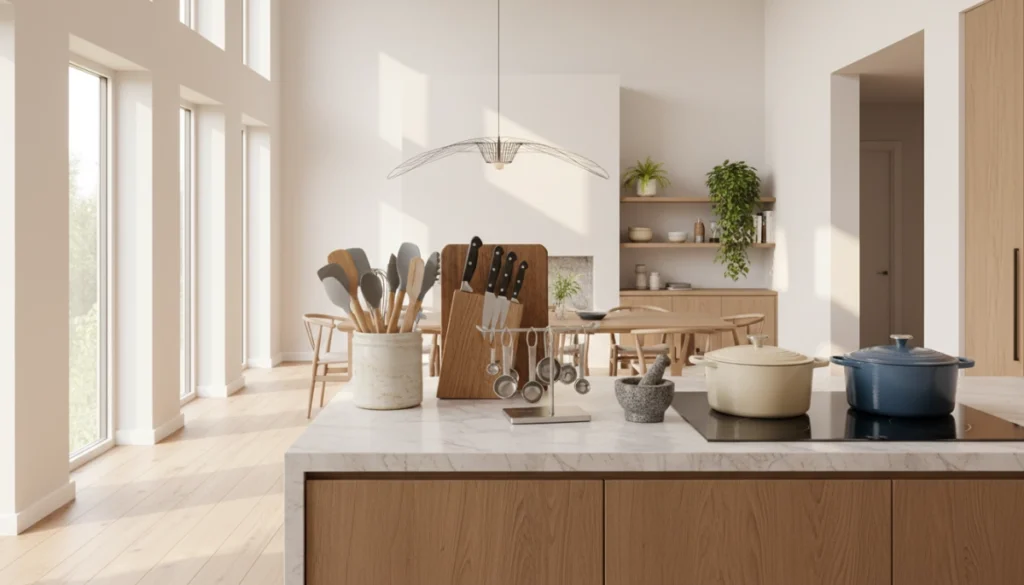
Core Principles for Choosing Essential Kitchen Tools
You don’t need a Pinterest-perfect kitchen to cook well—you need a small, smart set of essential kitchen tools every home cook should own. The goal is simple: tools that actually make cooking easier, faster, and more enjoyable.
Quality Over Quantity
Instead of a drawer full of flimsy gadgets, focus on fewer, better tools that you’ll reach for every day.
Look for:
- Solid construction (no wobbly handles, no seams that trap food)
- Comfortable grip you can hold for a while
- Trusted brands or well-reviewed small makers that stand behind their products
A tight, high-quality starter kitchen setup always beats a big, mismatched collection of cheap tools.
Multi-Use Tools That Earn Their Space
In a real home kitchen—especially in small apartments—every tool should work hard.
Prioritize multi-use kitchen tools, like:
- Chef’s knife that chops, slices, and minces almost everything
- Heavy skillet that sears, sautés, bakes, and roasts
- Sheet pan for roasting veggies, baking chicken, and one-pan dinners
- Silicone spatula that stirs, scrapes, and folds
If a tool only does one “cute” task, skip it. Your beginner kitchen essentials should be flexible, not fussy.
Material, Durability, and Safety
When I choose tools for my own line, I focus on three things: material, durability, safety.
Judge tools by:
- Material
- Stainless steel: strong, rust-resistant, great for everyday cooking tools
- Wood: gentle on pans and knives, but needs hand-washing
- Silicone: heat-safe, nonstick-friendly, easy to clean
- Durability
- Tight joints, no rattling parts
- Thick enough not to bend under pressure
- Rust-resistant metals and food-safe plastics
- Safety
- Non-toxic materials (BPA-free, food-grade silicone)
- Heat resistance clearly labeled
- Handles that stay cool and don’t get slippery
If a tool feels flimsy in your hand, it won’t last in your kitchen.
What to Splurge On vs. Save On
You don’t have to spend a fortune to build a functional kitchen checklist, but some tools are worth investing in.
Splurge on:
- Essential knives for home cooking (especially a chef’s knife)
- Core cookware you use daily (skillet, saucepan, Dutch oven)
- Digital kitchen scale if you bake or want consistent results
Save on:
- Measuring cups and spoons
- Basic mixing bowls and colanders
- Extra spatulas, tongs, and peelers
Pay more where precision, performance, and longevity really matter. Go budget-friendly on simple, low-stress items.
Common Mistakes When Buying Kitchen Gadgets
Most people don’t struggle because they lack tools—they struggle because they bought the wrong ones. Avoid these pitfalls:
- Buying trendy gadgets you’ll use twice and then forget
- Choosing big sets (knife blocks, cookware bundles) full of pieces you don’t need
- Ignoring comfort and ergonomics—if it hurts to hold, you won’t use it
- Overloading small kitchens instead of choosing space-saving kitchen tools
- Skipping research on materials, reviews, and safety
If a tool doesn’t clearly solve a real cooking problem you have, it’s probably not an essential.
When you stick to must-have kitchen tools that are high-quality, multi-purpose, durable, and safe, you build a basic kitchen setup for home cooks that actually works—for everyday cooking, not just for show.
Essential Knives Every Home Cook Needs
When I build out essential kitchen tools every home cook should own, I always start with knives. With just three knives, most home cooks in the US can handle 95% of daily cooking.
Chef’s Knife: Your Primary Everyday Knife
Your chef’s knife is the workhorse. If you’re buying one serious knife, this is it.
- Size:
- 8-inch: best all-around size for most home cooks
- 6-inch: better if you have small hands or a tiny kitchen
- Shape: Go for a classic Western chef’s knife with a gentle curve so you can easily rock-chop.
- Balance:
- Knife shouldn’t feel “handle heavy” or “blade heavy”
- When you pinch the blade where it meets the handle, it should feel stable and natural.
For beginner kitchen essentials, I usually recommend a mid-priced stainless steel chef’s knife—sharp, durable, and low maintenance.
Paring Knife for Small and Precise Prep
A paring knife is your go-to for small, detailed work:
- Peeling apples or potatoes
- Hulling strawberries
- Deveining shrimp
- Trimming spots or eyes off produce
Look for a 3–4 inch blade that feels like an extension of your hand. This is one of those must-have kitchen tools that doesn’t need to be expensive—just sharp and comfortable.
Serrated Bread Knife for Delicate Foods
A serrated bread knife is not just for bread. It’s clutch for:
- Crusty baguettes and sourdough
- Soft sandwich bread
- Tomatoes and stone fruits
- Cakes and delicate baked goods
Choose a 8–10 inch blade with sharp, well-defined teeth. This is a tool you can usually save on—even budget options work well and last a long time.
Basic Knife Care, Sharpening, and Safe Storage
Good knives are core to any functional kitchen checklist, but only if you take care of them:
- Cleaning:
- Hand wash with mild dish soap
- Dry immediately—never leave knives in the sink
- Avoid the dishwasher; heat and detergent ruin edges and handles
- Sharpening:
- Hone with a honing rod every 2–3 uses to keep the edge aligned
- Get a proper sharpening (stone, guided system, or pro sharpening) a few times a year, depending on use
- Storage:
- Use a knife block, magnetic strip, or in-drawer knife tray
- Never toss knives loose in a drawer—they dull faster and are unsafe
With a solid chef’s knife, a paring knife, and a serrated bread knife, you’ve covered the essential knives for home cooking. These three are the backbone of any basic kitchen setup for home cooks in the US.
Cutting Boards and Prep Surfaces: Essential Kitchen Tools Every Home Cook Should Own
Best cutting board materials for your knives
For a basic kitchen setup for home cooks, I always stick to knife-friendly surfaces:
- Wood (maple, walnut) – Gentle on blades, looks great on the counter, ideal for everyday prep.
- Bamboo – Harder and more affordable, good budget kitchen tool, but can dull knives a bit faster than softer wood.
- Plastic (HDPE) – Perfect for raw meat and fish; lightweight, cheap, and dishwasher-safe.
Skip glass, marble, and ceramic boards. They look nice but wreck your knife edge and are slippery and loud.
Ideal cutting board sizes for small and large kitchens
In most U.S. kitchens, these sizes cover almost everything:
- Small kitchens / apartments:
- 8×10\” or 9×12\” plastic board for quick snacks and small tasks
- 10×14\” main board that fits easily in the sink and dish rack
- Larger kitchens:
- 12×18\” or bigger wood board as your main prep surface
- One smaller board for breakfast, fruit, and quick slicing
Think about sink size and storage space before you buy. If it can’t stand upright in a cabinet or fit in your sink, you won’t use it.
Color-coding and separating boards for meat and produce
For food safety and easy routines at home, I always separate boards:
- One board for raw meat/poultry/seafood (often red or a clearly marked plastic board)
- One board for fruits, veggies, bread, and cooked foods (wood or a different color plastic)
Color-coded plastic sets are cheap, save time, and help avoid cross-contamination—especially helpful for busy families.
Non-slip and easy-clean features to look for
Must-have features for everyday cooking tools:
- Non-slip grips or rubber edges so the board doesn’t slide while you chop
- Juice groove on at least one board for cutting meat or juicy fruits
- Dishwasher-safe plastic boards for raw meat and quick cleanups
- Sealed or well-oiled wood so it doesn’t soak up water and warp
If a board moves around, add a damp paper towel or dish towel underneath—simple and effective.
Extra boards for quick snacks and small tasks
I always keep a few extra boards in rotation:
- Thin, lightweight plastic mats for garlic, onions, and strong-smelling ingredients
- Small board just for fruit, cheese, and bread so they don’t smell like chopped onions
- Designated “kids” or family snack board for after-school cutting and weekend grazing boards
These essential cutting boards and prep surfaces make everyday cooking smoother, safer, and easier to clean—exactly what most home cooks in the U.S. need from their must-have kitchen tools.
Core cookware every home cook will actually use
When I set up a basic kitchen setup for home cooks in the U.S., I stick to core cookware: a few must-have pots and pans that cover 95% of everyday cooking. You don’t need a giant set—just the right pieces.
Essential skillet or frying pan (stainless steel vs. cast iron)
You want one main skillet you reach for daily.
Stainless steel skillet (10–12 inches):
- Best for: searing steak, sautéing veggies, pan sauces, one-pan dinners
- Pros: durable, dishwasher-safe (most), no seasoning needed, great browning
- Choose: heavy-bottom, oven-safe handle, 10\” for small households, 12\” for families
Cast iron skillet (10–12 inches):
- Best for: steaks, cornbread, roasting chicken, high-heat searing, stove-to-oven
- Pros: crazy durable, holds heat, gets better with use, perfect for U.S.-style comfort food
- Needs: light maintenance—regular seasoning, hand-wash, dry right away
If you cook a lot of saucy dishes and weeknight meals, start with stainless steel. If you love roasting, searing, and rustic cooking, grab cast iron first. Many home cooks eventually keep one of each.
Choosing a versatile saucepan size
You really only need one go-to saucepan for everyday cooking:
- Best size: 2–3 quarts
- Use it for: boiling pasta for one or two, oatmeal, rice, boxed mac and cheese, heating soup, small-batch sauces
- Look for: lid included, comfortable handle, thick bottom, measuring marks inside if possible
A 2-quart works for singles and couples. A 3-quart is more versatile for families and meal prep.
Stockpot or Dutch oven for big-batch meals
For American-style soups, chilis, and meal prep, a larger pot is key:
Dutch oven (5–6 quarts):
- Best for: soups, stews, braises, no-knead bread, big pasta dishes
- Pros: oven-safe, great heat retention, looks good on the table
- Enameled versions are easier for everyday home cooks—no rust stress
Stockpot (8 quarts or so):
- Best for: large batches of stock, crab boils, big pasta nights
- Lighter than a Dutch oven but mostly for boiling, not braising
If you’re building a beginner kitchen essentials list, I’d pick a 5–6 qt Dutch oven first. It’s one of the most essential kitchen tools every home cook should own.
Sheet pans for roasting and one-pan dinners
A half-sheet pan is a must-have kitchen tool:
- Size to buy: standard half sheet (about 13\” x 18\”)
- Use it for: roasting veggies, sheet-pan dinners, baking bacon, cookies, frozen foods
- Look for: heavy-gauge aluminum, not flimsy, rimmed edges
Grab 2 half-sheet pans and maybe 1 quarter-sheet for quick snacks or reheating leftovers. These are core cookware pieces that punch way above their price.
When and why to use nonstick pans
Nonstick pans are great, but they’re not forever tools. I treat them as specialty cookware, not my main workhorse.
Use nonstick for:
- Eggs and omelets
- Pancakes and French toast
- Delicate fish
- Quick, low-to-medium heat sautés
Tips:
- Avoid high heat
- Use wood or silicone utensils
- Hand-wash to extend life
You don’t need a full nonstick set—one good 8\”–10\” nonstick skillet is plenty in a basic kitchen setup for home cooks.
How many pots and pans you really need
For a functional kitchen checklist that works in small apartments and typical U.S. homes, this is enough:
- 1 stainless steel or cast iron skillet (10–12\”)
- 1 nonstick skillet (8–10\”)
- 1 saucepan (2–3 qt)
- 1 Dutch oven (5–6 qt)
- 2 half-sheet pans + 1 quarter-sheet pan
That’s it. This basic cookware for home cooks will handle:
- Weeknight dinners
- Meal prep
- Simple baking
- Brunch and breakfast
Start with this compact, multi-use lineup, then add more only when your actual cooking habits demand it.
Everyday Cooking Utensils and Hand Tools
When I talk about essential kitchen tools every home cook should own, this is the daily-use core. If you’re building a starter kitchen setup in a U.S. home or apartment, these are the must-have kitchen tools you’ll reach for every day.
Must-have tongs
Good tongs are basically an extension of your hand. I always keep at least one pair of:
- 12-inch locking tongs for grilling, sautéing, and serving
- Silicone-tipped for nonstick pans, metal for stainless and cast iron
- Look for: strong spring, comfortable grip, and a simple lock so they store flat
These replace a fork at the stove and keep you from tearing meat or burning your fingers.
Wooden spoons & silicone spatulas
For nonstick vs stainless steel cookware, you need tools that won’t scratch or melt.
-
Wooden spoons
- Great for sauces, stews, and scraping the bottom of a pot
- Don’t get hot fast, feel solid, and last for years with simple hand-washing
-
Silicone spatulas
- Heat-resistant and safe for nonstick and cast iron
- Get at least:
- 1 flexible spatula for scraping bowls and pans
- 1 stiffer spatula for stirring thicker batters and sautés
These are basic everyday cooking tools that protect your pans and make cleanup easier.
Whisks for sauces and baking
You don’t need a drawer full of whisks, just two smart picks:
- Balloon whisk for eggs, pancake batter, and baking
- Flat or French whisk for pan sauces and gravy (sits flat in the pan, no lumps hiding in the corners)
Go for stainless steel with a comfortable handle. A good whisk saves you from clumpy sauces and uneven batters.
Vegetable peeler essentials
A bad peeler makes prep annoying; a good one makes it fast.
- Choose a Y-style or straight swivel peeler with:
- Sharp stainless blade
- Non-slip handle (especially useful when your hands are wet)
- Easy to clean and safe in a drawer
- Use it for potatoes, carrots, apples, and even shaving chocolate or Parmesan
For beginner kitchen essentials, a sharp peeler is way more important than a fancy gadget.
Measuring cups and spoons
For consistent results, especially in baking, measuring tools are non-negotiable.
- Dry measuring cups (1 cup down to ¼ cup)
- Liquid measuring cup with a clear spout (2–4 cup size)
- Measuring spoons (1 tbsp down to ¼ tsp, with clear, engraved markings)
Look for sturdy sets that don’t warp in the dishwasher. Accurate measuring is a simple win for better home cooking.
Other daily-use tools I always keep
For a functional kitchen checklist, I recommend rounding out your home cooking tools with:
- Slotted spatula/turner – for flipping eggs, pancakes, burgers, and fish
- Ladle – for soups, stews, and serving chili
- Slotted spoon – for lifting veggies or pasta from boiling water
- Microplane or fine grater – citrus zest, hard cheese, garlic, ginger
- Bench scraper – scooping chopped veggies, cleaning flour off counters
With these must-have kitchen tools, you can handle almost all everyday cooking in a U.S. home kitchen without cluttering your drawers.
Measuring and Precision Tools for Better Results
When people ask me about essential kitchen tools every home cook should own, I always push measuring and precision tools higher on the list than they expect. In a home kitchen, especially in the US where most recipes use cups and spoons, these tools are what turn “pretty good” into “consistently great.”
Why a digital kitchen scale is a game changer
A digital kitchen scale is one of the most underrated beginner kitchen essentials.
Here’s why it matters:
-
Accuracy:
- Flour, sugar, rice, coffee — all measure more accurately by weight than by volume.
- No guessing if your “cup” of flour is packed or loose.
-
Consistency:
- Your favorite cookie or bread recipe turns out the same every time.
- Great if you’re meal prepping or repeating your best dishes.
-
Less mess, faster prep:
- Weigh straight into the bowl or pot.
- Fewer measuring cups to wash.
When you buy one, look for:
- Grams + ounces with easy switching
- Tare function (reset to zero with a bowl on top)
- At least 11 lb capacity for big-batch cooking
- Flat, easy-clean surface
For home cooks in the US, a digital scale pays off fast if you bake, track macros, or cook from international recipes.
When to use weight vs. volume in recipes
I keep it simple:
-
Use weight (scale) for:
- Baking (flour, cocoa, sugar, yeast, chocolate chips)
- Grains (rice, quinoa, oats)
- Protein portions (chicken, steak, fish)
-
Use volume (cups/spoons) for:
- Liquids in most US recipes (cups of broth, milk, oil)
- Small add-ins (teaspoons of spices, baking powder, salt)
- Quick everyday cooking where exact amounts don’t matter much
If a recipe gives both options, I’ll always choose grams/ounces. It’s more reliable and easier to scale up or down.
Picking reliable measuring cup and spoon sets
Every starter kitchen setup in the US needs at least:
- Dry measuring cups (1/4, 1/3, 1/2, 1 cup)
- Liquid measuring cup (2–4 cup glass or plastic with a pour spout)
- Measuring spoons (1/4 tsp to 1 tbsp)
When you’re choosing affordable kitchen essentials here, focus on:
- Clear, permanent markings
- Etched or stamped metal > printed ink that rubs off
- Sturdy build
- Stainless steel for dry cups and spoons
- Thick glass or BPA-free plastic for liquid cups
- Stackable and space-saving
- Important for small apartments and tiny kitchen drawers
Avoid flimsy spoons that bend or “novelty” designs that look cute but are hard to read or clean.
Timers, thermometers, and other precision tools
A few basic precision kitchen tools solve a lot of everyday cooking problems:
-
Kitchen timer (or reliable phone timer):
- Use it for pasta, roasted veggies, cookies, and resting meat.
- Set multiple timers if you cook several things at once.
-
Instant-read thermometer:
- A true must-have kitchen tool for meat and poultry.
- Takes the guesswork out of chicken doneness and steak temps.
- Aim for a digital one that reads in a few seconds.
-
Oven thermometer:
- Many US ovens run hot or cold by 15–25°F.
- An oven thermometer tells you the real temp so your baking is more accurate.
-
Small extras worth having:
- Fridge/freezer thermometer if your fridge runs warm
- Probe thermometer for roasts or whole turkey
These home cooking tools don’t take much space, but they dramatically reduce undercooked chicken, burnt cookies, and overbaked casseroles. If you’re building a functional kitchen on a budget, I’d still invest in a digital scale, a good thermometer, and one solid set of cups and spoons before buying any flashy gadget.
Prep and Straining Essentials Every Home Cook Should Own
When I set up a basic kitchen setup for home cooks, I keep prep and straining tools simple but solid. These are essential kitchen tools every home cook should own if you actually cook most meals at home.
Colanders and Strainers for Everyday Cooking
You don’t need a drawer full of random strainers. You just need a few smart pieces:
- Large colander (metal or sturdy plastic)
- Draining pasta, rinsing veggies, washing fruit
- Look for: stable base, wide handles, and plenty of holes so water drains fast
- Fine-mesh strainer
- Rinsing rice and quinoa, straining sauces, sifting flour or powdered sugar
- Go for stainless steel with a sturdy rim so it doesn’t warp
- Small handheld strainer
- Quick draining canned beans, catching lemon seeds, dusting powdered sugar
These multi-use kitchen tools save space and replace a lot of single-use gadgets.
Mixing Bowl Sets: How Many Do You Actually Need?
For a starter kitchen setup, I always recommend a set of nesting mixing bowls:
- 3–5 bowls in different sizes is enough for most home cooks:
- Small (1–2 quarts) – beating eggs, small marinades, salad dressings
- Medium (3–4 quarts) – tossing salads, mixing batters
- Large (5+ quarts) – bread dough, big salads, meal prep
- Materials that work best in U.S. kitchens:
- Stainless steel – light, durable, no worries about breaking
- Glass – great for microwaving and seeing contents clearly
- Look for non-slip bases and pour spouts if you bake a lot
These bowls are core home cooking tools you’ll use almost every day.
Can Opener and Bottle Opener Basics
These sound boring, but when they fail, you feel it fast:
- Manual can opener
- Choose a smooth-edge or side-cutting model for safety
- Stainless steel gears, comfortable grip, and easy turning are worth paying for
- Bottle opener / corkscrew combo
- One good opener handles beer, soda, and wine
- Small, sturdy, and easy to keep in a drawer
They’re simple, but they’re non-negotiable must-have kitchen tools in any U.S. home.
Small Prep Bowls for Organized Cooking
If you want cooking to feel calmer and faster, small prep bowls are key:
- Use them to:
- Pre-measure spices, garlic, ginger, and herbs
- Hold chopped onions, peppers, or garnish
- Keep toppings organized for taco night, burgers, or salad bars at home
- Go for stackable glass or stainless steel to save space
- A set of 6–12 mini bowls is enough for most home cooks
These little bowls turn your kitchen into a functional cooking station and make it easier to follow recipes without scrambling mid-cook.
All of these prep and straining essentials are affordable, compact, and used constantly. They’re the kind of budget kitchen tools that quietly make everyday cooking smoother, cleaner, and faster.
Optional upgrades that make cooking easier
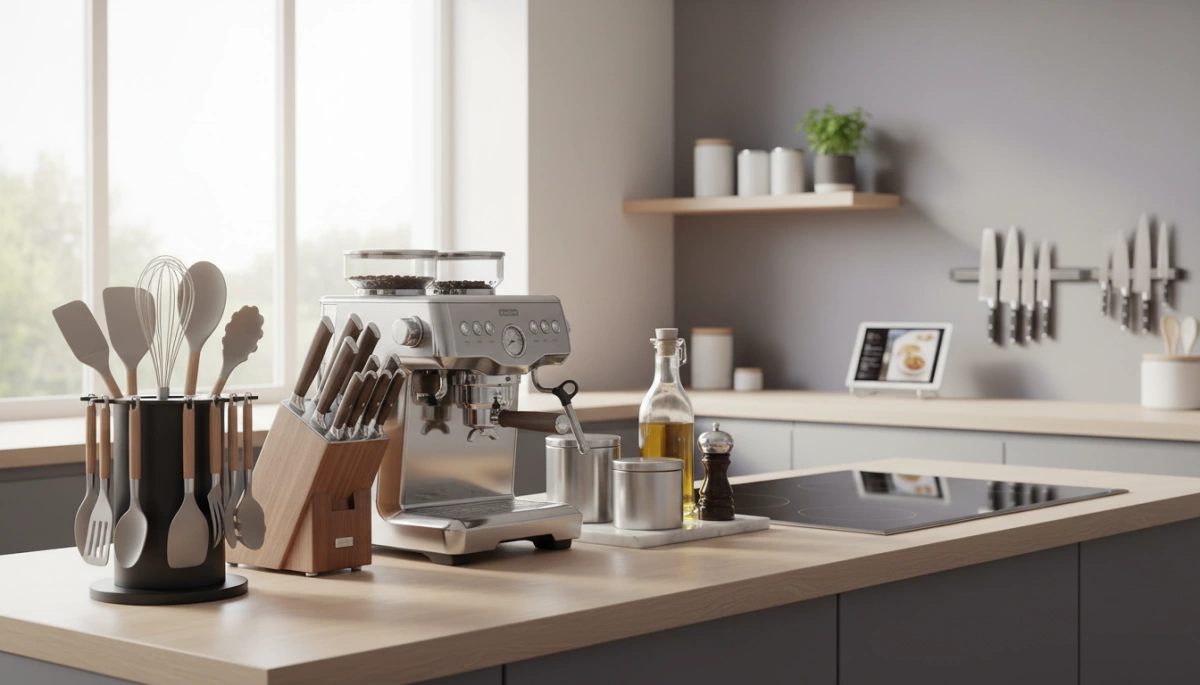
Once you’ve got your essential kitchen tools every home cook should own, a few smart upgrades can make everyday cooking faster, easier, and more fun—especially in a typical U.S. home kitchen where time and counter space are limited.
Immersion blender: small tool, big impact
An immersion blender is one of the best multi-use kitchen tools you can add.
What I use it for:
- Soups: Blend right in the pot for smooth tomato, butternut, or potato soup (no risky transfers to a blender).
- Sauces: Emulsify pan sauces, gravy, and dressings in seconds.
- Smoothies & shakes: Quick single-serving smoothies without pulling out a big blender.
- Baby food or purees: Easy to make small, fresh batches.
What to look for:
- At least 200–300 watts of power
- Detachable stainless steel shaft for easy cleaning
- Simple two-speed or variable-speed control
If you cook a lot of soups and sauces, this is a must-have kitchen tool.
Food processor: your prep workhorse
A food processor earns its space when you cook at home often or meal prep for the week.
Best uses:
- Chopping: Onions, garlic, carrots, celery in bulk for soups and stews
- Shredding: Cheese, cabbage, carrots, Brussels sprouts for tacos, salads, slaws
- Doughs: Pizza dough, pie crust, biscuit dough
- Dips & spreads: Hummus, pesto, nut butters, salsas
What matters:
- Capacity: 8–14 cups works well for most U.S. home kitchens
- Discs & blades: Slicing and shredding discs + standard S-blade
- Easy to clean: Fewer crevices, dishwasher-safe bowl and lid
If you do a lot of chopping, batch cooking, or baking, this is one of the most essential kitchen tools for everyday cooking.
Kitchen shears: the most underrated tool
Good kitchen shears beat regular scissors and even a knife for a lot of small jobs.
Everyday uses:
- Herbs: Snip chives, parsley, cilantro right over the pan or plate
- Poultry: Trim fat, spatchcock a chicken, cut through small bones and joints
- Packaging: Open bags, boxes, and tough plastic without wrecking your knives
- Pizza & quesadillas: Cut clean slices without dragging toppings
What to choose:
- Take-apart shears for deep cleaning
- Non-slip handles and solid hinge
- Stainless steel blades that can handle poultry
If you’re building a basic kitchen setup for home cooks, kitchen shears are a small upgrade with huge daily impact.
Other handy gadgets worth it for frequent cooks
If you cook at home most nights, a few more versatile kitchen gadgets can earn their keep:
- Microplane/zester: For lemon zest, garlic, ginger, and hard cheese
- Bench scraper: Moves chopped food from board to pan, scrapes dough and flour
- Salad spinner: Wash and dry greens so they actually stay crisp
- Garlic press (good one): If you use garlic constantly and hate mincing
These are budget kitchen tools that still feel like a luxury upgrade.
How to choose upgrades that match your cooking style
Before buying anything, I always ask three questions:
-
Do I cook this type of food often?
- Lots of soups/sauces → Immersion blender
- Big-batch cooking, slaws, dips → Food processor
- Roast chicken, herbs, meal prep → Kitchen shears
-
Will this replace a chore I hate?
- Hate chopping onions? Food processor.
- Hate transferring hot soup to a blender? Immersion blender.
-
Do I have space to store it?
- Small apartment kitchens: pick one major appliance (immersion blender or food processor) plus compact tools like shears and a microplane.
Match your upgrades to how you actually cook, not how you wish you cooked. That’s how you build a functional kitchen checklist that’s powerful, space-efficient, and worth every dollar.
Care, Cleaning, and Maintenance of Essential Kitchen Tools
Taking care of your essential kitchen tools every home cook should own is what keeps them safe, sharp, and working for years. A basic routine is enough if you stay consistent.
Daily Cleaning Habits That Protect Your Tools
Keep it simple, but don’t cut corners:
- Wash tools right after use – especially knives, wooden spoons, and cast iron.
- Use warm water + mild dish soap for most must‑have kitchen tools.
- Dry immediately with a towel instead of air-drying to avoid rust and water spots.
- Wipe down handles, knobs, and lids (they collect grease fast).
- For stuck-on food, soak briefly in warm soapy water—don’t scrape with metal on nonstick or delicate surfaces.
These quick habits protect your basic cookware, utensils, and knives better than any fancy gadget.
What Should Never Go in the Dishwasher
If you want a functional kitchen checklist that actually lasts, keep these out of the dishwasher:
- Good knives – the heat and detergent dull edges and can warp handles.
- Cast iron & carbon steel pans – they’ll rust and lose seasoning.
- Wooden cutting boards & wooden utensils – they crack and warp.
- Nonstick pans (most budget ones) – coatings break down faster.
- Anything with glued handles – they loosen over time.
When in doubt with an essential kitchen tool, hand wash.
How and When to Sharpen Knives
Sharp knives are non-negotiable for home cooks:
- Hone weekly with a honing rod to keep the edge aligned.
- Sharpen every 3–6 months if you cook a few times a week (more often if you cook daily).
- Use:
- A whetstone (best control, small learning curve).
- A guided sharpener (simple and fast for beginners).
- A local pro sharpening service once or twice a year if you don’t want to DIY.
- Store knives in a magnetic strip, in-drawer block, or sheath—never loose in a drawer.
Regular sharpening is one of the highest ROI habits in any starter kitchen setup.
Seasoning and Caring for Cast Iron and Carbon Steel
Cast iron and carbon steel are powerhouse tools for everyday cooking if you maintain them right:
- To season:
- Wash and dry completely (heat it on the stove to drive off moisture).
- Rub on a thin layer of neutral oil (like canola).
- Bake inverted at 400–450°F for about an hour, then cool in the oven.
- After cooking:
- Wipe out food; use hot water and a scrub brush or salt for stuck bits.
- Dry over low heat, then wipe with a light coat of oil.
- Avoid long soaks, dishwashers, and acidic foods for long cooking times until the seasoning is well built.
Do this, and your pan gets more nonstick over time instead of worse.
Storage Tips to Keep Tools Organized and Long-Lasting
Good storage makes a small apartment kitchen or full-sized home kitchen feel easier to cook in:
- Knives: use a block, in-drawer organizer, or magnetic strip.
- Pots and pans: stack with pan protectors or towels between nonstick and stainless.
- Lids: use a lid rack inside a cabinet door or drawer to avoid clutter.
- Utensils: keep everyday cooking tools (spatulas, tongs, whisks) in a counter crock, extras in a drawer with dividers.
- Cutting boards: stand them upright in a rack so they dry fully and don’t warp.
Protecting and organizing your must-have kitchen tools isn’t complicated—it’s just a few smart habits that keep your essential kitchen tools every home cook should own working like new.
Building a Functional Kitchen on a Budget
Prioritized starter kit for new home cooks
If you’re building a basic kitchen setup for home cooks on a tight budget, start with a small, must-have kitchen tools kit:
- 8\”–10\” chef’s knife (your workhorse)
- Small paring knife
- One large cutting board
- 10\”–12\” skillet (nonstick or cast iron)
- 2–3 qt saucepan with lid
- 5–8 qt stockpot
- 1–2 sheet pans
- Basic utensils: tongs, wooden spoon, spatula, whisk, ladle
- Measuring cups and spoons
- 2–3 mixing bowls
- Colander
- Can opener
With this simple starter kit, you can handle almost all everyday cooking in a small apartment or first home.
Choosing affordable but reliable brands
For the U.S. market, I focus on brands that are budget kitchen tools but still durable:
- Knives: entry lines from Victorinox, Mercer, or similar quality
- Cookware: mid-range stainless or nonstick sets from mainstream U.S. retailers
- Utensils: my own branded durable kitchen utensils line plus basic silicone tools
- Mixing bowls, colanders, sheet pans: stainless or heavy-gauge aluminum from restaurant-style suppliers
Skip fancy packaging. Put your money into build quality, not marketing.
Where to save and where to invest
For a functional kitchen checklist, here’s how I split it:
Invest a bit more in:
- A good chef’s knife
- One solid skillet (cast iron or stainless)
- A sturdy cutting board
Save money on:
- Extra utensils and gadgets
- Mixing bowls, plastic measuring cups, basic colanders
- Glass storage containers bought in sets
Spend on the tools you touch every single day. Go cheap on backups and “nice-to-have” gadgets.
Space‑saving tips for small apartments
If you’re in a studio or tiny kitchen, pick multi-use kitchen tools:
- One deep skillet that can sear, simmer, and shallow-fry
- Nesting mixing bowls and stackable measuring cups
- Sheet pans that double as trays and freezer organizers
- Wall rails or magnetic strips for knives and utensils
- Collapsible colanders or foldable drying racks
Think vertical storage and nesting. If it doesn’t do at least two jobs, don’t buy it.
Planning purchases over time
You don’t need the full home cook kitchen starter kit on day one. Build it in stages:
- Phase 1 (move-in basics): knife, cutting board, skillet, saucepan, spoon, spatula, tongs, one pot.
- Phase 2 (once you cook 3–4x/week): stockpot, sheet pans, mixing bowls, colander, measuring tools.
- Phase 3 (when you know your style): upgrades like a Dutch oven, better knives, or an immersion blender.
Buy slowly, based on what you actually cook. That’s how you build a functional kitchen on a budget that you’ll really use.
Putting Your Essential Kitchen Tools to Work
When you’ve got the essential kitchen tools every home cook should own, the real win is knowing how to use them every day without overthinking it.
Basic cooking tasks these tools cover
With a small, solid starter kitchen setup, you can handle almost everything you actually cook at home:
-
Knives + cutting boards
- Chopping onions, garlic, and herbs
- Slicing meat, chicken, and fish
- Prepping salad, fruit, and snack boards
-
Pots, pans, and sheet pans
- Searing chicken, steak, and veggies in a skillet
- Boiling pasta, potatoes, and grains in a saucepan or stockpot
- Roasting veggies and sheet-pan dinners in the oven
-
Everyday utensils
- Stirring sauces and soups with wooden spoons
- Flipping and tossing with tongs and spatulas
- Whisking dressings, marinades, and pancake batter
-
Measuring and precision tools
- Baking with consistent results using measuring cups, spoons, and a digital kitchen scale
- Cooking meat safely with an instant-read thermometer
- Timing pasta, baked goods, and roasted foods with a simple timer
This basic home cook kitchen starter kit easily covers weeknight dinners, weekend brunch, and simple baking.
How to practice with a small toolset
You don’t need a drawer full of gadgets. Use a few must-have kitchen tools over and over until they feel natural:
-
Pick 3–4 recipes and repeat them.
For example: roasted chicken thighs, a veggie stir-fry, a pasta dish, and a soup. You’ll practice knife work, pan control, and seasoning. -
Focus on one skill at a time:
- Knife skills: dice an onion, slice carrots, mince garlic
- Heat control: practice searing in stainless steel or cast iron
- Measuring: weigh flour, sugar, and rice with your digital kitchen scale
-
Use your tools intentionally:
- Always cut on a proper cutting board, never on the counter
- Use the right pan size so food browns instead of steams
- Measure ingredients the same way each time for repeatable results
The more you repeat, the more your essential kitchen tools start to feel like second nature.
Common kitchen frustrations these tools solve
Good, basic home cooking tools eliminate a lot of the pain points most people in the U.S. run into:
-
Frustration: everything sticks and burns.
- Fix: use the right pan (nonstick for eggs, stainless or cast iron for searing), preheat properly, don’t overcrowd, use enough oil.
-
Frustration: uneven chopping and slow prep.
- Fix: one sharp chef’s knife, one stable cutting board, and a bit of practice. This alone speeds up weeknight cooking.
-
Frustration: recipes never turn out the same.
- Fix: use measuring cups, measuring spoons, and a kitchen scale; cook to temperature instead of guessing doneness.
-
Frustration: too many tools, nowhere to put them (small apartment problems).
- Fix: lean on multi-use kitchen tools—one good skillet, one saucepan, one stockpot, a couple of sheet pans, and a few core utensils.
Next steps once you’ve mastered the essentials
Once your basic kitchen setup for home cooks feels comfortable, level up slowly and on purpose:
-
Upgrade where you feel the pain most.
- If chopping takes forever → consider a food processor.
- If you love soups and sauces → add an immersion blender.
- If you roast and bake a lot → invest in better sheet pans or a second set.
-
Improve quality, not quantity.
Replace weak links: dull knives, warped pans, flimsy spatulas. Invest in durable, multi-use kitchen tools that fit your cooking style. -
Build out a functional kitchen checklist.
Make a simple list of what you actually use every week. That list guides what you buy next, so you avoid clutter and wasted money.
With a tight set of essential kitchen tools, you can cook better at home, control your budget, and keep your kitchen simple, efficient, and built for real everyday use in a U.S. home.