
Understanding the Science Behind Artisanal Sourdough
If you’re trying to master artisanal sourdough bread at home and wondering why your dough sometimes acts “alive,” it’s because it is. Once you understand the science, your sourdough goes from guesswork to repeatable, bakery-quality results.
Wild Yeast and Lactic Acid Bacteria in Sourdough
A sourdough starter is a living culture of:
- Wild yeast – creates gas (CO₂) for rise and oven spring
- Lactic acid bacteria (LAB) – build flavor, aroma, and help with digestion
Together, this wild yeast sourdough culture is what makes naturally leavened bread different from commercial yeast bread: more flavor, better keeping quality, and a more interesting crumb.
How Natural Fermentation Builds Gluten, Flavor, and Aroma
During natural sourdough fermentation:
- Enzymes soften the dough and help gluten organize
- Time and gentle handling (like stretch and fold sourdough techniques) build structure
- Organic acids and alcohols develop deep flavor and a toasty, complex aroma
The dough will feel smoother, more elastic, and slightly airy when fermentation is on track.
Lactic vs. Acetic Acid: What Shapes Sourdough Taste
Your sourdough’s flavor comes from two main acids:
- Lactic acid – mild, yogurt-like tang; softer, round flavor
- Acetic acid – sharper, vinegar-like bite; more aggressive sour
You can influence this balance:
- Cooler, longer fermentation → more acetic, sharper sour
- Warmer, steady fermentation → more lactic, gentle tang
Use this to balance sourness and mild flavor based on what you like.
Hydration Levels (65–80%) and What They Change
Hydration = water weight ÷ flour weight × 100%.
Typical home sourdough baking guide ranges:
- 65–70% hydration
- Easier to handle
- Tighter, sandwich-friendly crumb
- 70–80% hydration (high hydration sourdough dough)
- Stickier, needs more skill
- More open crumb sourdough bread, bigger holes
Start around 70% sourdough hydration percentage and move up as your skills grow.
Flour Strength, Protein, and Your Crumb and Rise
Flour choice matters more than people think:
- Bread flour (higher protein) → stronger gluten, taller loaf, chewier crumb
- All-purpose → softer, more tender crumb, slightly less rise
- Whole wheat or rye sourdough bread variation → more flavor, denser crumb unless balanced with bread flour
For a crusty artisan loaf from a home oven, I usually blend bread flour + a bit of whole wheat or rye for flavor and structure.
Temperature Control and Fermentation Speed
Temperature is your steering wheel:
- Warm kitchen (75–80°F / 24–27°C)
- Faster bulk fermentation time and temperature
- More lactic acid, milder sour
- Cool kitchen (68–72°F / 20–22°C)
- Slower fermentation
- More acetic acid, stronger sour
Use:
- A simple proofing box hack (oven light on, or a cooler with warm water)
- A cheap dough thermometer to keep things consistent
You’ve got this—once you control temperature, your timing becomes predictable.
Starter vs. Levain: What’s the Difference?
Both are the same culture used in different ways:
- Starter
- Your ongoing, daily (or weekly) sourdough starter from scratch
- Kept small, fed regularly
- Levain
- A build made from a bit of starter + fresh flour + water
- Mixed specifically for one bake, at a set hydration and schedule
Use a levain when you want controlled flavor, timing, and strength. Use starter directly when you’re keeping things simple and baking often.
How Fermentation Time Affects Sourness, Texture, and Digestion
Fermentation time is your main flavor dial:
- Shorter fermentation
- Milder flavor
- Slightly tighter crumb
- Less sour
- Longer fermentation (including cold retard in the fridge)
- Deeper flavor and aroma
- More open crumb when done right
- Increased sourness and better digestibility for many people
If your bread is too sour, shorten fermentation or keep dough slightly warmer. If it’s flat in flavor, extend bulk fermentation or add a longer cold proof. This is normal and fixable with small adjustments.
Master this science, and your home bakery quality sourdough stops being a gamble and becomes a routine you can trust every time.
Creating and Maintaining a Vigorous Sourdough Starter at Home
If you want to start mastering artisanal sourdough bread at home, a strong, active sourdough starter is non‑negotiable. This is your wild yeast engine. Here’s a straight, US‑kitchen‑friendly guide to creating and maintaining a starter that’s reliable week after week.
Step‑by‑Step Sourdough Starter From Scratch (Day‑by‑Day)
Use a digital scale and room‑temp filtered water if you can. Aim for a warm-ish kitchen (70–75°F is ideal).
Day 1
- 50 g whole wheat or rye flour
- 50 g water
- Mix to a thick paste in a clear jar.
- Cover loosely (lid set on top or a clean cloth).
- Let sit at room temp 24 hours.
Day 2
- You might see a few bubbles or nothing at all—both are normal.
- Discard about half (leave ~50 g in the jar).
- Add 50 g flour (whole wheat, rye, or a mix with bread flour).
- Add 50 g water, mix well.
- Rest 24 hours.
Days 3–4
- Now you should see more bubbles and some rise.
- Twice a day (every ~12 hours):
- Keep 50 g starter, discard the rest.
- Feed with 50 g flour + 50 g water (1:1:1 ratio starter:flour:water by weight).
- Starter should start smelling more pleasantly yeasty/fermented.
Days 5–7
- Switch to bread flour or a 50/50 bread + whole wheat mix.
- Keep feeding 1–2x per day at 1:1:1.
- You’re aiming for:
- Doubling in size in 4–8 hours
- Lots of bubbles
- Mildly tangy, clean smell
Once it consistently doubles and looks lively, you’ve got a usable starter for home sourdough baking.
Best Flours for Starting a Sourdough Culture
For US home bakers, these work great:
- Rye flour – Kickstarts fermentation fast; great for the first few days.
- Whole wheat flour – Also very active; easy to find at any grocery store.
- Bread flour – Strong gluten; best for long‑term, everyday feedings.
A lot of home sourdough bakers in the US use rye or whole wheat to start, then move to bread flour for consistency.
Starter Hydration: How Thick or Runny?
Most home sourdough starters are kept at 100% hydration: equal parts flour and water by weight.
- 100% hydration (most common)
- Texture: thick pancake batter
- Easy to stir, holds bubbles well
- Great for general sourdough bread recipes
If your kitchen is hot, a slightly thicker starter (a bit less water) can slow things down. If it’s cool, a slightly looser starter can speed fermentation. But if you’re just starting, stick to 1:1 flour to water.
Feeding Ratios and Schedules for an Active Starter
Once your starter is active, here’s how I keep mine strong for reliable, naturally leavened bread:
At room temperature (daily baking or frequent use)
- Feed 1–2 times per day.
- Go with a 1:2:2 or 1:3:3 ratio (starter:flour:water). Example:
- 20 g starter
- 60 g flour
- 60 g water
- This keeps acidity in check and yeast strong.
In the fridge (casual home baking, 1x per week or so)
- Keep your starter thicker (it lasts better).
- Feed, let it sit at room temp for 1–2 hours, then refrigerate.
- Feed about once a week.
- Before baking, pull it out and give 2–3 room‑temp feedings to fully wake it up.
How to Know When Your Starter Is Ready to Bake
For mastering artisanal sourdough bread at home, watch the starter, not the clock. It’s ready to use when:
- It doubles (or more) in 4–8 hours after feeding
- Top is domed, not flat or sunken
- Full of bubbles throughout, not just on top
- Smell is clean and tangy, like yogurt, apples, or mild vinegar
Float test (optional, but popular):
- Drop a spoonful of starter into a glass of room‑temp water.
- If it floats, it’s airy and ready.
- If it sinks, it’s usually underfed or past peak.
Room Temperature vs Fridge Storage
Pick what fits your routine:
Room Temp Starter
- Best if you bake 3+ times per week.
- Pros: Always ready; super active.
- Cons: Needs more flour and attention (1–2 feedings daily).
Fridge Starter
- Best if you bake once a week or less.
- Pros: Low maintenance; feed about once a week.
- Cons: Needs extra feedings before baking to get fully active again.
Most US home bakers end up with a “fridge starter + pre‑bake refresh” setup for convenience.
Reviving a Sluggish or Neglected Starter
If your sourdough starter is weak, slow, or hasn’t been fed in a while, don’t toss it yet.
Signs it’s sluggish:
- Barely rises after feeding
- Few bubbles
- Smells like nail polish remover or harsh alcohol
How to bring it back:
- Stir well to mix in any liquid (hooch).
- Discard down to a small amount (10–20 g).
- Feed at 1:3:3 or 1:4:4 with warm water (75–80°F).
- Keep it at room temp and repeat every 12 hours.
- Use bread + whole wheat or rye for a few feedings to boost activity.
Usually, 2–3 days of consistent feeding brings a tired starter back to life.
Dealing With Hooch, Off Smells, and Common Starter Issues
You’ll see some weird stuff; most of it is normal.
Hooch (gray or brown liquid on top)
- Cause: Starter is hungry.
- Fix:
- Stir it back in if it doesn’t smell awful, then feed.
- Or pour it off and feed.
- Prevention: Feed more often or use a higher feed ratio.
Strong, sharp, or “solvent” smell
- Cause: Starter has gone too long without food.
- Fix: A few frequent feeds at room temp usually fix it.
Orange/pink streaks or fuzzy mold
- This is not normal.
- If you see bright colors or fuzzy growth, throw it out and restart. Safety first.
Long‑Term Maintenance for Consistent Home Sourdough Baking
To keep your starter strong and your sourdough loaves consistent:
- Pick a flour and stick with it (bread flour is ideal for everyday use).
- Use a repeatable feeding ratio—for example, 1:3:3 at room temp.
- Label your jar with feed times so you know how long it’s been.
- Keep the jar size reasonable—you only need a small amount of starter for each bake.
- Refresh before big bakes: 2–3 strong feedings ahead of a weekend or event bake.
A well‑kept starter becomes one of the easiest parts of home sourdough baking. Once you dial in your feeding routine, you’ll have a dependable wild yeast culture ready for everything from basic beginner sourdough loaves to more advanced, high‑hydration artisan bread.
Essential Tools and Ingredients for Home Kitchen Sourdough
When you’re mastering artisanal sourdough bread from your home kitchen, the right tools and ingredients make everything easier, more consistent, and way less frustrating.
Must‑have tools for home sourdough
For reliable home sourdough baking, I treat these as non‑negotiable:
- Digital scale (gram scale) – This is #1. Accurate weights = consistent dough and better results than cups.
- Mixing bowls – 2–3 medium/large bowls for mixing, autolyse, and bulk fermentation.
- Dough scraper –
- Bench scraper for folding, dividing, cleaning your counter.
- Bowl scraper (flexible plastic) for sticky high‑hydration dough.
These three alone will instantly level up any beginner sourdough bread recipe at home.
Dutch oven vs baking stone vs sheet pan
For sourdough baking in a conventional oven, steam and heat are everything:
-
Dutch oven (best for most home bakers)
- Traps steam naturally.
- Gives great oven spring, crust, and ear.
- Ideal for a single crusty artisan loaf from a home oven.
-
Baking stone or steel
- Great heat retention and bottom crust.
- Use with a pan of hot water or ice for steam.
- Better for multiple loaves or pizza / ciabatta‑style sourdough.
-
Sheet pan
- Works if you’re on a budget.
- Preheat well and use steam (pan of water) for better crust.
If you live in a small apartment or rental, a Dutch oven sourdough bread setup is usually the most practical.
Proofing basket (banneton) alternatives
No banneton? No problem. For proofing basket alternatives, use what’s already in your kitchen:
- Medium mixing bowl
- Colander
- Small pot
Line with:
- A clean lint‑free kitchen towel dusted heavily with flour
- Or a towel + mix of rice flour + all‑purpose flour for less sticking
This works for boules, batards, and most naturally leavened bread shapes.
Tools for scoring sourdough loaves
You don’t need anything fancy to improve your sourdough scoring patterns:
- Lame (baker’s blade) – Best control and clean cuts, great for ear formation.
- Double‑edge razor blade – Super sharp, cheap, easy to replace.
- Sharp serrated knife – Works in a pinch if the blade is really sharp.
Good scoring = better oven spring, more dramatic ear formation on a sourdough loaf, and fewer random blowouts.
Thermometers, timers, and simple gear
To get home bakery quality sourdough, a few small tools go far:
-
Instant‑read thermometer
- Check dough temp for bulk fermentation time and temperature control.
- Check loaf internal temperature for sourdough bread (aim ~208–212°F).
-
Timer or phone app
- Track stretch and fold sourdough intervals.
- Keep fermentation and proofing consistent.
-
Clear container (deli tub or glass)
- Ideal for monitoring starter growth.
These basic tools help you repeat your wins and dial in your sourdough baking timeline.
Best flour types for artisanal sourdough
For mastering artisanal sourdough bread at home, your flour choice matters:
- Bread flour (11.5–13% protein) – My default for strong gluten and good rise.
- All‑purpose flour – Works, but aim for higher‑protein brands in the U.S.
- Whole wheat flour – Adds flavor, nutrition, and a more rustic crumb.
- Rye flour – Amazing for wild yeast sourdough culture and deeper flavor.
Typical starting blend for an open crumb sourdough bread:
- 80–90% bread flour
- 10–20% whole wheat or rye
Water quality and salt choices
For natural sourdough fermentation, keep it simple but clean:
-
Water
- If your tap water smells like a pool (strong chlorine), use filtered water or let it sit out overnight.
- Room‑temp to slightly warm water helps control dough temperature for sourdough fermentation.
-
Salt
- Use fine sea salt or kosher salt.
- Avoid heavily iodized table salt if you can; some bakers feel it slows fermentation.
Good water and salt choices support a healthy sourdough starter from scratch and consistent dough behavior.
Why weighing beats cups and spoons
For sourdough hydration percentage and consistent results, volume is not enough:
- Flour compresses differently every time in cups.
- Hydration (65–80% for most artisanal sourdough) only makes sense in grams.
- A scale lets you repeat successes and follow any step‑by‑step sourdough instructions online.
If you’re serious about home sourdough baking, a digital scale is the first upgrade I recommend.
Budget‑friendly substitutions and where to buy
You don’t have to spend big to start:
-
Budget swaps
- Dutch oven → heavy pot with a tight lid
- Banneton → bowl with floured towel
- Lame → razor blade + coffee stir stick or chopstick
- Dough scraper → stiff plastic card
-
Where to buy in the U.S.
- Big box stores (Walmart, Target) for scales, Dutch ovens, basic tools.
- Restaurant supply stores for bulk bread flour and cheap gear.
- Online (Amazon, specialty baking shops) for bannetons, stones, and higher‑end tools.
Set yourself up with just a few smart purchases, and you’ll have everything you need to bake consistent, bakery‑style sourdough bread at home without overspending.
Master artisanal sourdough bread recipe step-by-step
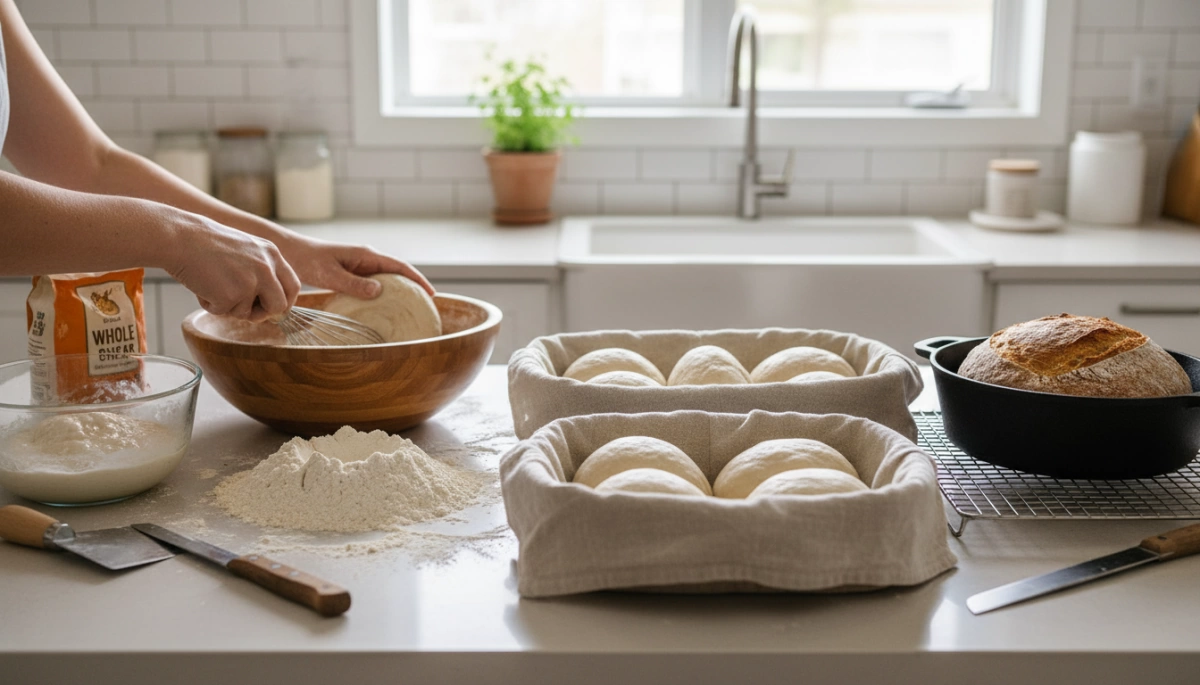
Here’s the base mastering artisanal sourdough bread at home formula I use and teach. It’s simple, repeatable, and works in a normal U.S. home oven.
Base sourdough formula (1 medium loaf)
- Bread flour: 400 g (about 3 1/4 cups, but weigh if you can)
- Water: 280–300 g (70–75% hydration)
- Active sourdough starter (100% hydration): 80 g
- Salt: 9 g (about 1 1/2 tsp)
You can swap 10–30% of the bread flour for whole wheat or rye for more flavor and color.
Autolyse: mixing flour and water
The autolyse technique makes the dough easier to handle and improves crumb.
- Mix 400 g flour + 260–280 g water (hold back 20 g water for later with salt).
- Stir until no dry bits remain. It will look shaggy and rough.
- Cover and rest 30–60 minutes at room temp (68–75°F).
This rest lets the flour hydrate, gluten start forming, and the dough become smoother without kneading.
Adding starter and salt
After autolyse:
- Add 80 g active sourdough starter and mix by squeezing and folding until mostly combined.
- Sprinkle 9 g salt over the dough.
- Add the remaining water if needed, and gently work the dough with:
- Pinching the dough between fingers
- Folding edges into the center
Aim for a smooth, cohesive dough. It’s fine if it still feels a bit sticky.
Stretch and fold during bulk fermentation
Now you enter bulk fermentation—where the dough rises and develops strength.
- Place the dough in a lightly oiled bowl.
- Over the first 2 hours, do 3–4 rounds of stretch and fold:
- Wet your hand.
- Grab one side of the dough, stretch it up gently, and fold it over.
- Rotate the bowl 1/4 turn and repeat 4–6 times per round.
- Rest 30–45 minutes between rounds.
This “no knead” stretch and fold sourdough method builds gluten without a mixer.
Recognizing proper bulk fermentation
You’re looking for signs instead of just watching the clock. In a typical U.S. kitchen (70–75°F), bulk takes 3–5 hours.
Done with bulk when:
- Dough has risen about 50–75%
- Surface looks smoother and slightly domed
- You see small to medium bubbles along the sides and bottom of the bowl
- It feels airy, jiggly, and lighter when you lift it
If it’s still dense and flat, it needs more time. If it’s super puffy and collapses easily, it may be over-proofed.
Pre-shaping and bench rest
Once bulk is done:
- Lightly flour the counter.
- Gently turn the dough out (don’t punch it down).
- Pre-shape:
- For a boule (round): use a bench scraper to tuck the dough under itself, rotating to form a loose ball.
- For a batard (oval): gently form a loose log shape.
- Cover lightly and bench rest 20–30 minutes.
This relaxes the gluten and makes final shaping easier and cleaner.
Final shaping: boule and batard
You want good surface tension for oven spring and an artisan crust.
Boule (round):
- Lightly flour the top, flip the dough so floured side is down.
- Fold top to center, bottom to center, sides to center.
- Flip seam-side down and use your hands or scraper to drag the dough toward you, tightening the surface.
Batard (oval):
- Lightly flour top, flip floured side down.
- Fold top third down, bottom third up (like a letter).
- Fold sides slightly in, then roll the dough from top to bottom into a tight log.
- Seal seam with your fingers.
The shaped dough should feel tight on the surface but not tearing.
Proofing in a banneton or lined bowl
For proofing baskets (bannetons):
- Flour the banneton generously (rice flour works great).
- Place dough seam-side up in the basket.
No banneton? Use:
- A medium mixing bowl
- Line it with a clean, floured kitchen towel
Cover with a bag or wrap to keep it from drying out.
Let it proof at room temp 45–90 minutes before the fridge, depending on your schedule and kitchen temp.
Cold retard in the fridge
To dial in flavor and timing, I almost always use a cold retard:
- After the short room-temp proof, cover tightly.
- Refrigerate 8–16 hours at 38–42°F.
Benefits:
- Deeper, more complex natural sourdough fermentation flavor
- Easier scoring (cold dough cuts cleaner)
- Flexible baking schedule (bake in the morning or evening when it fits your day)
Scoring sourdough for oven spring and ear
Preheat your oven to 475°F with your Dutch oven inside for at least 45–60 minutes.
Right before baking:
- Turn the cold dough out onto parchment, seam-side down.
- Use a lame, razor, or sharp knife.
- For a classic ear:
- Make one long, confident slash about 1/4–1/2 inch deep
- Hold the blade at a slight angle (about 30–45°)
- You can add extra shallow decorative cuts if you want, but don’t overdo it.
Good scoring helps control where the loaf opens and boosts oven spring.
Baking sourdough in a Dutch oven
This is the easiest way to get bakery-style artisan crust at home.
- Carefully remove the preheated Dutch oven.
- Lower the dough (on parchment) into the pot.
- Cover and bake:
- 20–25 minutes covered at 475°F (steam trapped inside)
- 20–25 minutes uncovered at 450–475°F
Aim for:
- Deep golden-brown crust
- Internal temp of about 208–212°F
If your crust is pale, bake longer uncovered; if it’s burning, lower the temp slightly.
Cooling, slicing, and storing sourdough
This is where most people rush and ruin the crumb.
- Cool the loaf on a rack at least 1–2 hours before slicing.
- Cutting too early = gummy sourdough crumb and compressed texture.
- For storage:
- Day 1–2: paper bag or cut-side down on a board, loosely covered
- Longer: slice and freeze in a zip bag; toast straight from frozen
Avoid sealing warm bread in plastic—it softens the crust fast.
Baker’s timeline: same day vs overnight
Both same-day sourdough and overnight cold proof sourdough work; it’s just about your schedule.
Typical overnight (most flexible):
- Morning: Mix, autolyse, add starter and salt.
- Late morning/afternoon: Bulk with stretch and folds.
- Evening: Shape, short proof, fridge overnight.
- Next morning: Bake straight from the fridge.
Same-day option (warmer kitchen):
- Early morning: Mix and start bulk.
- Midday: Finish bulk, shape, proof.
- Afternoon: Bake.
Use your local room temperature as your guide. Warmer homes (Southern states, summer) ferment faster; cooler climates need longer.
Adjusting hydration and flour blends
Once you’re comfortable with this beginner sourdough bread recipe, start experimenting:
- More open crumb / high hydration sourdough:
- Increase water to 78–80% (320 g water for 400 g flour).
- Expect stickier dough; use more gentle folds and a well-floured surface.
- Whole wheat sourdough loaf / rye sourdough variation:
- Replace 10–30% of bread flour with whole wheat or rye.
- Add 5–15 g extra water—whole grains absorb more.
- Multigrain sourdough:
- Add soaked seeds or grains (like oats, sunflower, flax) at the first or second fold.
- Slightly increase hydration to keep the dough from drying out.
Keep notes: hydration, flour mix, bulk time, and how the final loaf looked and tasted. That’s how you dial in true home bakery quality sourdough in your own U.S. kitchen.
Troubleshooting Common Sourdough Bread Problems
Sourdough will fight you a little at first. That’s normal. Here’s how I dial in consistent, bakery-style results at home and fix the most common issues fast.
How to fix flat or spread-out sourdough loaves
Flat loaves usually mean weak gluten or over-proofing.
What to do:
- Strengthen the dough
- Use bread flour or a strong all-purpose (11–13% protein).
- Do 3–5 rounds of stretch and fold during bulk fermentation.
- Tighten your shaping
- Build strong surface tension: pull the dough toward you on the counter several times.
- Chill before baking
- Cold proof 8–16 hours in the fridge so the dough firms up and holds shape.
- Use support
- Proof in a banneton or a lined bowl, then bake in a preheated Dutch oven.
Under-proofed vs over-proofed sourdough bread
You need to know which one you’ve got before you can fix it.
Under-proofed signs:
- Loaf bursts wildly at the score line.
- Tight, dense crumb with some large, uneven tunnels.
- Dough felt tight and springy going into the oven.
Over-proofed signs:
- Dough feels very puffy and fragile, hard to score.
- Loaf bakes wide and low, little oven spring.
- Crumb is very uniform and tight, sometimes slightly gummy.
How to adjust:
- Under-proofed: Let bulk and/or final proof go longer.
- Over-proofed: Shorten fermentation or use cooler dough temps (70–75°F).
Dealing with dense or gummy sourdough crumb
Dense crumb fixes:
- Increase bulk fermentation time until dough rises ~50–75% and shows bubbles.
- Make sure starter/levain is doubled and active before mixing.
- Use proper hydration: around 70–75% is a sweet spot for most US bread flours.
Gummy crumb fixes:
- Bake longer: internal temp 208–212°F.
- Let loaf cool completely (at least 2–3 hours) before slicing.
- If crumb is still gummy, it was probably under-proofed → extend proof next time.
Improving oven spring for a taller sourdough loaf
To get that big, tall, open-crumb sourdough bread at home:
- Use steam
- Dutch oven with lid on for 20–25 minutes, then off to finish.
- Score correctly
- One long, shallow (1/4–1/2 inch) score for a classic ear.
- Hit the right temperature
- Preheat your oven and Dutch oven to 475–500°F.
- Don’t over-proof
- Dough should still have a bit of bounce when poked, not collapse.
Why your sourdough crust is too pale, too soft, or burnt
Pale crust:
- Oven not hot enough → bake at 475–500°F.
- Not enough time with lid off → extend uncovered baking by 5–10 minutes.
- Add a pinch more sugar with whole grain loaves (optional) for more color.
Soft crust:
- Leave loaf in the oven 5–10 minutes with door slightly cracked after baking.
- Cool on a wire rack, never in the pan or Dutch oven.
Burnt crust:
- Drop temp by 25°F.
- Tent with foil for the last 10–15 minutes of baking.
- Bake on a lower rack if the top is scorching.
Adjusting fermentation for warmer and colder home kitchens
In the US, most home kitchens swing a lot by season. Adjust your sourdough fermentation to match.
Warm kitchen (75–80°F+):
- Use cooler water.
- Cut starter/levain percentage slightly.
- Shorten bulk and final proof; watch the dough, not the clock.
Cool kitchen (65–70°F or lower):
- Use slightly warmer water (80–85°F).
- Proof in a warm spot: inside the oven with the light on, or a DIY proofing box (closed microwave with a mug of hot water).
- Expect longer bulk fermentation and proof times.
Balancing sourness and mild flavor
Want more sour?
- Longer cold retard (up to 24 hours in the fridge).
- Use a stiffer starter (lower hydration) and feed less often.
- Let bulk go a bit longer (without over-proofing).
Want milder sourdough bread?
- Use starter at peak rise, not overly acidic or collapsed.
- Shorten cold retard to 8–12 hours.
- Keep regular feedings (1–2x per day at room temp) for a sweeter profile.
Common scoring mistakes and better cuts
Mistakes:
- Cuts too shallow → weak ear and random blowouts.
- Cuts too deep or too many → loaf spreads sideways.
- Scoring cold dough with a dull knife → ragged edges.
Fix it:
- Use a sharp razor or lame.
- Angle blade at about 30–45° for an ear.
- For a basic artisan look: one main slash along the length of the loaf.
Quick-reference sourdough troubleshooting table
| Problem | Most Likely Cause | Fast Fix |
|---|---|---|
| Flat, spread-out loaf | Weak gluten / over-proofed | Stronger shaping, more folds, shorter proof, colder dough |
| Tight, dense crumb | Under-proofed / weak starter | Longer bulk, more active starter, right hydration |
| Gummy interior | Under-baked / cut too soon | Bake to 208–212°F, fully cool before slicing |
| Pale crust | Low heat / short bake | Higher temp, longer uncovered bake, strong preheat |
| Burnt crust | Too hot / too long | Lower temp, tent with foil, bake on lower rack |
| Little or no oven spring | Over-proofing / low steam | Shorter proof, Dutch oven or better steam |
| Too sour | Long fermentation / very acidic | Shorter cold proof, fresher starter, warmer/faster bulk |
| Not sour enough | Short fermentation | Longer cold retard, stiffer starter, slightly longer bulk |
| Ragged or ugly scores | Dull blade / poor angle | Use sharp razor, 30–45° angle, score confidently |
Use this as your quick sourdough bread troubleshooting guide anytime a loaf doesn’t behave. With a bit of pattern-spotting and small tweaks, you’ll dial in consistent, bakery-quality artisanal sourdough bread from your home kitchen.
Variations and Flavor Twists for Artisanal Sourdough
When you’ve got your base loaf dialed in, mastering artisanal sourdough bread at home is all about flavor twists that actually fit your lifestyle and your week.
Seeded sourdough crusts and mix-ins
For a nutty, crunchy loaf that works great for toast and sandwiches:
- Crust-only seeds: Roll shaped dough in a mix of sesame, flax, and sunflower seeds right before final proof.
- Mixed into the dough: Add 15–20% seeds (based on flour weight) during the last set of stretch and folds.
- Pro tip: Soak seeds in water for 30–60 minutes so they don’t steal moisture from the dough.
Olive, herb, and garlic sourdough
For a savory, “weekend dinner” style naturally leavened bread:
- Add chopped olives, rosemary, and roasted garlic after bulk fermentation starts (during a fold).
- Use low hydration olives (drained well) so the dough doesn’t get soupy.
- Keep total add-ins around 20–25% of flour weight to protect your structure.
Cinnamon raisin and sweet sourdough
Perfect for breakfast and French toast:
- Mix cinnamon, raisins, and a touch of brown sugar or honey into a slightly richer dough.
- Add raisins after a couple of folds so they don’t shred the gluten early.
- Expect slower natural sourdough fermentation because sugar and fat slow things down.
Whole wheat, rye, and multigrain sourdough
For more flavor and nutrition without losing rise:
- Swap 20–40% of your bread flour for whole wheat or rye.
- Higher whole grain = faster fermentation, so watch your bulk fermentation time and temperature closely.
- For multigrain sourdough, soak grains (like oats, cracked wheat) in hot water and cool before adding.
High-hydration sourdough and open crumb
If you want that “show-off” open crumb sourdough bread:
- Push hydration into the 75–80% range.
- Use a strong bread flour and do more stretch and fold sourdough sets.
- Shorter, cooler proofs help keep structure so you don’t end up with a flat ciabatta-style puddle.
Cheese, nuts, and dried fruit
Great for a snack loaf or holiday table:
- Add sharp cheddar, walnuts, or dried cranberries during the first or second fold.
- Cut cheese into small cubes and keep total add-ins under 25% of flour weight.
- Watch fermentation—fat and sugar slow down the dough, so bulk might run longer.
Adjusting hydration for enriched doughs
For enriched sourdough doughs (milk, butter, eggs, sugar):
- Lower base hydration by 5–10%, since milk and eggs add liquid.
- Expect longer bulk and proof times; keep dough a bit warmer for steady activity.
- Mix longer or do extra folds to build strength in softer, richer doughs.
Using sourdough discard
Keep waste low and value high in a US home kitchen:
- Pancakes & waffles: Use discard for tangy, crispy breakfast.
- Crackers: Mix discard with olive oil, salt, herbs; roll thin and bake.
- Quick flatbreads: Cast iron skillet, discard, a bit of oil and salt—done.
Planning a rotation of loaves at home
To keep things simple but interesting:
- Weekday: One main “house loaf” (standard artisan sourdough crust and crumb).
- Weekend: One “fun” loaf (seeded sourdough, olive rosemary sourdough, or cinnamon raisin sourdough bread).
- Discard days: Batch pancakes, crackers, or waffles and freeze extras.
Build a loose sourdough baking timeline that fits your work hours, and repeat the same few formulas. That’s how you get consistent, home bakery quality sourdough without babysitting dough all week.
Advanced tips for mastering artisanal sourdough bread at home
Building and using a levain for control
To get bakery-level control over flavor and timing, I build a levain instead of using my main sourdough starter straight.
- Simple levain formula: 1 part active starter + 2 parts water + 2 parts flour (usually 50% bread flour, 50% whole wheat or rye).
- Timing: Mix at night, let it sit 8–12 hours at 70–75°F, and use it when it’s domed, bubbly, and just starting to recede.
- Flavor control:
- Warmer levain (75–80°F) = milder, sweeter loaf.
- Cooler levain (68–72°F) + longer time = more sour, more complex loaf.
- Use 15–25% levain based on total flour for most home sourdough baking. Less levain = slower, more flavor; more levain = faster, milder.
This “built levain vs sourdough starter” approach makes your naturally leavened bread far more predictable.
Dough temperature and simple proofing box hacks
Dough temperature drives fermentation speed, sourness, and texture. I aim for a final dough temp of 75–78°F for most artisan sourdough.
To hit your dough temperature:
- Use slightly cool water if your kitchen is warm, slightly warm water if your kitchen is cold.
- Mix, then take the dough’s temp with a cheap digital thermometer.
DIY proofing box for US homes:
- Turn your oven light on, door closed: often sits around 75–85°F. Check with a thermometer first.
- Use a turned-off microwave with a mug of hot water inside. Replace water every few hours.
- Use a plastic bin with the dough inside and a small bowl of warm water to gently warm the space.
When you control dough temp, your bulk fermentation time and sourdough baking timeline become repeatable.
Steam methods without a Dutch oven
No Dutch oven? You can still get a crusty artisan loaf and strong oven spring in a regular US oven.
Try one or combine:
- Preheated steel or baking stone on the middle rack for strong bottom heat.
- Cast iron skillet or metal pan on a lower rack; add 1 cup boiling water right after loading the loaf.
- Toss a few ice cubes in a hot pan on the lower rack for a slow steam release.
- Bake inside a large inverted roasting pan or aluminum turkey pan over the loaf to trap steam.
Always preheat 30–45 minutes so your oven, stone, or steel is fully hot before your sourdough goes in.
Advanced scoring and getting a dramatic sourdough ear
For a big oven spring and a bold ear on your artisanal sourdough bread at home:
- Chill the shaped loaf in the fridge before baking; cold dough scores cleaner.
- Use a lame or razor blade, not a dull knife.
- Main score: one long cut at a 30–45° angle, about ¼–½ inch deep, slightly off-center.
- Keep the blade confident and fast; slow cuts drag and tear.
- Decorative scoring (wheat stalks, leaves) should be shallow and never cut across the main expansion line.
Better scoring = better ear formation and more consistent crust.
Checking doneness by internal temperature and sound
To avoid gummy or underbaked sourdough:
- Use a digital thermometer:
- Target 208–212°F in the center of the loaf.
- Tap the bottom of the loaf:
- It should sound hollow and firm, not dull and dense.
- Crust should be deep golden to brown, not pale or soft.
If your sourdough crumb is always too moist, bake an extra 5–10 minutes with the oven door cracked to drive off excess moisture.
Scaling sourdough recipes for multiple loaves
To scale any beginner sourdough bread recipe or advanced formula:
- Work in baker’s percentages: flour = 100%, water, salt, and levain are percentages of that.
- Multiply all ingredients by the same factor (e.g., 1.5x for 1½ loaves, 2x for 2 loaves).
- Keep bowl size and oven capacity realistic. Most US home ovens max out at:
- 2 Dutch ovens, or
- 2–3 batards/rounds on a stone or steel.
For bigger batches, stagger your bulk fermentation and proofing so you’re not trying to bake everything at once.
Freezing dough or baked sourdough loaves
Freezing helps you keep a home bakery-quality sourdough routine without baking daily.
Freezing dough:
- Best at the shaped stage, before final proof or right after a short cold proof.
- Wrap tightly in plastic, then bag it to prevent freezer burn.
- Thaw in the fridge overnight, then proof at room temp until ready to bake.
Freezing baked bread:
- Let the artisan loaf cool completely.
- Slice or keep whole, wrap well, and freeze.
- To refresh:
- Thaw, then bake at 375–400°F for 10–15 minutes (5–10 minutes for slices) until the crust is crisp again.
Using your senses to judge fermentation and shaping
Tools matter, but your senses are the real consistency tool in home sourdough baking.
- Look:
- Bulk dough should be puffed, jiggly, and airy, not flat or tight.
- Shaped dough should hold its form and show small surface bubbles near the end of proof.
- Feel:
- Dough should feel alive, slightly bouncy, and gassy, not stiff or soupy.
- Smell:
- Balanced sour, a little fruity or yogurty, not harsh vinegar or nail polish.
- Touch test:
- Gently press a floured finger into the proofed dough:
- Slow bounce back with a slight dent left = ready to bake.
- Full bounce back = under-proofed.
- No bounce, dent remains = likely over-proofed.
- Gently press a floured finger into the proofed dough:
This is how I dial in naturally leavened bread without chasing every number.
Creating a repeatable sourdough routine
To get bakery-quality sourdough bread at home week after week, lock in a simple, repeatable system:
- Use the same base formula (flour mix, levain %, hydration) as your “house loaf.”
- Keep a starter feeding schedule that fits your life (for most US households: fridge during the week, feed up before weekend baking).
- Use the same proofing setup (oven light, proofing box hack, or specific fridge shelf) every time.
- Track a quick log:
- Room temp, dough temp, timelines, how the loaf looked and tasted.
- Change one thing at a time: hydration, fermentation time, or flour blend—not everything at once.
Once that routine feels automatic, you can layer in seeded sourdough, multigrain sourdough, high hydration sourdough dough, and other variations while still hitting consistent crust, crumb, and flavor.