

Ever wonder if you really need a different morning vs night skincare routine—or if it’s just marketing hype?
You’re not alone.
Your skin actually behaves differently around the clock. During the day, it’s busy defending against UV, pollution, and blue light. At night, it switches into repair and regeneration mode, boosting cell turnover and soaking up treatment ingredients more effectively.
That’s why an effective AM vs PM skincare routine isn’t about doing more steps—it’s about using the right products at the right time:
- Morning skincare routine: lightweight protection and hydration (think antioxidants, SPF, and light moisturizer).
- Nighttime skincare routine: deeper cleansing, repair, and nourishment (hello double cleansing, retinol, and richer moisturizers).
In this guide, you’ll see the exact difference between day and night skincare, the ideal skincare routine order AM PM, and how to build a simple, science-backed regimen that actually fits your life—without wasting time or money.
Why Morning vs Night Skincare Even Matters
If you’ve ever stood in front of the mirror wondering why your “10-step routine” still isn’t working, you’re not alone. Most people are confused not because they don’t have enough products, but because they’re using the same stuff morning and night without thinking about what the skin actually needs at different times of day.
Real-life skincare struggles
You might recognize yourself in a few of these:
- You follow a complicated AM vs PM skincare routine from TikTok, but your skin still looks the same (or worse).
- You bought vitamin C, retinol, toners, mists, and three moisturizers… and now everything just feels like a guessing game.
- Your morning skincare steps leave you greasy under makeup, or your nighttime skincare routine stings and makes you peel.
- You’re using “good” products, but not in the right order or at the right time of day.
That’s where understanding the difference between day and night skincare actually starts saving your skin — and your money.
How your skin’s needs change from AM to PM
Your skin doesn’t behave the same 24/7. It follows a kind of circadian rhythm:
-
Daytime = defense mode
More exposure to UV, pollution, blue light, sweat, and makeup. Your skin is busy protecting itself and keeping the barrier intact. -
Nighttime = repair mode
Less environmental stress. This is when your skin focuses on regeneration, repair, and recovery. It also absorbs products a bit more efficiently.
Because of that, your daytime vs nighttime skin needs are different — and your routine should match that.
Protection vs repair: the core difference
Think of it this way:
-
Morning skincare routine = protection skincare
- Shield from UV and pollution
- Control oil and shine
- Keep skin comfortable under makeup
- Support your barrier so it can handle the day
-
Night skincare routine = night repair skincare
- Deep cleanse sunscreen and makeup
- Boost regeneration with retinol or gentle exfoliants
- Rebuild the barrier with hydrating and nourishing ingredients
- Help with long-term concerns like acne, dark spots, and aging
Once you see it as protection in the AM, repair in the PM, the whole morning vs night skincare routine thing starts to make sense.
Who actually needs separate AM and PM routines?
You don’t need a 12-step routine. But you do need different priorities in the morning and at night if you:
- Live in a place with strong sun or high pollution
- Wear makeup or daily sunscreen (you should)
- Have acne, hyperpigmentation, sensitivity, or signs of aging
- Have oily skin in the day but feel dry or tight at night
- Want real, visible changes — not just “self-care” vibes
Even a simple AM PM skincare routine with 3–4 targeted steps each can outperform a random stack of “trendy” products used whenever.
What to expect from a solid AM/PM skincare setup
When you build a basic but smart skincare routine order AM PM, you can realistically expect:
- Smoother mornings: Less oil, less dryness, makeup sits better, skin looks more even.
- Calmer nights: Less irritation, fewer surprise breakouts, skin feels nourished instead of stripped.
- Better long-term results: Brighter tone, fewer dark spots, softer fine lines, stronger barrier.
- Less product waste: You actually finish products because you know exactly when and why you’re using them.
The goal isn’t more steps — it’s the right steps, at the right time of day. Once you lock in a clear morning vs night skincare routine with protection in the AM and repair in the PM, your skin finally has a chance to do what it’s designed to do: stay healthy and look good with less effort.
Skin Science: How Your Skin Behaves Day vs Night
Skin Circadian Rhythm (In Simple Terms)
Your skin runs on a 24‑hour clock, just like your sleep schedule. That’s your skin circadian rhythm.
In plain talk:
- Daytime: your skin focuses on defense.
- Nighttime: your skin switches to repair and rebuild.
This is the core reason a morning vs night skincare routine shouldn’t look exactly the same.
Daytime Skin: Defense Mode
During the day, your skin is dealing with everything: UV, blue light, pollution, sweat, oil, and makeup. Typical daytime behavior:
- Barrier tightens up to block irritants and bacteria.
- Oil production increases, especially in U.S. city environments with heat, A/C, and commute sweat.
- Free radical damage from sun and pollution ramps up (hello, fine lines and dark spots).
What this means for your AM skincare routine:
- Focus on protection: antioxidant serum in the morning (vitamin C, niacinamide) + broad spectrum sunscreen SPF 30 or higher.
- Use lightweight moisturizer or gel textures so your skin can breathe under makeup or mask-wearing.
Nighttime Skin: Repair and Regeneration
At night, your skin goes into recovery mode:
- Cell turnover speeds up – skin sheds and renews faster.
- Micro‑damage from the day is repaired (UV, friction from masks, pollution).
- Absorption increases, so products sink in better.
This is why night repair skincare is where you use your “heavy hitters”:
- Retinol at night for anti‑aging and acne support.
- AHA/BHA exfoliant at night (used a few times a week, not daily).
- Hydrating night cream or richer barrier repair skincare (ceramides, squalane, hyaluronic acid) to lock everything in.
How Sleep Quality Affects Nighttime Skincare
You can have the best PM skincare routine and still not see results if your sleep is trash:
- Short or poor sleep = more inflammation, dull skin, slower healing, more breakouts.
- Consistent, deeper sleep = better repair, more glow, stronger barrier.
If you’re a night‑shift worker or sleep late (very common in the U.S.):
- Treat your longest sleep as “night” for your PM skincare, even if it’s 7 a.m.
- Still use SPF in your morning routine when you’re awake and exposed to daylight.
What This Science Means for Your AM vs PM Product Choices
To keep it simple:
Morning skincare = protection
- Gentle cleanser or just a rinse
- Antioxidant serum (vitamin C, E, niacinamide)
- Lightweight vs rich moisturizer → choose light for day
- Broad spectrum sunscreen SPF 30+ (non‑negotiable in the U.S., especially if you drive a lot or sit near windows)
Nighttime skincare = repair and results
- Oil cleanser for makeup removal + double cleansing evening if you wear SPF and makeup
- Treatment serums: retinol, AHA/BHA, niacinamide, peptides
- Barrier‑support cream: ceramides, squalane, hyaluronic acid
- Richer night cream or sleeping mask if your skin runs dry or you’re in heated/AC air all night.
Bottom line: your daytime vs nighttime skin needs are different, so your AM vs PM skincare routine should be, too. Use the science to pick smarter products, not more products.
Morning Skincare Routine Basics (AM vs PM Skincare Routine)
Main goals of a morning skincare routine
In the morning, your skincare routine has one job: protect your skin for the day ahead. For most of us in the U.S., that means:
- Shielding from UV and pollution (sun, blue light, city air, commute, workouts)
- Keeping oil and shine under control without drying your skin out
- Hydrating just enough so makeup goes on smooth and your skin doesn’t feel tight by noon
- Preventing future damage with antioxidants and daily SPF in your morning protection skincare
Think of your morning vs night skincare routine like this:
- Day = armor (protection)
- Night = repair (treatments and recovery)
How many steps you really need in the morning
You don’t need a 10‑step routine before work. For most people, a 3–5 step AM skincare routine is more than enough:
Minimum morning skincare steps (baseline):
- Cleanse (or just rinse if your skin is dry/sensitive)
- Moisturize
- SPF (broad spectrum sunscreen SPF 30 or higher – non‑negotiable)
If you want a little more (but still fast):
4. Antioxidant serum (like vitamin C for daytime protection)
5. Eye cream or lip care (optional, but nice if you deal with dryness or concealer creasing)
Skincare routine order AM: what goes on first and last
The skincare routine order AM is simple:
- Thinnest to thickest, water-based to oil-based, SPF always last (before makeup).
Here’s the basic AM skincare order:
- Cleanser – gentle cleanser for AM routine or water rinse
- Toner/Essence (optional) – light, watery hydration if you like it
- Serum – antioxidant serum in the morning (vitamin C, niacinamide, etc.)
- Moisturizer – lightweight vs rich moisturizer depends on your skin type and climate
- Sunscreen – broad spectrum SPF 30+ as the final skincare step
- Makeup – layer on top once SPF has set
If you’re using international brands plus my own products, follow this rule:
- Active serums first,
- Creams next,
- SPF last,
- Makeup after everything.
How to keep your AM routine light but effective
Mornings in the U.S. are busy—kids, commute, gym, Zoom—so your AM vs PM skincare routine has to be quick and wearable:
- Pick a non‑stripping cleanser so your skin isn’t tight before 9 a.m.
- Use a single antioxidant serum instead of stacking a bunch of actives.
- Go for a lightweight moisturizer if you’re oily/combo or live in a humid state; use a gel‑cream or lotion, not a heavy balm.
- If you have dry skin or live in colder climates, choose a richer cream, but keep it thin enough that it won’t pill under SPF and makeup.
- Choose a sunscreen that doubles as a primer (many U.S. formulas now blur pores and control shine). That lets you cut a step.
- When in doubt, use: cleanser → vitamin C → moisturizer → SPF. That’s a clean, effective morning skincare routine that works for most skin types.
Keep your morning vs night skincare routine simple: protect hard in the AM, treat and repair at night.
Step‑by‑Step Morning Skincare Routine (AM vs PM Skincare Routine)
Let’s keep your morning skincare routine simple, fast, and protective. In the morning, I’m always thinking: cleanse, protect, hydrate, SPF. That’s it.
Step 1: Morning Cleanse or Just Rinse
Not everyone needs a full cleanser in the morning.
You probably need a gentle AM cleanser if:
- You have oily or acne‑prone skin
- You sweat a lot at night or sleep hot
- You use heavy night creams, oils, or occlusives
- You live in a humid US climate (Florida, Texas, Southeast, etc.)
Use a gentle cleanser for AM routine that doesn’t strip your barrier. No harsh foaming, no “squeaky clean.”
You can just rinse with lukewarm water if:
- You’re dry, sensitive, or over‑stripped
- You used a strong active at night (like retinol or acids)
- Your skin feels comfortable, not greasy, when you wake up
The goal in the morning is a light reset, not a deep scrub.
Step 2: Toner or Essence – Use It Only If It Helps
You don’t “need” a toner or essence, but it can be useful.
Use a toner/essence if you want:
- Extra hydration (look for glycerin, hyaluronic acid, panthenol)
- A soft refresh after cleansing
- Better product layering in dry US climates (Midwest winters, high AC, etc.)
Skip toner if:
- Your skin is easily irritated
- Your cleanser is already gentle and hydrating
- You’re using a bunch of other hydrating products
Avoid harsh, alcohol‑heavy toners in the morning. Focus on hydrating toners and essences, not stripping ones.
Step 3: Antioxidant Serum or Vitamin C for Daytime Protection
This is where morning protection skincare really kicks in.
A good antioxidant serum in the morning helps defend against:
- Pollution
- UV damage
- Blue light and everyday stress
Look for:
- Vitamin C serum (ascorbic acid or stable C derivatives)
- Vitamin E
- Niacinamide
- Other antioxidant blends (ferulic acid, green tea, resveratrol)
Benefits you’ll actually notice:
- Brighter, more even tone over time
- Better support against hyperpigmentation and dark spots
- Stronger overall daytime skin defense
If your skin is sensitive, start with niacinamide or a gentler antioxidant formula rather than a high‑strength vitamin C.
Step 4: Lightweight Moisturizer for Day Wear
Daytime = comfort without greasiness. Your AM moisturizer should work under SPF and makeup.
For oily or combo skin:
- Go for a lightweight gel or gel‑cream
- Look for oil‑free or non‑comedogenic labels
- Great in hot, humid US states
For dry or normal skin:
- Choose a light cream that hydrates without feeling heavy
- If you’re in a cold or dry climate, a slightly richer cream is fine, as long as it doesn’t pill under sunscreen
Key ingredients to look for:
- Hyaluronic acid
- Glycerin
- Ceramides
- Squalane
You want your skin to feel soft and flexible, not sticky or suffocated.
Step 5: SPF in Morning Routine – Non‑Negotiable
If you only do one thing in your morning vs night skincare routine, make it SPF.
For US everyday life (driving, walking the dog, office light, screens), you should be using:
- Broad‑spectrum sunscreen SPF 30 or higher
- Every. Single. Morning.
- Reapply every 2 hours if you’re outdoors
Why SPF is non‑negotiable:
- Protects against skin cancer
- Prevents premature aging (wrinkles, sagging, sun spots)
- Essential if you use retinol at night, AHA/BHA exfoliants, or vitamin C
Choose the texture based on your skin:
- Oily/combination: lightweight gel or fluid SPF
- Dry/sensitive: creamier, moisturizing SPF, mineral formulas if you’re reactive
This is the core difference between day and night skincare: AM = protect with SPF, PM = repair.
Optional Morning Add‑Ons: Eye Cream, Lip Care, Mists
If your basics are solid, you can layer in extras:
Eye cream (optional):
- Use if you have puffiness, dryness, or concealer that creases
- Look for caffeine, peptides, light hydrators
- Keep it lightweight for daytime
Lip care:
- A simple balm or SPF lip product is enough
- Crucial in dry, windy US states or winter months
Face mists:
- Nice for a quick hydration boost, especially in AC or when you’re on the go
- Use before moisturizer or to refresh mid‑day (not a replacement for SPF)
Quick AM Routine (Simple and Effective):
- Cleanse or rinse
- Hydrating toner/essence (optional)
- Antioxidant serum / vitamin C
- Lightweight moisturizer
- Broad‑spectrum SPF 30+
That’s a clean, US‑friendly morning skincare routine that actually fits real life and sets you up for better night repair skincare later.
Key Morning Ingredients to Use and Avoid
Best ingredients for morning protection skincare
In a morning vs night skincare routine, your AM routine is all about protection. For daytime, I always build around three things:
- Gentle, non-stripping cleanser – keeps your barrier intact so everything else works better.
- Hydrating layers – think glycerin, hyaluronic acid, and panthenol for all‑day comfort.
- Barrier + antioxidant support – to handle UV, pollution, blue light, and office AC.
If you’re in the U.S. dealing with commuting, screens, indoor heat/AC, you want minimal steps but maximum protection in the morning.
Antioxidants (vitamin C, E, niacinamide) in the AM
For an effective AM vs PM skincare routine, antioxidants are non‑negotiable in the morning:
Great morning ingredients:
-
Vitamin C (ascorbic acid or stable derivatives)
- Targets: dullness, dark spots, uneven tone
- Why AM: pairs perfectly with SPF to reduce sun damage and boost glow
- Tip: if pure vitamin C (L‑ascorbic) stings, go for gentler versions (like sodium ascorbyl phosphate or 3‑O ethyl ascorbic acid).
-
Vitamin E (tocopherol)
- Boosts the protection power of vitamin C
- Helps dry and mature skin feel more cushioned and less tight
-
Niacinamide
- Great for oily, acne‑prone, or sensitive skin
- Helps with redness, enlarged pores, and oil control
- Plays nice with most actives and sits well under makeup
Look for a lightweight antioxidant serum in the morning skincare steps, then lock it in with moisturizer and broad spectrum sunscreen SPF 30 or higher.
Lightweight vs rich moisturizer textures for daytime
The difference between day and night skincare textures matters a lot if you’re wearing makeup or SPF.
For daytime, I usually recommend:
-
Lightweight gel or gel‑cream moisturizer
- Best for: normal, combination, oily, and acne‑prone skin
- Benefits: absorbs fast, doesn’t feel greasy, less pilling under makeup and sunscreen
-
Light lotion or cream
- Best for: dry, sensitive, or mature skin in cooler, drier U.S. climates
- Choose formulas labeled “non‑comedogenic” if you break out easily
-
Skip thick, balmy creams in the morning unless you have very dry skin and don’t wear much makeup. Heavy textures plus SPF plus foundation is usually a pilling disaster.
Ingredients to be careful with in the morning (strong acids, retinoids)
Some skincare ingredients are better saved for night repair skincare because they can make your skin more reactive in daylight.
Be very careful with these in your morning skincare routine:
-
Strong acids (AHA/BHA like glycolic, lactic, high‑strength salicylic)
- Can increase sun sensitivity and irritation
- If you absolutely must use an acid in the morning, keep it mild, not daily, and never skip sunscreen.
-
Retinoids (retinol, tretinoin, adapalene)
- Belong in your nighttime skincare routine
- Sun makes them less stable and your skin more sensitive
- Using retinol at night + sunscreen in the morning is the safer, smarter combo
-
High‑dose benzoyl peroxide
- Can bleach fabrics and over‑dry skin during the day
- Use lower strengths in the morning or stick to spot treatments and buffer with moisturizer.
When in doubt: strong actives at night, gentle protection in the morning.
How to layer makeup over your AM skincare without pilling
To make your AM vs PM skincare routine work with makeup, product order and texture really matter.
Skincare routine order AM (for makeup days):
- Cleanser (or water rinse if you’re very dry/sensitive)
- Antioxidant serum (vitamin C, niacinamide, etc.)
- Lightweight moisturizer
- Broad spectrum sunscreen SPF 30+ (last skincare step)
- Makeup (primer → foundation/BB/CC → the rest)
Tips to avoid pilling:
- Go from thinnest to thickest texture.
- Use small amounts of each product—more doesn’t mean better.
- Give each layer 30–60 seconds to absorb before the next.
- Choose water‑based or gel textures if you layer multiple products.
- If your SPF pills, test it on bare skin; if it’s still pilling, switch formulas (sometimes the issue is the sunscreen, not your routine).
A well‑built morning protection skincare routine should feel light, comfortable, and work with your makeup—not fight it.
Night Skincare Routine Basics
When I build a nighttime skincare routine, I’m focused on repair, not just looking good before bed. Your PM skincare routine is when you fix what the day did to your skin and prep it for tomorrow.
Main goals of a nighttime skincare routine
At night, your skin is in “repair mode,” so the goals are simple:
- Deep cleanse: Remove makeup, sunscreen, sweat, and pollution completely.
- Repair the barrier: Calm irritation and strengthen your skin barrier with hydrating, soothing products.
- Target concerns: Use treatment products for acne, dark spots, fine lines, or texture.
- Lock in moisture: Prevent overnight water loss with a good night cream or sleeping mask.
This is where night repair skincare really works for you.
Why different skincare morning and night makes sense
A morning vs night skincare routine isn’t about doing more; it’s about doing what makes sense at the right time:
- Day (AM) = protection: antioxidants, light moisturizer, SPF in the morning routine.
- Night (PM) = correction: retinol at night, AHA/BHA exfoliants, richer creams, barrier repair.
Your skin is more receptive at night and less exposed to UV and pollution, which is why stronger actives and evening skincare for repair belong in your PM routine.
How many steps you really need at night
You don’t need a 10-step nighttime skincare routine. For most people in the U.S., this is enough:
- Basic PM routine (3–4 steps)
- Cleanser (or double cleanse if you wear makeup/SPF)
- Hydrating toner or serum
- Treatment (if needed)
- Moisturizer / night cream
You can layer more if you enjoy it, but consistency matters more than step count.
Skincare routine order PM: ideal layering
For good absorption and comfort, this is the skincare routine order PM I recommend:
- Oil-based cleanser – to remove makeup, sunscreen, and waterproof products.
- Water-based cleanser – gentle wash to fully clean without stripping.
- Toner / essence / hydrating serum – light, watery layers first.
- Treatment serums – retinol, AHA/BHA, niacinamide, or peptides.
- Night cream or sleeping mask – richer moisturizer for night to seal everything in.
Think: thin to thick, water-based to oil-based. That order keeps your AM vs PM skincare routine balanced and makes your night products actually work while you sleep.
Step-by-Step Nighttime Skincare Routine (PM)
Step 1: Makeup remover or oil cleanser for long‑wear makeup and sunscreen
At night, I always start my PM skincare routine with an oil cleanser or makeup remover. Long‑wear foundation, waterproof mascara, and heavy SPF won’t fully come off with just a face wash.
- Use a cleansing oil, balm, or micellar water if you wear makeup or water‑resistant sunscreen.
- Massage on dry skin for 30–60 seconds, then rinse or wipe off.
- This step protects your skin barrier by avoiding harsh scrubbing and sets up your night repair skincare to actually work.
Step 2: Double cleansing evening with a gentle water‑based cleanser
Once the first layer of makeup and SPF is off, I go in with a gentle water‑based cleanser.
- Look for a low‑foam, non‑stripping cleanser (no need for harsh “squeaky clean”).
- Massage on damp skin for 30 seconds, then rinse with lukewarm water.
- This double cleansing evening step helps prevent clogged pores and breakouts without drying you out.
Step 3: Toner, hydrating layers, or exfoliant at night
After cleansing, I decide between hydration or exfoliation based on how my skin feels.
- Hydrating toner/essence (for most nights): Adds water back into the skin; good for dry, dehydrated, or sensitive skin.
- Exfoliant (AHA/BHA) (1–3x/week): Helps with texture, acne, and dullness. Use a glycolic, lactic, or salicylic acid product at night to avoid daytime sun sensitivity.
- I never exfoliate on the same night I use stronger retinol when my skin feels reactive.
Step 4: Treatment serums at night (retinol, AHA/BHA, niacinamide, peptides)
This is where the nighttime skincare routine gets targeted.
- Retinol/retinoids at night: Support anti‑aging, acne, and texture. In the U.S., I always tell people to start 2–3 nights a week, pea‑sized amount max.
- Niacinamide: Great for oily or acne‑prone skin, redness, and enlarged pores; easy to use most nights.
- Peptides: Support skin firmness and repair; work well with hydrating routines.
- If you’re using an AHA/BHA exfoliant, skip retinol that same night unless a derm directs you.
Layer from thinnest to thickest: watery serums first, creamier ones after.
Step 5: Night repair skincare with richer creams and sleeping masks
To lock everything in, I use a hydrating night cream or richer moisturizer.
- Look for ceramides, hyaluronic acid, glycerin, squalane, and barrier repair ingredients.
- For dry or mature skin, a thicker night cream or sleeping mask works well a few times a week.
- Oily skin can still use a lightweight gel‑cream so the barrier doesn’t dry out overnight.
Optional night add‑ons: eye cream, spot treatments, facial oil
Depending on what your skin is doing, I add:
- Eye cream: For dryness, fine lines, or puffiness around the eyes.
- Spot treatments: Benzoyl peroxide or sulfur only on active breakouts, after serum and before moisturizer.
- Facial oil: Great for dry or compromised skin barriers; I pat it on as the last step over moisturizer, not instead of it.
This kind of simple but targeted AM vs PM skincare routine lets your morning be about protection and your night routine be about repair and real results.
Nighttime Ingredients for Repair and Results
At night, I focus on repair and real results, not just feeling “hydrated.” Your PM skincare routine is where the heavy lifters go: retinol, AHA/BHA exfoliants, and barrier-support ingredients like ceramides and squalane. Used right, they change your skin; used wrong, they wreck your barrier. Here’s how I’d set this up for most people in the U.S.
Retinol at Night: How to Start Without Wrecking Your Barrier
Retinol is a classic night repair skincare ingredient for fine lines, texture, and breakouts, but it has to be eased in.
How to start retinol at night:
- Begin with 0.2–0.3% (or “retinol for beginners” / “retinal for sensitive skin”)
- Use 1–2 nights per week for the first 2–3 weeks
- Always apply on completely dry skin (damp skin = more irritation)
- Follow with a gentle, hydrating night cream or barrier cream
To avoid irritation (“retinol burn”):
- Skip other strong actives (AHA/BHA, benzoyl peroxide) on retinol nights
- Use a gentle cleanser and no harsh scrubs
- Add a bland moisturizer first, then retinol, then another thin layer of moisturizer (the “sandwich” method) if you’re sensitive
- If you’re waking up red, itchy, or flaky, drop down to once a week or switch to a retinol eye cream / low-dose retinol serum
AHA/BHA Exfoliants in Your Nighttime Skincare Routine
Chemical exfoliants belong in your PM skincare routine because your skin is already in repair mode and you’re away from UV exposure.
- AHA (glycolic, lactic): better for dull, dry, or sun-damaged skin, helps with glow and texture
- BHA (salicylic acid): better for oily, acne-prone, and clogged pores, goes deeper into the pore
How to use AHA/BHA at night:
- Start with 1–2 nights per week (no more than that for most people)
- Apply after cleansing, before thicker serums and creams
- Skip on nights you use retinol if your skin is sensitive or easily reactive
Signs you’re overdoing it: stinging, tightness, shiny-but-dry skin, burning when you apply anything. If that’s you, cut back to once a week or pause for 1–2 weeks and focus only on barrier repair skincare.
Hydrating and Barrier-Support Ingredients for PM
For night repair, I always build a hydration + barrier base around the actives. Look for:
- Ceramides – refill your skin’s “mortar,” key for a strong barrier
- Hyaluronic acid (HA) – pulls in water; great under a richer night cream
- Squalane – lightweight oil that feels comfortable even in humid U.S. climates
- Glycerin, panthenol, beta-glucan – simple, effective hydrators and soothers
Good PM layering idea:
- Gentle cleanser
- Optional AHA/BHA or retinol (not both for beginners)
- Hydrating serum (HA + glycerin)
- Barrier repair cream with ceramides + squalane
This combo works well whether you’re in dry winter air in the Midwest or AC-heavy summers in the South.
What Not to Mix in Your Night Routine (Common Bad Combos)
To keep your nighttime skincare routine effective and safe, avoid these high-risk combos, especially if your skin is sensitive:
- Retinol + strong AHA/BHA (same night, same routine)
- Retinol + benzoyl peroxide (can deactivate retinol and over-dry skin)
- Multiple exfoliants in one night (AHA toner + BHA serum + peeling solution = overkill)
- High-dose vitamin C (L-ascorbic acid) + strong acids or retinoids (too irritating for most)
If you want to use all of these, split them:
- AM: vitamin C + niacinamide + SPF
- PM: alternate retinol nights and exfoliant nights, with plain hydrating nights in between
How Often to Use Strong Actives in the Evening
Here’s a simple starting point I recommend for most people:
Retinol at night:
- Beginners: 1–2x per week
- Intermediate (no irritation, barrier feels fine): 2–3x per week
- Advanced / dermatologist-guided: up to 5x per week, with barrier-focused nights in between
AHA/BHA at night:
- Normal / combo skin: 1–2x per week
- Oily / acne-prone: 2–3x per week, as tolerated
- Sensitive / rosacea-prone: 0–1x per week, or use very low-strength formulas only if approved by your derm
Non‑negotiable: On nights you use strong actives, pair them with a hydrating night cream or barrier repair moisturizer and wear broad spectrum sunscreen SPF 30+ every morning. Your evening skincare for repair only works long term if you protect it during the day.
Morning vs Night Skincare Routine: Direct Comparison
Difference between day and night skincare goals
Morning (AM skincare routine):
- Goal = protect + prevent damage
- Focus on:
- Blocking UV rays
- Fighting pollution + free radicals
- Keeping oil and makeup in place
Night (PM skincare routine):
- Goal = repair + correct
- Focus on:
- Supporting skin regeneration during sleep
- Fading dark spots, acne, fine lines
- Rebuilding the skin barrier
AM vs PM skincare routine steps side by side
| Step | Morning vs Night Skincare Routine | AM Focus (Day) | PM Focus (Night) |
|---|---|---|---|
| Cleanse | Both | Light cleanse/rinse | Proper cleanse, often double cleansing |
| Tone | Optional | Light hydration/mist | Prep for actives, gentle exfoliant |
| Treat | Both | Antioxidant serum (vitamin C) | Retinol, AHA/BHA, niacinamide, peptides |
| Moisturize | Both | Lightweight, non-greasy | Richer, barrier-focused |
| Protect | Morning only | SPF 30+ broad spectrum | Not needed (unless retinoid sensitivity) |
Product textures: lightweight vs rich moisturizers
Morning moisturizer (lightweight vs rich moisturizer):
- Go lightweight: gel-cream, lotion, oil-free
- Plays well under makeup and sunscreen
- Great for U.S. climates with commute, sweat, and AC
Night cream (hydrating night cream):
- Go richer: cream, balm, or sleeping mask
- Look for ceramides, squalane, shea butter
- Especially key if you’re using retinol at night or exfoliants
Key ingredients to prioritize in the morning vs at night
Best ingredients for morning protection skincare:
- Vitamin C (antioxidant serum in the morning)
- Niacinamide (oil control + redness support)
- Vitamin E, green tea, resveratrol
- Hyaluronic acid for light hydration
- Broad spectrum sunscreen SPF 30 or higher
Best nighttime ingredients for repair:
- Retinoids (retinol, retinal)
- AHA/BHA exfoliant (glycolic, lactic, salicylic acid)
- Peptides for firming
- Ceramides, squalane, glycerin for barrier repair skincare
Ingredients better saved for night
Keep these mainly in your nighttime skincare routine:
- Retinoids / retinol at night
- Strong acids: high-strength AHA/BHA, peel pads
- Treatment oils: heavier facial oils, blend of actives
- High-dose brightening blends (strong tranexamic, arbutin, etc.)
They can make skin more sun-sensitive or too heavy for daytime.
Time and effort: realistic AM vs PM routines
If you’re busy, your simple AM/PM skincare routine can look like this:
Morning (3–4 minutes):
- Cleanser (or splash of water)
- Antioxidant serum (optional but ideal)
- Lightweight moisturizer
- SPF 30+ (non-negotiable)
Night (5–8 minutes):
- Oil cleanser + gentle cleanser (double cleansing evening if you wear makeup/SPF)
- Treatment serum (retinol or AHA/BHA, not both on the same night for most people)
- Hydrating night cream or sleeping mask
This gives you the core difference between day and night skincare:
- Day = protect what you have
- Night = repair and improve what needs work
Building a Simple AM/PM Routine for Beginners
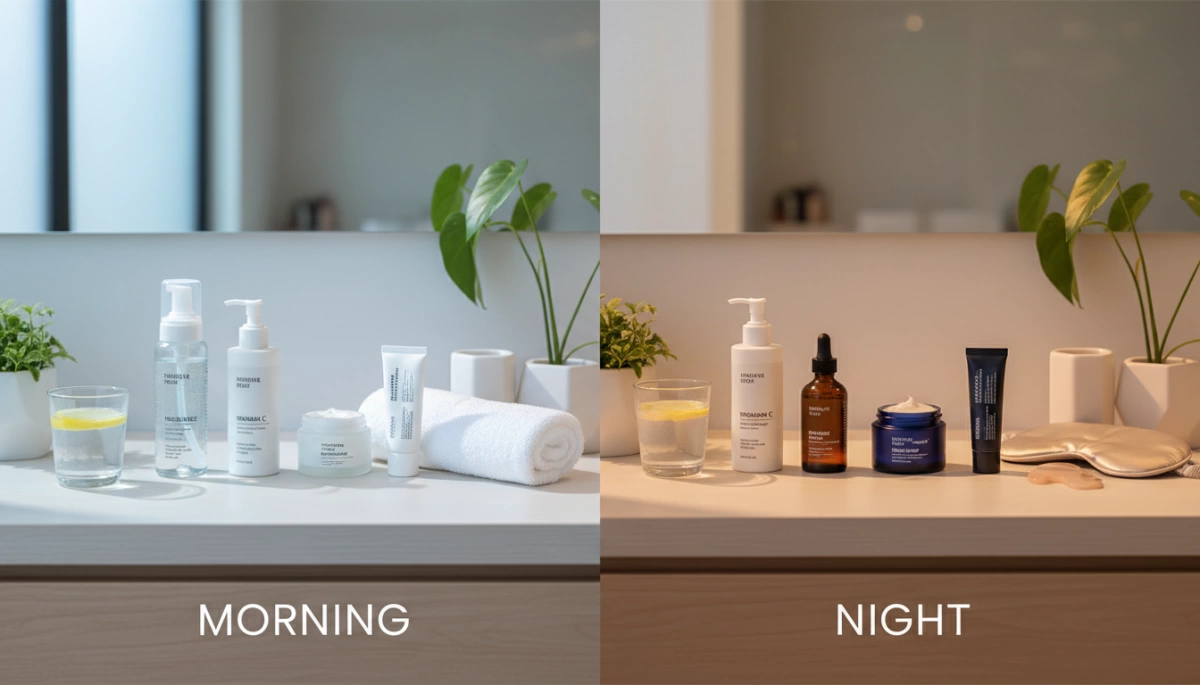
If you’re just starting a morning vs night skincare routine, keep it simple. A consistent AM vs PM skincare routine beats a 12-step routine you never stick to.
Minimal Morning Skincare Routine (3-Step)
This is your morning protection skincare setup. Fast, realistic, and beginner-friendly.
Step 1: Gentle cleanse (or rinse)
- Use a gentle cleanser for AM routine if you’re oily, acne-prone, or wear heavy skincare at night.
- If you’re dry or sensitive, a lukewarm water rinse is often enough.
Step 2: Antioxidant + hydration
- Use a lightweight antioxidant serum in the morning (like vitamin C for daytime or niacinamide) for pollution and free-radical protection.
- If your skin is tight, follow with a light gel moisturizer.
Step 3: SPF in morning routine (non‑negotiable)
- Use a broad spectrum sunscreen SPF 30 or higher every single morning, even if you work indoors.
- Go for textures that suit your skin:
- Oily: gel or fluid
- Dry: creamy, moisturizing
- Sensitive: mineral/mineral-hybrid formulas
This 3-step morning skincare routine covers cleansing, protection, and barrier support.
Minimal Nighttime Skincare Routine (3-Step)
Night is for night repair skincare, not overcomplicating things.
Step 1: Cleanse thoroughly
- If you wear makeup or sunscreen, start with an oil cleanser for makeup removal or balm.
- Follow with a gentle water-based cleanser (double cleansing evening) to remove residue without stripping.
Step 2: Treatment or serum
- Target your main concern with one active:
- Acne / clogged pores: AHA BHA exfoliant at night (2–3x/week, not daily at first)
- Dark spots: gentle vitamin C or niacinamide
- Anti-aging: low-strength retinol at night (2x/week to start)
Step 3: Hydrating night cream
- Seal everything in with a hydrating night cream focused on barrier repair skincare (ceramides, hyaluronic acid, squalane).
- For very dry skin, add 1–2 drops of facial oil on top.
How to Upgrade from Basic to Full Routines
Once the 3-step simple AM/PM skincare routine feels easy, add slowly:
To upgrade your AM routine:
- Add an essence or hydrating toner if you’re dehydrated.
- Add a dedicated eye cream if your eye area is dry or makeup creases.
- If you wear makeup, choose lightweight vs rich moisturizer textures so your base doesn’t pill.
To upgrade your PM routine:
- Add a separate exfoliant on nights you’re NOT using retinol.
- Add a sleeping mask 1–2x/week if you’re dry or travel often.
- Add targeted spot treatments for acne or dark spots.
Rule of thumb: introduce one new product at a time and give it 2–3 weeks before adding another.
Budget-Friendly AM/PM Routine (US-Focused)
You don’t need luxury to see results. For most people in the US, a smart, budget-friendly morning vs night skincare routine looks like this:
- Drugstore gentle cleanser (usable AM and PM)
- One treatment serum based on your main concern (vitamin C, niacinamide, or retinol)
- One basic moisturizer for day and night (adjust texture by skin type)
- One good sunscreen you actually like wearing daily
Start with multipurpose products:
- Use the same cleanser morning and night.
- Use one moisturizer both AM and PM, then upgrade later if needed.
- Skip extras (masks, mists, tools) until the basics are locked in.
How Long Until You See Results?
With a consistent AM vs PM skincare routine, here’s a realistic timeline:
- 1–2 weeks: Skin feels more hydrated, less tight or flaky.
- 4–6 weeks: Texture improves, fewer daily breakouts, makeup sits better.
- 8–12 weeks: Dark spots, fine lines, and deeper concerns start to shift (especially with retinol and exfoliants).
- 3–6 months: This is where real change shows if you’ve been consistent with SPF in morning routine and night repair skincare.
Bottom line: keep your morning vs night skincare routine simple, consistent, and affordable at first. Nail the basics, then layer in more advanced products as your skin (and budget) can handle it.
Customizing Morning vs Night Skincare Routine by Skin Type
Your AM vs PM skincare routine shouldn’t look the same for every skin type. Here’s how I’d set it up for real life, based on what actually works.
Dry Skin: Extra Hydration Morning and Night
Goal: Comfort, moisture, and barrier repair.
Morning skincare routine (dry skin):
- Gentle cream or milk cleanser (or just rinse if you’re not oily)
- Hydrating toner or essence (glycerin, hyaluronic acid)
- Antioxidant serum (vitamin C + niacinamide if your skin tolerates it)
- Rich but non-greasy moisturizer
- Broad spectrum sunscreen SPF 30+ with a creamy texture
Nighttime skincare routine (dry skin):
- Cream or oil cleanser to avoid stripping
- Hydrating layers (toner + serum with hyaluronic acid, panthenol, aloe)
- Barrier repair skincare: ceramides, squalane, cholesterol, shea butter
- Optional: sleeping mask 2–3x a week for extra moisture
Oily & Acne-Prone: Oil Control AM, Treatments PM
Goal: Control shine in the morning, treat breakouts at night.
Morning skincare routine (oily/acne-prone):
- Gentle foaming cleanser
- Lightweight, non-sticky toner (optional)
- Niacinamide serum for oil control + pores
- Oil-free gel moisturizer
- SPF 30+ (look for “non-comedogenic,” “matte,” or “oil-free”)
Nighttime skincare routine (acne-prone):
- Oil cleanser to remove makeup and sunscreen
- Gentle water-based cleanser (double cleansing evening is key)
- AHA/BHA exfoliant at night (2–4x a week, not daily at first)
- Targeted serum: salicylic acid, azelaic acid, or niacinamide
- Light gel-cream or lotion moisturizer (don’t skip moisturizer)
Combination Skin: Balance Different Zones AM vs PM
Goal: Hydrate dry areas, control shine in the T-zone.
Morning skincare routine (combination):
- Gentle gel cleanser
- Hydrating toner or essence all over
- Niacinamide or antioxidant serum
- Light lotion on T-zone, slightly richer cream on dry areas
- Broad spectrum sunscreen SPF 30+
Nighttime skincare routine (combination):
- Oil cleanser if you wear makeup/SPF, then gentle cleanser
- Exfoliant (AHA/BHA) 1–3x a week on T-zone, less often on dry spots
- Hydrating serum across the face
- Use different textures: gel on oily areas, cream on drier cheeks
Sensitive Skin: Gentle AM, Low-Irritation PM Actives
Goal: Calm, protect, and avoid flare-ups.
Morning skincare routine (sensitive):
- Very gentle, fragrance-free cleanser or just lukewarm water
- Soothing toner or essence (no alcohol, no strong fragrance)
- Serum with niacinamide, centella, or oat to calm redness
- Simple moisturizer with ceramides
- Mineral sunscreen (zinc or titanium dioxide) if chemical filters irritate you
Nighttime skincare routine (sensitive):
- Soft, non-stripping cleanser
- Hydrating serum (hyaluronic acid, panthenol, beta-glucan)
- Barrier repair cream with ceramides, squalane, cholesterol
- If using actives: start with low-strength (like 5% lactic acid or very gentle retinol) 1–2x per week and patch test first
Mature or Aging Skin: Antioxidants AM, Retinoids PM
Goal: Support firmness, smooth texture, and even tone.
Morning skincare routine (mature/aging):
- Gentle cleanser (no harsh foaming)
- Antioxidant serum in the morning: vitamin C, E, ferulic, or resveratrol
- Hydrating serum (hyaluronic acid) to plump
- Medium-to-rich moisturizer depending on how dry your skin is
- Broad spectrum SPF 30+ every single day, face + neck + chest
Nighttime skincare routine (mature/aging):
- Thorough cleanse (double cleanse if you wear makeup/SPF)
- Hydrating toner or essence
- Retinol at night or prescription retinoid (start 2–3x per week)
- Peptide or ceramide-rich moisturizer
- Optional: facial oil over moisturizer if skin is dry or tight
Teen vs Adult Skin: Different Needs, Same Basics
Teens (simple, acne-safe):
- Morning: gentle cleanser, light oil-free moisturizer, SPF 30+
- Night: cleanse, spot treatment for acne (benzoyl peroxide or salicylic acid), light moisturizer
→ Skip strong retinoids and heavy exfoliation unless a dermatologist suggests it.
Adults (more targeted):
- Morning: still simple, but add antioxidants (vitamin C, niacinamide)
- Night: retinoids, AHA/BHA, and richer barrier repair skincare when needed
→ Focus on consistency, not 20 steps.
Bottom line: Your morning vs night skincare routine should change with your skin type and your life. Keep AM focused on protection, keep PM focused on repair, and adjust textures and actives based on whether you’re dry, oily, combo, sensitive, mature, or still in your teen years.
Adjusting AM/PM Skincare for Common Skin Concerns
Acne and Breakouts: Morning vs Night Strategy
For acne‑prone skin, your AM vs PM skincare routine should split into prevention in the morning and treatment at night.
Morning (AM acne routine):
- Gentle cleanser or water rinse (no harsh scrubs)
- Lightweight, non‑comedogenic moisturizer (gel or lotion)
- Niacinamide serum for oil control and redness
- Broad spectrum sunscreen SPF 30+ (oil‑free, non‑comedogenic) – this protects healing breakouts and scars from getting darker
Night (PM acne routine):
- Double cleansing evening if you wear makeup/SPF (oil cleanser + gentle water‑based cleanser)
- Targeted AHA/BHA exfoliant at night 2–3x/week (salicylic acid for clogged pores)
- Acne treatment (benzoyl peroxide or retinoid at night)
- Barrier repair skincare on top (light, soothing moisturizer) so skin doesn’t dry out
Keep it simple: treat at night, protect in the morning.
Hyperpigmentation and Dark Spots: When to Treat What
For dark spots and post‑acne marks, your morning vs night skincare routine should focus on shielding by day, correcting by night.
Morning (hyperpigmentation AM routine):
- Antioxidant serum in the morning – vitamin C or a combo with niacinamide
- Moisturizer that doesn’t feel heavy under makeup
- Broad spectrum sunscreen SPF 30+ (or higher) every day, all year
- Reapply SPF if you’re outdoors a lot – no sunscreen = slower fade
Night (hyperpigmentation PM routine):
- Gentle cleanser, no stripping
- Chemical exfoliant (AHA like lactic or glycolic acid) 1–3x/week to speed cell turnover
- Targeted treatment serum – niacinamide, tranexamic acid, azelaic acid, or retinol at night
- Hydrating night cream to keep skin calm so you can tolerate actives
Think: AM = protect pigment, PM = fade pigment.
Redness and Sensitivity: Calming Routines AM vs PM
If your skin gets red, reactive, or easily irritated, your AM/PM skincare routine needs to stay gentle and low‑friction.
Morning (sensitive skin AM routine):
- Very gentle, sulfate‑free cleanser or just lukewarm water
- Calming toner or serum with ingredients like centella, panthenol, or aloe
- Simple moisturizer (no strong fragrance or essential oils)
- Mineral sunscreen (zinc/titanium) if chemical filters sting your skin
Night (sensitive skin PM routine):
- Soft cleanse – no makeup wipes or scrubs
- Skip strong acids most nights; if you use them, keep it 1x/week max
- Barrier repair skincare: look for ceramides, cholesterol, fatty acids, squalane
- If you use retinol, choose low strength, 1–2x/week, and buffer with moisturizer
Rule: If it burns or stays red, it’s not “working” – it’s too strong.
Dehydrated vs Dry Skin: Fixing Each with Smart Timing
A lot of people in the US mix these up.
- Dehydrated skin = lacks water
- Dry skin = lacks oil
For dehydrated skin (tight, dull, fine lines):
- Morning:
- Hydrating toner/essence with hyaluronic acid + glycerin
- Lightweight moisturizer that locks in water
- SPF to prevent more moisture loss
- Night:
- Layer watery hydrating products first, then a creamy moisturizer
- Add sleeping mask 2–3x/week if your skin feels tight by morning
For dry skin (flaky, rough, rarely oily):
- Morning:
- Creamier cleanser
- Richer moisturizer under SPF (cream or balm texture in winter)
- Night:
- Thicker night cream or facial oil over your moisturizer
- Focus on ceramides, shea butter, squalane for barrier support
Timing matters: water layers (essences/serums) first, then rich moisturizers and oils last, especially at night.
Dull, Tired Skin: Boosting Glow Morning and Night
If your skin looks flat or tired, your morning vs night skincare routine should hit glow by day, renewal by night.
Morning (glow‑boosting AM routine):
- Gentle exfoliating cleanser a few times a week (not daily if you’re sensitive)
- Vitamin C for daytime to brighten and fight free radicals
- Lightweight moisturizer that doesn’t make you look greasy
- SPF in morning routine – sun damage is the fastest way to lose glow
Night (glow‑boosting PM routine):
- Proper cleanse (especially if you commute, work out, or live in a city)
- AHA/BHA exfoliant at night 1–3x/week for smoother texture
- Retinol at night (if your skin can handle it) to support skin regeneration during sleep
- Hydrating night cream or sleeping mask so you wake up looking more plumped, not dull
Glow comes from consistent AM/PM skincare, not just one “miracle” product.
Common Morning Skincare Mistakes (AM vs PM Skincare Routine)
1. Skipping Sunscreen or Using Too Little SPF
In a morning vs night skincare routine, SPF is the one step you can’t negotiate.
- Use broad spectrum sunscreen SPF 30 or higher every single morning, even if you’re indoors or it’s cloudy.
- Use ½ teaspoon for face and neck (about two finger lengths).
- Reapply every 2 hours if you’re outside or near windows.
Without sunscreen, your vitamin C serum, antioxidant serum, and retinol at night can’t do their job long term.
2. Using Heavy, Greasy Products in the Morning
Daytime is about lightweight protection, not smothering your skin.
- Choose a lightweight moisturizer or gel-cream for day, and save the rich moisturizer and treatment oils for your night repair skincare.
- Heavy products under makeup cause pilling, creasing, and extra shine, especially for oily or combo skin.
If your skin feels sticky or greasy, you’re using too much product or the wrong texture for your AM routine.
3. Layering Products in the Wrong Order
Skincare routine order AM matters more than people think. Wrong order = wasted product.
Basic AM skincare routine order:
- Cleanser (or rinse)
- Toner/Essence (optional)
- Serum (like vitamin C, niacinamide, antioxidants)
- Moisturizer
- SPF (always last step in skincare, before makeup)
Thin to thick, water-based to oil-based. SPF is always your final skincare layer in the morning.
4. Mixing Harsh Actives Before Daytime Sun Exposure
Some strong actives + sun = irritation and faster sun damage.
Be extra careful with in the morning:
- High-strength AHAs/BHAs (glycolic, salicylic, lactic)
- Strong retinoids/retinol
- Multiple actives layered at once (like vitamin C + strong acid toner + exfoliant)
If you use acids, keep them mild in the AM and stay strict with SPF. Save strong acids and retinoids for your nighttime skincare routine.
5. Copying Social Media Routines That Don’t Match Your Skin
What works for a 19-year-old creator with oily skin in LA might wreck a 35-year-old with sensitive, dry skin in New York.
Avoid:
- Buying full routines just because they “went viral”
- Layering 5+ actives “for glow” with no plan
- Ignoring your own skin type and lifestyle
Instead, build a simple AM vs PM skincare routine that fits:
- Your skin type (dry, oily, combo, sensitive, acne-prone)
- Your budget
- Your time (realistic 3–5 steps, not 12)
The goal in the morning: protect, not punish your skin.
Common Mistakes in Night Skincare
1. Not cleansing properly before bed
If your nighttime skincare routine starts on dirty skin, everything after is basically wasted.
Big mistakes:
- Only using a makeup wipe
- Skipping cleanser because you “didn’t wear makeup”
- Not doing a double cleansing evening routine when you wore SPF or long‑wear makeup
Do instead:
- If you wore sunscreen or makeup:
- Oil cleanser or balm to break down SPF/makeup
- Gentle water‑based cleanser to actually clean the skin
- If you didn’t: one gentle cleanse is enough, but don’t skip it
Clean skin at night = better absorption + fewer breakouts.
2. Overloading actives in your nighttime skincare routine
Night is when most people throw everything on their face—and that’s why they end up red, flaky, or breaking out.
Common overloading combos:
- Retinol + AHA + BHA + vitamin C all in one night
- Using a strong exfoliant every single night
- Layering multiple “treatment” serums back to back
Signs you’re doing too much:
- Stinging, burning, or tightness
- Sudden sensitivity to products that used to feel fine
- More breakouts or rough texture
Keep your night repair skincare simple:
- 1 active step max per night (retinol or acid, not both)
- Balance with hydrating and barrier repair products
3. Switching products too fast to “fix” your skin
A lot of people in the U.S. bounce from product to product because TikTok said so, then blame their skin.
What goes wrong:
- No product gets a full 4–6 weeks to work
- Skin barrier never stabilizes
- You don’t know what’s helping vs hurting
Stronger PM products need time, especially:
- Retinol at night
- AHA/BHA exfoliants
- Dark spot treatments
Give a new product at least 3–4 weeks (unless it clearly burns or causes a rash) before judging it.
4. Using retinol and strong exfoliants together
This is one of the most common night skincare mistakes and a fast track to irritation.
Harsh pairings to avoid at night (without derm guidance):
- Retinol + high‑percentage AHA
- Retinol + BHA + physical scrub
- Retinol + strong peeling solutions
Better approach:
- Retinol nights: retinol + gentle hydrating layers + moisturizer
- Exfoliant nights: AHA/BHA + hydrating serum + moisturizer
- At least 1–2 “rest nights” weekly: no strong actives, just barrier repair skincare
5. Going to bed with a damp, under‑moisturized skin barrier
Going to sleep with skin that’s just slightly damp and not properly sealed in can leave you tight, dry, and irritated by morning.
Mistakes here:
- Only using a thin serum and calling it a night
- Letting hydrating toner/essence fully evaporate with nothing on top
- Thinking oily skin doesn’t need a hydrating night cream
Do instead:
- Apply moisturizer while skin is slightly damp (not dripping wet)
- Choose texture based on your skin:
- Oily/acne‑prone: lightweight gel‑cream
- Normal/combination: soft cream
- Dry/sensitive: richer cream or sleeping mask
- Lock in your routine so your barrier stays calm and supported overnight
Getting your PM skincare routine right isn’t about doing “more”—it’s about doing the right steps, in the right order, without beating up your skin.
Pro Tips to Make Your AM/PM Routine Actually Work
Test New Products Safely at Night First
If you’re adding anything new to your AM vs PM skincare routine, start at night.
How to patch test:
- Apply a small amount to just one area (side of face or jawline), not your whole face.
- Use it 2–3 nights a week for the first 2 weeks.
- If you see burning, stinging, or a rash, rinse off and stop using it.
- Only move it into your full nighttime skincare routine once your skin stays calm.
For stronger actives (retinol, AHA/BHA), avoid layering a bunch of new products at the same time. One new product at a time only.
Signs Your Morning Skincare Routine Is Working (or Not)
A solid morning vs night skincare routine should show in your daytime skin.
Good signs:
- Skin feels comfortable, not tight or greasy by midday
- Makeup goes on smooth, no heavy pilling over your morning skincare steps
- Less redness or burning when you’re in the sun
- Fewer new dark spots / less uneven tone over time
Bad signs:
- Skin burns when you apply sunscreen or step into the sun
- You look shiny within an hour, or feel dry and flaky by noon
- Constant pilling when you layer SPF and makeup
- Breakouts pop up in the same areas after your AM routine
If things feel off, simplify your morning protection skincare to: gentle cleanser, antioxidant serum, lightweight moisturizer, broad-spectrum sunscreen SPF 30+.
Signs Your Night Repair Skincare Is Too Strong or Too Weak
Too strong:
- Stinging every night, not just mild tingling
- Peeling, flaking, or tightness around the mouth, nose, and eyes
- Sudden sensitivity to products that used to feel fine
- Breakouts plus irritation after adding retinol or strong acids
Dial it back by:
- Cutting retinol or AHA/BHA to 1–2 nights per week
- Using a thicker hydrating night cream or barrier repair skincare
- Avoiding mixing multiple strong actives in one PM routine
Too weak:
- No real change in texture, pores, or fine lines after 8–12 weeks
- Dark spots or acne marks barely fading
- Still getting the same amount of breakouts
Then you can:
- Slowly increase retinol nights (as long as your skin is calm)
- Add an AHA/BHA exfoliant at night 1–2x weekly
- Focus more on consistency rather than chasing new products
How to Track Changes in Your Skin Over a Month
To see if your simple AM/PM skincare routine is actually working, track it like this:
- Take makeup-free selfies weekly in the same lighting
- Note oiliness, dryness, and breakout spots in your phone’s Notes app
- Pay attention to how your skin feels when you wake up vs midday
- Don’t judge a product before 4–6 weeks unless you’re clearly irritated
You’re looking for small, steady improvements, not overnight miracles.
When to See a Dermatologist
Get professional help if:
- Acne is deep, painful, or leaving scars
- You have sudden, intense redness, burning, or itching
- Dark spots keep spreading even with sunscreen and vitamin C
- Over-the-counter retinol and exfoliants aren’t doing much after 3–4 months
- You’re not sure how to safely use actives in your AM vs PM skincare routine
A dermatologist can build a custom morning and night skincare routine for your skin type and prescribe stronger treatments when drugstore products aren’t enough.
Adapting Your Routine to Seasons and Lifestyle
Summer vs Winter AM Skincare Changes
Your AM vs PM skincare routine should not look the same in July and January. The skin’s needs shift fast with heat, cold, and indoor AC.
Summer morning routine tweaks (hot, humid, sunny):
- Use a gentle cleanser for AM routine (gel or foaming, non‑stripping).
- Switch to a lightweight moisturizer or gel cream; avoid heavy layers under SPF.
- Lean into antioxidant serum in the morning (vitamin C, niacinamide) for pollution + UV defense.
- Go hard on broad spectrum sunscreen SPF 30+ (SPF 50 if you’re outside a lot). Reapply every 2 hours.
- If you’re oily or acne‑prone, use oil‑control products in the morning (niacinamide, zinc, light BHA toner).
Winter morning routine tweaks (cold, dry, indoor heat):
- Use a creamier or hydrating cleanser or just a water rinse if your skin is dry and sensitive.
- Upgrade to a richer moisturizer but keep it comfortable under makeup.
- Layer in hydrating serums (hyaluronic acid, glycerin) before moisturizer.
- Seal things in with a barrier repair skincare cream (ceramides, squalane, cholesterol).
- SPF is still non‑negotiable, even if it’s gloomy out.
Adjusting Nighttime Skincare in Dry or Humid Climates
Night repair skincare has to match the air you’re sleeping in.
If you’re in a dry climate or blasting indoor heat:
- Focus on hydrating night cream textures and barrier support.
- Look for ceramides, squalane, shea butter, and hyaluronic acid in your PM routine.
- Use strong actives (retinol at night, AHA/BHA) less often to avoid over‑drying.
- Try a sleeping mask 2–3 nights a week if your skin feels tight.
If you’re in a humid climate:
- Go lighter at night: gel creams, emulsions, thin lotions.
- You can still use retinol or AHA BHA exfoliant at night, just keep layers minimal so pores don’t feel congested.
- Facial oils should be used sparingly or only on dry patches.
Skincare for Night Shift Workers or Irregular Sleep
If your “nighttime” is 9 a.m., your skin still has a circadian rhythm, but you’re also fighting light exposure, stress, and messed‑up sleep.
- Treat your “before sleep” routine as your PM routine, no matter what time the clock says:
- Double cleansing evening style if you wear makeup/SPF.
- Use night repair skincare (retinoids or gentle exfoliants if your skin tolerates them).
- Finish with a hydrating night cream or barrier‑focused moisturizer.
- For your “wake‑up” routine (even if it’s at night):
- Do a light cleanse or rinse.
- Use antioxidants (vitamin C, niacinamide) for environmental protection.
- Always finish with broad spectrum sunscreen SPF 30 if you’ll be near windows or outdoor light.
- Prioritize sleep quality (dark room, regular schedule where possible); your skin regeneration during sleep depends on it.
Travel Days: Simple AM vs PM Skincare on the Go
Travel, especially for U.S. customers flying long distances, wrecks the skin fast: dry cabin air, different water, stress, new climate.
Keep a simple AM/PM skincare routine when traveling:
- Stick to a minimalist skincare routine:
- AM: gentle cleanser, antioxidant serum, lightweight vs rich moisturizer (choose based on climate), SPF in morning routine.
- PM: oil cleanser for makeup removal or wipes + gentle cleanser, one treatment (retinol OR AHA/BHA, not both), hydrating cream.
- On planes:
- Skip heavy actives; focus on hydration and barrier repair.
- Use a hydrating mist, serum, then moisturizer; SPF only if you’re near windows with strong light.
- Travel sizes or refillable bottles only; keep it low effort so you actually stick to it.
How Hormones, Stress, and Diet Affect AM/PM Routines
Your lifestyle shows up on your face. Hormones, stress, and diet change what your morning vs night skincare routine needs.
Hormones (period, pregnancy, perimenopause):
- Can increase oil and acne:
- AM: use oil‑control but gentle products (niacinamide, light BHA).
- PM: add targeted acne prone skincare at night (salicylic acid, adapalene or retinoids if cleared by your doctor).
- Perimenopause/menopause often brings dryness and sensitivity:
- More barrier repair skincare and fewer harsh actives at night.
Stress:
- Raises inflammation, worsens acne, redness, and dullness.
- Keep routines simple and soothing:
- AM: mild cleanser, antioxidant serum, calm moisturizer, SPF.
- PM: gentle cleanse, niacinamide and barrier cream, limit strong exfoliants.
Diet and lifestyle (high sugar, low water, heavy alcohol):
- Can lead to more breakouts and dehydration.
- Skincare can’t fix everything, but you can:
- Add extra hydrating layers at night (HA, glycerin, urea).
- Keep exfoliation at night controlled (1–3x/week, not daily).
- Use brightening ingredients (vitamin C AM, retinoids or azelaic acid PM) for dull, uneven tone.
The bottom line: your morning vs night skincare routine should move with your life—season, schedule, travel, and stress. If your skin changes, your routine should too.