
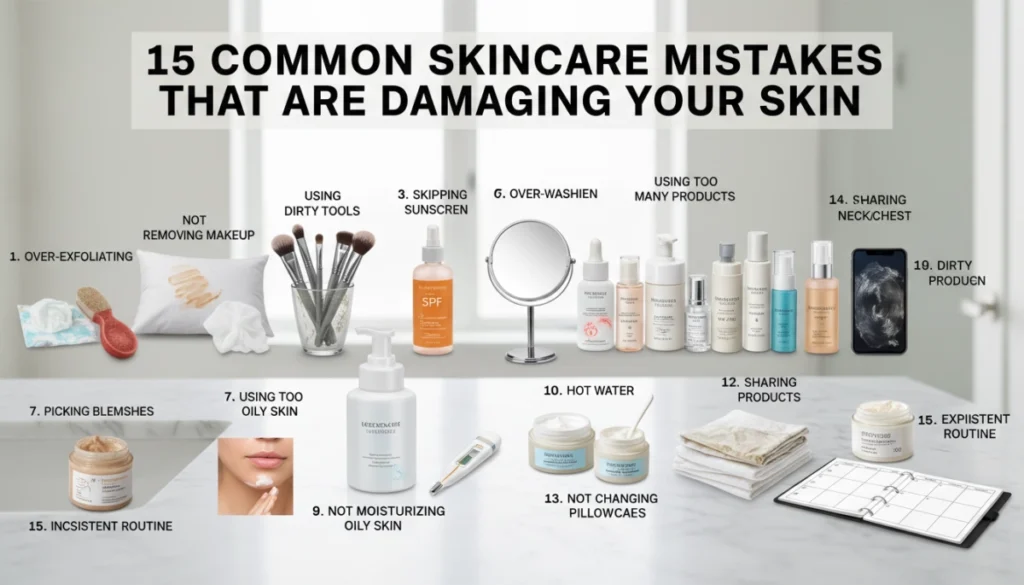
You’re doing “all the right things” for your skin…
Yet you’re still dealing with breakouts, dryness, redness, or that stubborn dull, tired look.
Chances are, it’s not your products—it’s a few common skincare mistakes quietly working against you.
In this guide, you’ll discover 15 common skincare mistakes that are damaging your skin—things like over-exfoliating, skipping sunscreen, sleeping in makeup, using harsh cleansers, and mixing too many active ingredients at once.
Most of these damaging skin habits come from good intentions and bad advice.
The good news? They’re 100% fixable.
You’ll learn:
- Which everyday skincare errors are secretly hurting your skin barrier
- How they lead to premature skin aging, irritation, and more breakouts
- Simple, proven tweaks to fix your skincare routine and get calmer, brighter, healthier skin
If you’re ready to stop sabotaging your glow and finally build a routine that actually works, keep reading.
Why These Skincare Mistakes Matter
If your skin feels red, tight, oily yet dehydrated, or constantly breaking out, it’s usually not because you “have bad skin.” It’s much more often about a few everyday skincare mistakes quietly damaging your skin barrier.
Your skin barrier is the thin, protective layer on the surface of your skin that keeps moisture in and irritants out. When daily habits chip away at it—even small ones like using harsh cleansers, skipping sunscreen, or over-exfoliating—you get:
- Irritation and sensitivity – stinging, burning, and redness from products that used to feel fine
- More breakouts and clogged pores – an angry, unbalanced barrier leads to more acne, not less
- Premature aging – fine lines, rough texture, and sagging show up faster when the barrier is weak
- Dark spots and uneven tone – UV damage and inflammation trigger stubborn hyperpigmentation
These damaging skin habits build up over time. You might not see a reaction overnight, but months of common skincare errors can turn into dull, tired-looking skin that never seems to improve—no matter how expensive your products are.
That’s why I focus first on fixing everyday skincare mistakes instead of telling you to buy more. When you:
- Protect your barrier
- Use actives correctly
- Cleanse and moisturize the right way
…your existing products start working better, your skin calms down, and you get closer to healthy, glowing skin without constantly chasing the next “miracle” serum.
Over-Exfoliating Your Skin
Over-exfoliating your skin is one of the most common skincare mistakes I see, and it quietly wrecks your skin barrier.
What Over-Exfoliation Does to Your Skin Barrier
When you overdo scrubs, peels, or strong acids, you:
- Strip away protective oils and weaken the skin barrier
- Trigger redness, burning, and sensitivity
- Make breakouts, dark spots, and fine lines look worse
- Increase water loss, so your skin feels dry but looks oily and irritated
This kind of skin barrier damage is a big reason your products “stop working.”
Signs You’re Over-Exfoliating
If you’re dealing with any of these, you’re probably over-exfoliating your skin:
- Burning or stinging from products that never used to sting
- Persistent redness or blotchiness
- Tight, dry, “squeaky clean” feeling after washing
- Flaky patches with shine or oil sitting on top
- Breakouts that feel inflamed and angry instead of just clogged
How Often You Should Exfoliate (By Skin Type)
You don’t need daily exfoliation. For most people in the U.S., this is a safer range:
- Oily / acne-prone skin: 2–3x per week (gentle chemical exfoliant)
- Combination skin: 1–2x per week
- Dry or sensitive skin / rosacea-prone: 0–1x per week, very gentle, or skip entirely
- Using strong actives (retinol, prescription acne meds): Cut exfoliation way down or pause
If your skin is already irritated, stop all exfoliation until it calms down.
How to Fix Over-Exfoliating and Repair Your Skin Barrier
To undo this damaging skin habit, pull back hard and go into repair mode:
- Stop all scrubs, peels, and acids for at least 1–2 weeks
- Switch to a gentle, non-stripping cleanser (no foaming “oil-control” wash)
- Use a simple moisturizer with ceramides, glycerin, and/or hyaluronic acid
- Add a barrier-repair cream or balm at night if your skin feels raw or tight
- Use daily sunscreen (SPF 30 or higher) — over-exfoliated skin burns fast
- Avoid hot water, strong toners, fragrance-heavy products, and new actives
Most over-exfoliated skin in the U.S. market calms down in 2–6 weeks if you stop the damage and focus on barrier repair skincare instead of chasing stronger products.
Skipping Daily Sunscreen Is Wrecking Your Skin
Skipping daily sunscreen is one of the 15 common skincare mistakes that quietly does the most damage. In the U.S., we’re in cars, near windows, on phones outside at games, walking dogs—UV hits your skin even when you’re “not really in the sun.” If you’re serious about healthy, glowing skin and anti-aging, SPF is non‑negotiable.
Why Skipping Sunscreen Is One of the Worst Skincare Mistakes
When you skip SPF, you’re basically choosing:
- Faster wrinkles and fine lines
- More dark spots and uneven tone
- Weaker skin barrier and more sensitivity
- Higher long-term risk of skin cancer
UV damage builds up daily, even on cloudy days and through glass. You can have a perfect routine, but if you don’t wear sunscreen, you’re undoing your own results.
How UV Damage Causes Premature Aging and Dark Spots
UV rays trigger:
- Collagen breakdown → sagging, wrinkles, “crepey” skin
- Pigment overproduction → dark spots, melasma, post-acne marks that won’t fade
- Chronic inflammation → redness, rough texture, dull, tired‑looking skin
That “I just look tired all the time” look? A lot of it is sun damage plus inconsistent SPF.
Common Sunscreen Myths You Need to Drop
These skincare mistakes to avoid show up in almost every conversation I have with U.S. customers:
-
“I’m inside most of the day, I don’t need SPF.”
Indoor light + windows still let UVA through. If you can see daylight, your skin is getting hit. -
“I have darker skin, so I’m protected.”
Deeper skin tones still get sun damage, dark spots, and uneven tone—they just show up differently. -
“Sunscreen breaks me out.”
Heavy, oily formulas might. Wrong product ≠ sunscreen is bad. Look for “non-comedogenic” and formulas for acne-prone or oily skin. -
“My makeup with SPF is enough.”
You’d need way more foundation than anyone actually wears. Treat makeup SPF as a bonus, not your main protection.
How to Build an Easy Everyday SPF Habit
To fix this damaging skin habit, make sunscreen automatic, like brushing your teeth:
-
Use a formula you actually like.
For U.S. customers, lightweight, non-greasy, no white cast, and no strong scent is key. I build my formulas to disappear into the skin, not sit heavy. -
Apply enough:
- About 2–3 finger lengths of sunscreen for face and neck
- SPF 30 or higher, every morning
-
Make it last-step morning routine:
- Cleanser
- Moisturizer
- Sunscreen (always last before makeup)
-
Reapply when you’re out:
- Every 2 hours if you’re in direct sun
- Use stick, spray, or powder SPF over makeup—super practical for school runs, games, lunch breaks.
Daily sunscreen is the simplest, most effective anti-aging and dark-spot prevention step you can take. Fix this one skincare mistake, and your whole routine works better.
Sleeping in Makeup: One of the Biggest Skincare Mistakes

What happens when you sleep with makeup on
Sleeping in makeup is one of the 15 common skincare mistakes that quietly wrecks your skin over time. When you leave makeup on overnight:
- Foundation, concealer, and powder mix with oil, sweat, and pollution
- This combo sits in your pores for hours, clogging them and trapping bacteria
- Your skin can’t properly repair, renew, or breathe while you sleep
- Eye makeup can irritate your eyes and lash line, leading to redness and breakage
Bottom line: sleeping in makeup is a direct path to dull, tired-looking skin and more breakouts.
How clogged pores, irritation, and dullness show up
If sleeping in makeup has become a habit, you’ll usually notice:
- More breakouts and clogged pores – blackheads, whiteheads, and texture bumps
- Irritation and redness – especially around the nose, chin, and eyes
- Rough, uneven texture – your skin feels bumpy instead of smooth
- Dullness – even with highlighter, your skin looks flat, not glowing
- Flakiness – especially if you use long-wear or matte formulas that dry skin out
These are classic everyday skincare mistakes that push your skin toward sensitivity and barrier damage.
Best way to remove makeup gently (without stripping)
You don’t need a 10-step routine. You just need the right removal steps that won’t wreck your barrier:
Step 1: Melt and lift the makeup
Use one of these first:
- Oil cleanser or cleansing balm – best for long-wear, waterproof makeup
- Micellar water on cotton pads – great for sensitive or acne-prone skin
Gently massage (or swipe) until makeup breaks down. Don’t scrub.
Step 2: Cleanse with a gentle face wash
Follow with a non-stripping, low-foam cleanser:
- No harsh sulfates, strong fragrance, or alcohol
- Skin should feel clean, not tight or “squeaky”
This “double cleanse” gets rid of makeup, sweat, and sunscreen without over-drying.
Simple night routine if you’re tired or lazy
If you’re in the U.S., working long hours, parenting, or just exhausted at night, keep it stupid simple so you’ll actually stick to it:
Bare-minimum lazy-night routine:
- Micellar water or makeup-removing wipes (better than sleeping in makeup)
- Gentle cleanser at the sink if you have 30 more seconds
- Moisturizer – lightweight gel for oily skin, cream for dry/sensitive
If you can handle one extra step:
- Add a hydrating serum (like hyaluronic acid) before moisturizer to fight dullness
- Keep products on your nightstand so you don’t skip everything
As an owner/operator in this space, my rule is simple:
If you’re going to cut corners anywhere, never make that corner sleeping in makeup. Even the quickest 3-step night routine will help prevent clogged pores, irritation, breakouts, and premature skin aging caused by this super common skincare mistake.
Using Harsh, Stripping Cleansers
Using harsh, stripping cleansers is one of the most common skincare mistakes that quietly wrecks your skin barrier.
How Harsh Cleansers Damage Your Skin Barrier
When a cleanser is too strong, it:
- Strips your natural oils your barrier needs to stay balanced
- Disrupts your microbiome (the “good” bacteria that protect your skin)
- Triggers redness, burning, and tightness
- Can make acne, sensitivity, and dryness way worse over time
If your face feels “squeaky clean,” it’s usually a bad sign, not a goal.
Ingredients and Textures That Are Too Aggressive
Watch out for cleansers that are:
- Loaded with sulfates like Sodium Lauryl Sulfate (SLS)
- Heavy on alcohol (SD alcohol, denatured alcohol high on the list)
- Packed with fragrance or essential oils in a “tingly” wash
- Gritty, abrasive scrubs with rough beads or shells used daily
- Foams that create big, fluffy bubbles and leave that tight, dry feel
These are classic damaging skin habits that lead to barrier damage and dull, irritated skin.
How to Tell If Your Cleanser Is Too Strong
Your cleanser is likely too harsh if you notice:
- Skin feels tight, dry, or itchy right after washing
- You see redness, burning, or stinging with other products
- Oily skin that gets shiny fast because your barrier is stripped
- Flaking around the nose, mouth, or cheeks
- Breakouts that don’t calm down even with acne products
If your skin feels worse right after cleansing than before, that’s your sign.
Better Cleanser Choices by Skin Type
You don’t need anything fancy here. For most people in the U.S., these simple formulas work best:
Oily or Acne-Prone Skin
- Go for gentle gel or light foaming cleansers
- Look for: salicylic acid, minimal fragrance, non-comedogenic
- You want skin to feel clean but comfortable, not dry and squeaky
Dry Skin
- Use cream, lotion, or milky cleansers
- Look for: ceramides, glycerin, hyaluronic acid, squalane
- Skin should feel soft and hydrated after rinsing
Sensitive or Red-Prone Skin
- Choose fragrance-free, non-foaming, low-surfactant cleansers
- Avoid strong acids in your face wash
- No “cooling,” “tingling,” or “deep cleansing” claims
Combination Skin
- A gentle gel works for most
- You can spot-clean the T-zone a bit longer and keep it quick on dry areas
When in doubt, err on the side of mild, low-foam, fragrance-free. Fixing this one everyday skincare mistake alone can calm irritation, support your skin barrier, and make every other product in your routine work better.
Washing Your Face with Hot Water: A Common Skincare Mistake to Avoid
Using hot water on your face is one of those common skincare mistakes that feels nice in the moment but quietly wrecks your skin barrier over time.
Why Hot Water Is Rough on Your Face
Hot water:
- Strips your natural oils → dryness + tightness
- Weakens your skin barrier → redness + burning + sensitivity
- Can trigger flare-ups if you have acne, eczema, or rosacea
- Makes skin feel “squeaky clean” but actually leaves it dehydrated and irritated
Hot, Warm, and Cold Water: What’s Best?
| Water Temp | What It Does | Good/Bad for Skin Health |
|---|---|---|
| Hot | Strips oil, boosts redness, irritation | Bad – damaging skin habit |
| Warm | Cleans without harsh stripping | Best – skin barrier–friendly |
| Cold | Feels refreshing, reduces puffiness | Okay – but won’t “close pores” |
Ideal range: lukewarm water – think “room temp plus a little,” not steamy shower hot.
How Temperature Affects Different Skin Types
-
Dry skin:
Hot water = more flaking, tightness, and dull, tired-looking skin.
Stick to short, lukewarm washes and a creamy, gentle cleanser. -
Oily or acne-prone skin:
Hot water tricks your skin into producing more oil to compensate.
Use lukewarm water with a mild gel or foaming cleanser, then moisturize. -
Rosacea-prone or sensitive skin:
Heat is a major trigger → flushing, burning, broken capillaries.
Use cool–lukewarm water only, avoid steamy showers on your face.
How to Adjust Your Cleansing Routine to Protect Your Barrier
To avoid this skincare mistake that damages your skin barrier, try:
- Wash with lukewarm water only (if it feels hot on your hand, it’s too hot for your face).
- Keep face-washing to 1–2 times a day max.
- Use gentle, non-stripping cleansers (no harsh sulfates, no strong fragrances).
- After cleansing, pat (don’t rub) dry, then apply moisturizer while skin is still slightly damp.
- In the shower, wash your face last with cooler water instead of letting hot water hit it the whole time.
Small switch: hot → lukewarm water. Big payoff: less redness, stronger barrier, healthier, glowing skin.
Mixing Too Many Strong Actives at Once
If there’s one skincare mistake I see nonstop in the U.S., it’s loading up on every “power” ingredient at once. That’s how you end up with a fried skin barrier instead of healthy, glowing skin.
Common Strong Actives People Overload
These are the big ones I see stacked in the same routine:
- Retinol/retinoids (anti-aging, acne)
- Acids
- AHAs: glycolic, lactic, mandelic
- BHAs: salicylic
- PHAs: gentler acids
- Vitamin C (L-ascorbic acid especially)
- Benzoyl peroxide
- Strong niacinamide (10%+)
- Exfoliating toners/peels used daily
Using them all isn’t the problem. Using them all at the same time is.
Irritating Skincare Combinations to Avoid
These combos are some of the most common skincare mistakes to avoid if you don’t want burning, redness, and breakouts:
- Retinol + strong acids (AHA/BHA) in the same routine
→ Too much exfoliation, major barrier damage. - Retinol + benzoyl peroxide at the same time
→ Can be extremely drying and irritating. - High-strength vitamin C + AHA/BHA in the same routine
→ Extra sting, redness, and sensitivity. - Multiple exfoliating products in one routine
→ Example: exfoliating cleanser + acid toner + peeling serum. - Using every “intense” product daily
→ Skin never gets a chance to recover.
If your skin is sensitive, acne-prone, or you’re dealing with barrier damage, be even more strict with these.
Signs Your Actives Are Too Strong or Not Working Well Together
If you’re mixing too many strong actives, your skin will usually tell you:
- Redness that sticks around, not just a 10-minute flush
- Burning or stinging when you apply even simple products
- Tight, dry, or shiny skin that feels stripped after washing
- Flaking or peeling around the nose, mouth, or cheeks
- More breakouts than usual (especially tiny, rash-like bumps)
- Products suddenly sting that never bothered you before
These are classic signs of skin barrier damage from overusing actives, not “purging” in most cases.
How to Safely Layer Active Ingredients Without Damage
You don’t need a complicated routine to get results. You just need a smart one. Here’s how I’d set it up for most people in the U.S. with normal, busy lives:
1. Limit your “big guns” per routine
- Aim for 1 strong active per routine (AM or PM), especially if you’re new:
- AM: Vitamin C or gentle exfoliating toner (not both)
- PM: Retinol or AHA/BHA (not both)
2. Alternate days instead of stacking
- Example schedule:
- Monday, Wednesday, Friday (PM): Retinol
- Tuesday, Saturday (PM): AHA/BHA
- Other nights: Just cleanser + moisturizer
3. Layer from thin to thick
- Basic order:
- Cleanser
- Watery toner/essence (if you use one)
- Water-based serums (vitamin C, niacinamide, etc.)
- Creams/lotions
- Face oils (if used)
- SPF in the morning only
4. Buffer strong actives
- If you’re sensitive:
- Apply a light moisturizer first, then retinol on top.
- Use acids after moisturizer or switch to a gentler PHA.
5. Start low and slow
- Retinol: 2–3 nights a week, then build up.
- Acids: Start 1–2x per week, not daily.
- Vitamin C: Start with lower strength or gentler forms if your skin is reactive.
When in doubt, simplify. A calm, consistent routine with fewer strong actives will out-perform a chaotic routine full of “viral” products every single time.
Not Moisturizing Properly (Even If You Are Oily)
Why skipping moisturizer makes oily skin worse
One of the most common skincare mistakes is thinking “I’m oily, so I don’t need moisturizer.” That logic backfires.
When your skin gets dehydrated, it:
- Overproduces oil to compensate
- Looks shinier but still feels tight
- Breaks out more because of excess sebum + clogged pores
So yes, skipping moisturizer can actually make oily skin even oilier and more acne-prone.
Hydration vs. moisture (simple breakdown)
You need both — especially in the U.S. where many of us deal with AC, heating, and dry indoor air.
| Term | What it means | Look for on label |
|---|---|---|
| Hydration | Water in the skin | Hyaluronic acid, glycerin, aloe, panthenol |
| Moisture | Oil/occlusives that lock water in | Ceramides, squalane, shea butter, petrolatum, jojoba |
Hydrating = adding water.
Moisturizing = sealing that water in.
How to pick the right moisturizer for your skin type
Use this as a quick cheat sheet:
| Skin Type | Texture to choose | Key ingredients to look for |
|---|---|---|
| Oily / Acne-Prone | Lightweight gel or gel-cream | Niacinamide, hyaluronic acid, zinc, green tea, squalane |
| Dry | Rich cream or balm | Ceramides, shea butter, cholesterol, fatty acids |
| Combination | Gel-cream overall, richer on dry areas | Hyaluronic acid + light oils (squalane, jojoba) |
| Sensitive | Minimal, fragrance-free cream | Ceramides, panthenol, centella, colloidal oatmeal |
Skincare mistakes to avoid here:
- Thick, oily creams on very oily skin
- Strong fragrance if you’re sensitive
- Heavy alcohol-based gels that feel “light” but dry you out
Best way to apply moisturizer for maximum benefit
To avoid skin barrier damage and get the most out of your routine:
- Apply on damp skin
- After cleansing or toner, don’t wait until your face is bone dry
- Use enough product
- About a nickel-sized amount for face; more if you include neck
- Press, don’t rub harshly
- Gentle upward strokes; no tugging
- Layer smart
- Order: cleanser → hydrating serum (optional) → moisturizer → SPF (AM)
- Adjust by climate
- In dry U.S. winters: go a bit richer
- In humid summers: switch to gel or lighter lotion
Fixing not moisturizing properly is one of the fastest ways to reduce dull, tired-looking skin, control excess oil, and support a healthy, calm skin barrier.
Picking or Popping Pimples: One of the Worst Skincare Mistakes
Picking or popping pimples is easily one of the 15 common skincare mistakes that quietly destroys your skin over time.
What Really Happens When You Pop a Pimple
When you squeeze a pimple, especially with dirty fingers:
- You push bacteria and oil deeper into the skin
- The wall of the pore can tear, causing more inflammation
- Gunk can spread under the skin, turning one pimple into a cluster of breakouts
- Your skin barrier takes another hit, leading to red, sensitive, irritated skin
This is one of those damaging skin habits that feels satisfying for 5 seconds and then costs you months of healing.
How Picking Leads to Scars, Dark Spots, and More Breakouts
Pimple popping scars and dark spots are extremely common in the U.S., especially on acne-prone and deeper skin tones:
- Scars – Squeezing can cause indentations (ice pick or boxcar scars) that are expensive to treat
- Post-inflammatory dark spots – Melanin rushes to the damaged area, leaving brown spots that hang around for months
- More breakouts – Bacteria from your nails spreads to nearby pores, causing new pimples
- Long-term redness – Especially if you already have sensitive or rosacea-prone skin
These are classic skincare mistakes causing acne, hyperpigmentation, and uneven texture.
Safer Ways to Treat Active Breakouts at Home
If you’re dealing with an active breakout, focus on calm, targeted care, not attack mode:
- Hands off – Do not pick, press, scratch, or “just clean the top”
- Use a salicylic acid spot treatment or benzoyl peroxide 2.5–5% on individual pimples
- Apply hydrocolloid pimple patches – They absorb gunk, protect from your fingers, and reduce picking
- Keep your routine simple and gentle:
- Mild cleanser
- Lightweight, non-comedogenic moisturizer
- Daily SPF 30+ (to prevent dark spots from healing pimples)
This fits into a solid acne-prone skincare routine without wrecking your barrier.
When to See a Dermatologist Instead of Squeezing
Skip the bathroom mirror surgery and call a derm when:
- You have painful, cystic, or deep acne that never comes to a head
- Breakouts are covering large areas (cheeks, jawline, back, chest)
- You’re seeing scars or dark spots from past picking
- Over-the-counter products haven’t helped after 8–12 weeks
A board-certified dermatologist in the U.S. can offer:
- Prescription topicals (tretinoin, stronger retinoids, azelaic acid)
- Oral meds for hormonal or cystic acne
- Professional extractions done in a sterile, controlled way
Bottom line: Not touching your face and not picking pimples is one of the fastest ways to prevent skin barrier damage, premature skin aging, and dull, tired-looking skin—and it costs you nothing.
Ignoring Your Skin Type and Skin Needs
When it comes to the 15 common skincare mistakes, ignoring your actual skin type is one of the most expensive ones. In the U.S., we see this all the time: people buy every trendy serum on TikTok, then wonder why their face is burning, breaking out, or flaky. Trendy doesn’t mean it’s right for your skin.
Why “trendy” products can backfire
Using products that don’t match your skin type is one of the most common skincare mistakes to avoid:
- Oily/acne-prone skin using heavy, rich creams → clogged pores, more breakouts
- Dry or sensitive skin using strong acids or high-strength retinol → burning, redness, peeling
- Combination skin treating the whole face like it’s oily → dry patches, irritation
- Mature skin using only harsh scrubs → more sensitivity, no real anti-aging benefit
Bottom line: if the formula doesn’t match your skin, it can damage your skin barrier, trigger breakouts, and cause long-term redness and irritation from skincare.
How to figure out your real skin type
Skip the guesswork and do this simple at-home check:
- Wash with a gentle, non-stripping cleanser.
- Pat dry. Don’t apply anything.
- Wait 30–60 minutes and check in the mirror:
| What you see/feel | Your likely skin type |
|---|---|
| Shiny all over, visible pores | Oily skin |
| Tight, rough, maybe flaky | Dry skin |
| Oily T‑zone, dry cheeks | Combination skin |
| Barely oily, barely tight | Normal skin |
| Stings/burns easily, often red | Sensitive skin (any type) |
Your skin condition can change with U.S. seasons and lifestyle:
- Winter heat + cold wind → more dry, sensitive
- Hot, humid states → more oily, clog-prone
- Stress, travel, new meds → more breakouts or irritation
Re-check your skin every few months.
Common product mismatches that cause problems
These everyday skincare mistakes show up a lot in the U.S. market:
- Using foaming, harsh cleansers on dry or sensitive skin → stripped, tight skin
- Using coconut oil or heavy balms on acne-prone skin → clogged pores, closed comedones
- Layering multiple strong actives (retinol + strong acids + vitamin C) on sensitive skin → burning, peeling
- Using fragrance-heavy toners on reactive skin → redness, stinging
- Using alcohol-heavy astringents for oily skin → short-term “matte,” long-term more oil
If a product leaves you burning, bright red, or extra shiny and bumpy, it’s probably a mismatch—not “purging.”
How to choose products based on skin type (not marketing)
Ignore the hype. Match formulas to your skin type and skin needs:
-
Oily / acne-prone skin
- Look for: gel or lightweight lotions, “non-comedogenic,” “oil-free,” BHA (salicylic acid)
- Avoid: heavy oils, thick balms, coconut oil on the face
-
Dry skin
- Look for: cream textures, ceramides, hyaluronic acid, glycerin, squalane
- Avoid: strong foaming cleansers, daily scrubs, high % acids
-
Combination skin
- Use: light gel or lotion overall, spot-treat oily T‑zone with actives
- Avoid: treating your whole face like it’s super oily
-
Sensitive skin
- Look for: “fragrance-free,” “for sensitive skin,” minimal ingredient lists
- Avoid: strong fragrance, high-percentage acids, harsh physical scrubs
If a product is trending but doesn’t fit these basics for your skin type, skip it. A simple, skin-type-based routine beats a trendy, chaotic one every time for healthy, glowing skin.
Over-Cleansing Your Face
How cleansing too often damages your barrier
Over-cleansing your face is one of the most common skincare mistakes—and it quietly wrecks your skin barrier. When you wash too often or use the wrong cleanser, you:
- Strip away natural oils your skin actually needs
- Trigger more oil production (so you look shinier and break out more)
- Increase redness, flaking, tightness, and sensitivity
- Make every active (retinol, acids, vitamin C) feel harsher and more irritating
If your face feels squeaky-clean, tight, or stingy after washing, your barrier is likely taking a hit.
When double cleansing helps vs. hurts
Double cleansing can be great, but not for every skin type or lifestyle:
Double cleansing helps when:
- You wear long-wear makeup, SPF, or full glam daily
- You live in a city with heavy pollution
- You have oily or acne-prone skin and use a lot of waterproof products
Double cleansing does more harm when:
- You have dry, sensitive, or rosacea-prone skin and no heavy makeup
- You use two strong or stripping cleansers back-to-back
- You double cleanse morning and night for no real reason
In most cases in the U.S., I tell people:
- Night: Double cleanse only if you’re wearing makeup or water-resistant SPF
- Morning: Usually just one gentle cleanse (or even a rinse for dry/sensitive skin) is enough
Daily cleansing guidelines by skin type & lifestyle
Use these simple guidelines to avoid over-cleansing your face:
- Oily / acne-prone skin
- Morning: Gentle gel or foaming cleanser
- Night: Double cleanse only if wearing makeup/SPF; otherwise 1 cleanse
- Dry skin
- Morning: Water rinse or creamy cleanser
- Night: One gentle cream or milky cleanser (double cleanse only with heavy makeup)
- Combination skin
- Morning: Light gel or milky cleanser
- Night: Double cleanse if needed, but keep both steps gentle
- Sensitive / rosacea-prone skin
- Morning: Lukewarm water rinse or very mild cleanser
- Night: Single fragrance-free, non-foaming cleanser
If you work out mid-day, a quick lukewarm rinse or very mild cleanse is enough—no need for a full harsh wash every time.
How to reset your cleansing routine if your skin feels stripped
If your skin feels tight, shiny-but-dehydrated, or stings easily, reset your routine:
- Cut back to 2 cleanses max per day (1 AM, 1 PM; or even just PM for very dry/sensitive skin)
- Switch to a pH-balanced, sulfate-free, fragrance-free cleanser
- Use lukewarm water, never hot
- Follow every cleanse with:
- A hydrating toner or serum (glycerin, hyaluronic acid)
- A barrier-supporting moisturizer (ceramides, cholesterol, fatty acids)
- Pause or reduce strong actives (retinol, acids) for 1–2 weeks while your barrier recovers
Dialing back over-cleansing your face is one of the fastest ways to fix skin barrier damage, reduce oiliness and breakouts, and get your skin looking calm and healthy again.
Touching Your Face Constantly: A Silent Skincare Mistake
Constantly touching your face is one of the most common skincare mistakes that quietly wrecks your progress, especially if you have acne-prone or sensitive skin.
How Bacteria, Oil, and Dirt From Your Hands Affect Your Skin
Your hands touch keyboards, phones, doorknobs, steering wheels, shopping carts—then go straight to your face. That transfers:
- Bacteria and germs → more clogged pores, inflamed pimples, and breakouts
- Oil and sweat → extra shine, congestion, blackheads, and whiteheads
- Dirt and residue (food, hair products, makeup, sunscreen) → irritation, rough texture, and dull, tired-looking skin
If you’re dealing with recurring chin, jawline, or cheek acne, constant touching or leaning on your face is usually a big part of the problem.
Habits That Make Face-Touching Worse
Most people in the US don’t even notice how often they’re doing this. Common “hidden” habits:
- Working at a desk: resting your chin in your hand, leaning your cheek on your palm during Zoom calls
- Scrolling on your phone: holding your phone against your cheek, then touching the same side of your face
- Driving: leaning your face into your hand at red lights or in traffic
- Watching TV or gaming: rubbing your forehead, picking at bumps, scratching your jawline
- Stress habits: touching blemishes when you’re anxious or bored, rubbing your temples, picking at dry skin
These damaging skin habits are small, but they add up fast—especially if you’re already dealing with acne, redness, or a damaged skin barrier.
Simple Tricks to Stop Touching or Leaning on Your Face
You don’t have to be perfect—you just need to make touching your face harder to do without thinking. A few practical fixes:
-
Keep your hands busy
- Use a stress ball, pen, or fidget toy during calls or Zoom meetings
- Hold a mug, water bottle, or notebook instead of your face
-
Change your setup
- Adjust your chair and monitor so you’re not tempted to lean on your hand
- Use a headset or earbuds so you’re not pressing your phone to your cheek
-
Create physical reminders
- Wear a simple ring, bracelet, or watch to “catch” your attention when your hand goes up
- Put a sticky note on your monitor: “No face touching.” It works.
-
Upgrade your hand hygiene
- Wash your hands regularly throughout the day
- Keep hand sanitizer at your desk, in your bag, and in your car
-
Set a simple rule
- “I only touch my face with clean hands when I’m doing my skincare routine.”
When Face-Touching Makes Acne and Irritation Harder to Control
Face-touching is one of those everyday skincare mistakes that can cancel out a good routine. It’s especially important to stop if:
- You have acne-prone skin and keep breaking out on the same side of your face
- Your pimples get redder or more inflamed after you mess with them
- You see dark spots and pimple popping scars that won’t fade because you keep picking
- Your skin is sensitive, red, or easily irritated, and every touch just makes it worse
If you’re investing in a skincare routine—cleansers, serums, SPF—but still dealing with stubborn breakouts and irritation, cutting out constant face-touching is one of the fastest free fixes you can make. It’s a small habit change that pays off big in clearer, calmer, healthier-looking skin.
Applying Products in the Wrong Order
Why product order matters
Applying skincare in the wrong order is one of the most common skincare mistakes that quietly kills your results. If heavier products go on first, they block lighter ones from absorbing. That means your expensive serums just sit on top of your skin and basically do nothing.
Think of it like this: you’re building a sandwich. If you put the bread in the middle, it doesn’t work. Same with skincare layers.
Basic skincare layering rules (thin to thick, water to oil)
Use this simple order to avoid damaging skin habits and wasting product:
- Cleanser – Start with a gentle, non-stripping cleanser.
- Toner / Mist (if you use one) – Water-light, hydrating formulas.
- Watery Essences & Serums – Thin, treatment-focused products (vitamin C, niacinamide, hydrating serums).
- Targeted Treatments – Spot treatments, acne products, stronger actives (use only where needed).
- Eye Cream – Pat gently around the eye area.
- Moisturizer – Cream, gel, or lotion to lock everything in.
- Face Oil (optional) – Always after moisturizer, never before.
- Sunscreen (AM only) – Last step every morning. SPF 30+ for face, neck, and hands.
Rule of thumb:
- Thin to thick
- Water-based to oil-based
- SPF always last in the daytime
Where to place toners, serums, eye creams, treatments
To avoid everyday skincare mistakes with layering:
- Toner: Right after cleansing. Hydrating toners help other products absorb better.
- Serums: After toner, before moisturizer. This is where your main “treatment” lives (brightening, anti-aging, acne).
- Eye cream: After serums, before moisturizer. Lightly tap, don’t rub.
- Acne / spot treatments: After serums, before moisturizer, only on problem areas.
- Retinol (at night): Usually after a hydrating serum, before moisturizer (unless you’re buffering inside moisturizer for sensitive skin).
Common application mistakes that waste your products
Here are common skincare errors I see with U.S. customers all the time:
-
Putting oil or thick cream before serums
- Blocks absorption and can make skin look greasy without real benefit.
-
Sunscreen in the middle of the routine
- Anything you put on top of SPF can dilute or shift it. Always use SPF last in your AM routine.
-
Layering too many strong actives together
- Throwing on vitamin C, acids, and retinol in one go can cause redness, burning, and barrier damage.
-
Rubbing products in hard and too fast
- Give each layer 30–60 seconds to settle before the next. Gentle pressure is enough.
-
Using way too much product
- More doesn’t mean better. It just leads to pilling, waste, and irritated, sensitive skin.
If you keep your routine simple, follow thin-to-thick, water-to-oil, SPF last, you’ll avoid one of the biggest skincare mistakes to avoid and get way more out of every product you own.
Neglecting Neck, Hands, and Lips
Why These Areas Age Faster
If you’re only treating your face, you’re leaving out three of the fastest-aging areas: neck, hands, and lips. They:
- Have thinner, more delicate skin
- Get more sun exposure daily (driving, walking, screens by windows)
- Are often under-moisturized and rarely protected with SPF
That combo = wrinkles, crepey texture, dark spots, and dull, dry lips way earlier than you expect.
Everyday Habits That Damage Neck, Hands, and Lips
These common, damaging skin habits speed things up:
- Sun exposure without SPF on neck, chest, hands, and lips
- Constant hand-washing & sanitizer that strip moisture and barrier
- Driving with hands and left side of neck in direct sunlight
- Licking or biting lips, then going into dry indoor air or wind
- Skipping night care on neck and hands while doing a full face routine
Easy Ways to Extend Your Skincare Routine
You don’t need a 10-step routine for these areas. Just extend what you already use:
- Whatever you put on your face, take it down your neck and across your chest
- After hand-washing, apply a light, non-greasy hand cream (keep one in the car, office, and by the sink)
- Use a simple lip balm with hydrating ingredients (shea butter, ceramides, glycerin) all day, especially before bed
- At night, use your face moisturizer on your neck and hands if you don’t want extra products
SPF and Moisture Tips for Neck, Hands, and Lips
To avoid these common skincare mistakes and prevent premature skin aging:
-
Neck & chest:
- Use the same daily sunscreen you use on your face (SPF 30+ minimum, broad spectrum)
- Apply in the morning and reapply if you’re outside or driving a lot
-
Hands:
- Use SPF 30+ on the backs of your hands every morning (especially if you drive)
- Reapply SPF after washing hands if you’re going in and out of the sun
- Lock in moisture with fragrance-free hand cream after sanitizer or soap
-
Lips:
- Use a lip balm with SPF 30+ during the day (key step people in the U.S. constantly skip)
- At night, switch to a thicker, non-SPF lip treatment to repair and smooth
Protecting your neck, hands, and lips is one of the easiest ways to avoid dull, tired-looking skin, dark spots, and that “aged” look—without adding much time to your skincare routine.
Relying Only on Physical Scrubs
Relying only on physical scrubs is one of the 15 common skincare mistakes that quietly damages your skin barrier and keeps your face irritated, red, and sensitive.
How Rough Scrubs Damage Your Skin
Most grainy scrubs are too harsh for everyday skincare. They can:
- Create micro-tears in the skin
- Trigger redness, stinging, and long-term sensitivity
- Worsen acne, rosacea, and pigmentation
- Break down your skin barrier, leading to dull, tired-looking skin
Damaging skin habits like using walnut shells, sugar, or salt scrubs on your face can make your skin feel “smooth” for a minute but slower to heal and easier to irritate over time.
Physical vs. Chemical Exfoliation (Simple Breakdown)
| Type | What It Uses | How It Feels | Skin Risk Level | Best For |
|---|---|---|---|---|
| Physical exfoliation | Scrub particles, brushes, cloths | Scratchy or grainy | Higher (micro-tears, redness) | Body, very occasional face use |
| Chemical exfoliation | Acids like AHA, BHA, PHA | Smooth, lotion/serum-like | Lower when used correctly | Face, acne-prone, dull, dry skin |
Chemical vs physical exfoliation isn’t about “harsh vs gentle” by default. It’s about control. With chemical exfoliants, you can control strength and frequency. With rough scrubs, you’re basically guessing.
When a Gentle Scrub Is Okay (And When to Skip It)
A gentle physical scrub can be okay if:
- It uses very fine, round particles (like jojoba beads)
- You have non-sensitive, non-acne-prone skin
- You use it no more than 1x per week
- You apply with light pressure on damp skin
You should avoid physical scrubs completely if you have:
- Active acne, cystic breakouts, or a lot of clogged pores
- Rosacea, eczema, or super sensitive skin
- Over-exfoliated, red, or burning skin
- You already use strong retinol or acids in your routine
For most of my U.S. customers, especially with acne-prone or sensitive skin, I tell them: face scrubs are optional, not essential.
How to Switch to Gentle Chemical Exfoliants Safely
If you’re fixing this skincare mistake and dropping the rough scrubs, move slowly into gentle chemical exfoliants:
Step 1: Choose the right type
- Oily / acne-prone skin:
- Look for BHA (salicylic acid) 0.5–2%
- Dry / dull skin:
- Look for AHA (lactic or mandelic acid) 5–10%
- Sensitive skin:
- Look for PHA or low-strength lactic acid
Step 2: Start low and slow
- Use 1–2 nights per week to start
- Avoid mixing with strong retinol, high % vitamin C, or other acids on the same night
- Always follow with a simple moisturizer
Step 3: Watch for signs of overdoing it
Stop or cut back if you feel:
- Burning or stinging that lasts
- Peeling, flaking, or tightness
- Sudden breakouts plus irritation
Step 4: Protect your skin
Any exfoliation—physical or chemical—makes your skin more sun-sensitive. Pair your exfoliant with:
- Daily sunscreen SPF 30+ on face and neck
- A barrier-friendly moisturizer to keep skin calm
Using gentle chemical exfoliants instead of harsh scrubs is one of the easiest ways to avoid skin barrier damage, calm sensitive irritated skin, and get that healthy, glowing skin without tearing it up in the process.
Inconsistent Routine and Constant Product Switching
How “product hopping” confuses your skin
Inconsistent skincare routines and constant product switching are one of the most common skincare mistakes I see in the U.S. Your skin needs consistency to adjust, repair, and show results. When you change cleansers, serums, and treatments every week:
- Your skin barrier never stabilizes
- Breakouts and irritation are harder to trace back to one cause
- Actives (like retinol or acids) never get a fair chance to work
This kind of product hopping can look like “nothing works on me,” when the real issue is no product is given enough time.
How long to test a product before deciding if it works
For most everyday skincare products, this is a good rule of thumb:
- Cleanser / moisturizer: 2–4 weeks (you’re checking for irritation + comfort, not miracles)
- Acne treatments / retinol / exfoliating acids: 6–12 weeks
- Brightening / dark spot serums (vitamin C, niacinamide, etc.): 8–12 weeks
- Sunscreen: You’ll know in 1–3 uses if the texture, finish, or irritation is a problem
Unless you’re having a strong bad reaction, stick with a product at least 4–6 weeks before deciding it “doesn’t work.”
Signs a product is wrong vs. normal adjustment
Some reactions are normal “adjusting.” Others are red flags. Use this as a quick guide:
Normal adjustment (usually okay to keep going):
- Mild dryness or light flaking with new retinol or exfoliating acids
- Slight purging (small breakouts) in areas you already get acne
- Very mild tingling that fades quickly and doesn’t repeat every time
Product is probably wrong for you (stop using it):
- Burning, stinging, or intense itching that lasts
- New rash, hives, or swollen eyes/lips
- Breakouts in areas you never break out (like suddenly all over your cheeks when that’s not normal for you)
- Ongoing redness, tightness, or shiny “plastic” skin that feels stripped
When in doubt, pull the product, go back to basics, and patch test before trying again.
How to build a simple routine you can actually stick to
Instead of chasing every TikTok trend or new launch, lock in a simple, stable routine that fits real U.S. daily life (work, kids, late nights, travel). Aim for this:
AM (morning):
- Gentle cleanser (or just water if you’re very dry/sensitive)
- Moisturizer for your skin type (gel for oily, cream for dry, lotion for combo)
- Broad-spectrum SPF 30+ – non-negotiable
PM (night):
- Cleanser (double cleanse only if you wear makeup or sunscreen heavily)
- Treatment (pick ONE main active to start: retinol or exfoliating acid or acne treatment)
- Moisturizer (richer at night if you’re dry or using strong actives)
Key rules to avoid inconsistent skincare routines:
- Change one product at a time so you know what’s helping or hurting
- Give each new product a minimum of 4 weeks unless your skin is clearly angry
- Don’t chase “instant results” – real skin changes often take 2–3 months
- Keep a simple note in your phone with what you’re using and when you started it
If you stop product hopping and commit to a steady, simple routine, most people see less irritation, fewer breakouts, and more predictable, healthy, glowing skin.
Signs Your Skin Is Damaged by These Skincare Mistakes
When everyday skincare mistakes start to add up, your skin will tell you. If you’re seeing or feeling any of the signs below, your skin barrier is likely stressed or damaged and you need to slow things down fast.
Visible signs your skin barrier is damaged
Watch for these visible clues that your routine or habits are too harsh:
-
Redness that lingers
- Constant pinkness or blotchy patches
- Flare-ups after cleansing, exfoliating, or using strong actives
-
Flaking and peeling
- Dry, rough patches that won’t smooth out with moisturizer
- Makeup clinging to dry spots around the nose, mouth, or cheeks
-
Shiny but dehydrated skin
- Skin looks oily on the surface but feels tight underneath
- Greasy T-zone with dull, tired-looking cheeks
-
Rough or bumpy texture
- Skin feels sandpapery or uneven
- Tiny bumps that aren’t full-blown pimples but won’t go away
-
More breakouts than usual
- Pimples popping up where you don’t normally break out
- Clusters of small, angry spots after starting new products or over-exfoliating
These are classic signs of skin barrier damage from common skincare errors like over-exfoliating, over-cleansing, using harsh cleansers, or mixing too many actives.
Feel-based signs: when your face burns or stings
If your skin feels different, pay attention. Barrier damage often shows up as:
-
Stinging or burning
- Even “gentle” products suddenly burn, especially around the nose, mouth, and eyes
- Tap water or SPF stings when you put it on
-
Tightness after washing
- Skin feels “too small” for your face right after cleansing
- You feel like you have to put moisturizer on immediately or it hurts
-
Itching or tingling
- Persistent itchiness without a clear allergy
- Tingling every time you apply serums or toners
-
Increased sensitivity
- Products you used to tolerate now cause irritation
- You can’t handle retinol, acids, or vitamin C at your usual strength
If your face is talking to you like this, your everyday skincare mistakes are likely pushing your skin too far.
Damaged skin barrier vs. “normal” sensitivity
Not every bit of redness or tingling means your barrier is trashed. Here’s how I separate barrier damage from regular sensitivity:
More like barrier damage when:
- Multiple products suddenly sting or burn
- Your skin reacts even to simple products (cleanser, moisturizer, SPF)
- You see both redness and flaking at the same time
- Oil production changes (more shine but more dryness underneath)
- Breakouts, rough texture, and irritation all show up together
More like normal sensitivity when:
- Only one new product is causing the problem
- The irritation is in the exact area you applied a strong active
- Redness fades quickly once you wash that product off
- Your skin is fine with your usual basic products
In short: barrier damage = global freak-out, not just one cranky spot.
What to stop immediately when your skin is freaking out
If you’re seeing these signs of a damaged skin barrier, hit pause. In the U.S., I see people push through irritation because they want fast results. That backfires. Here’s what I stop right away on my own platform and with my customers:
Stop immediately:
-
All exfoliants
- Scrubs, brushes, cleansing devices
- AHA/BHA toners, peels, exfoliating pads, “pore refinement” liquids
-
Strong actives
- Retinol/retinoids
- High-strength vitamin C serums
- Strong acid masks or “resurfacing” serums
-
Harsh cleansing habits
- Foaming, stripping cleansers with sulfates and strong fragrance
- Washing more than twice a day
- Hot water on your face
-
Extra friction
- Rough washcloths, makeup wipes, and aggressive rubbing
- Overusing pore strips and picking or popping pimples
Keep it to a “skin reset” routine:
- A very gentle, hydrating cleanser (or just lukewarm water in the morning)
- A barrier-repair moisturizer (ceramides, glycerin, hyaluronic acid, fatty acids)
- A broad-spectrum SPF 30+ every morning (fragrance-free, for sensitive skin)
If your skin is getting worse, you see oozing, cracking, or painful swelling, or nothing calms it down after simplifying your routine for 1–2 weeks, it’s time to see a dermatologist instead of trying to fix it with more products.
When you catch these skincare mistakes early and stop the wrong habits fast, even badly irritated, over-exfoliated skin can usually bounce back.
How to Build a Smarter, Safer Skincare Routine
If you want healthy, glowing skin, fixing common skincare mistakes matters more than chasing every trending product. Here’s how I’d build a safe, simple routine that works for everyday life in the U.S.
Start with the basics: cleanse, moisturize, protect with SPF
Think of this as your non‑negotiable daily setup:
- Morning
- Gentle cleanser (or just lukewarm water if you’re very dry/sensitive)
- Light moisturizer (gel for oily, lotion/cream for dry or combo)
- Broad-spectrum sunscreen SPF 30+ for face, neck, and ears
- Night
- Makeup/SPF removed (micellar water or cleansing balm if you wear makeup)
- Gentle cleanser
- Moisturizer that matches your skin type
Nail this before you touch any strong actives. This alone fixes a lot of dull, tired-looking skin and sensitive, irritated skin issues.
How to slowly add actives without trashing your barrier
To avoid skin barrier damage from overusing retinol, acids, or vitamin C:
- Add one active at a time for at least 2–4 weeks
- Start 2–3 nights a week, not daily
- Use actives only at night at first:
- Retinol for fine lines/acne
- BHA (salicylic acid) for clogged pores/acne-prone skin
- AHA (glycolic/lactic) for texture/dullness
- Vitamin C in the morning if your skin tolerates it
- Always buffer strong actives with moisturizer (especially retinol and acids)
- If you see burning, peeling, or stinging that lasts: back off immediately and return to basics
This is how you avoid over-exfoliating skin, overusing retinol or acids, and mixing too many actives at once.
Patch test new products the right way
Patch testing saves you from full-face disasters:
- Apply a small amount of the new product:
- Behind the ear or along the jawline
- Use it once a day for 3–5 days
- Watch for redness, bumps, itching, or burning
- If it’s strong (retinol, acids, vitamin C), go slower: every other day in the test area
If your skin is calm after that, start with limited use (2–3x per week) on your whole face.
When to see a dermatologist instead of self-treating
Don’t try to DIY everything at home, especially if you’re dealing with:
- Severe acne, painful cysts, or deep pimple-popping scars
- Persistent redness, burning, or flaking that doesn’t calm down with gentle care
- Sudden dark spots, fast changes in moles, or odd patches after sun exposure
- Eczema, rosacea, or psoriasis flare-ups
- No improvement after 8–12 weeks of a consistent, simple routine
A board‑certified dermatologist can give you targeted prescriptions and help you avoid making skincare mistakes that cause acne, irritation, or premature aging.
Keep it simple, protect your barrier, respect SPF, and stay consistent. That’s how you build a smarter, safer skincare routine that actually works.
FAQs About Common Skincare Mistakes
Is over-exfoliated skin reversible and how long does it take?
Yes, over-exfoliated skin is usually reversible.
In most cases:
- Mild damage: 1–2 weeks
- Moderate damage: 3–6 weeks
- Severe barrier damage: 2–3 months
To help your skin barrier bounce back:
- Stop all scrubs, peels, and strong acids/retinoids for a bit
- Use a gentle, non-foaming cleanser once or twice a day
- Layer a simple moisturizer with barrier-repair ingredients (ceramides, cholesterol, fatty acids)
- Keep daily sunscreen (SPF 30+) on, even indoors near windows
If your face stings with water or basic moisturizer for more than a month, see a dermatologist.
How much sunscreen is enough and how often should I reapply?
For your face and neck, you want about 2 fingers worth of sunscreen (index + middle finger) of SPF 30 or higher. For the full body, it’s around 1 shot glass (about 1 oz).
Reapply:
- Every 2 hours if you’re outside
- Right after swimming, sweating, or towel-drying
- If you’re mostly indoors, apply in the morning and reapply at least once if you sit near windows or go out at lunch
Look for broad-spectrum SPF 30+ and make it the last step in your morning skincare routine.
Can I use retinol and vitamin C together safely?
You can, but you need to be careful to avoid irritation and skin barrier damage:
Safer options:
- Use vitamin C in the morning, retinol at night
- Start one active at a time, 2–3 nights a week
- Avoid layering strong vitamin C (L-ascorbic acid 15–20%) directly with a high-strength retinol if your skin is sensitive
If you do layer at night:
- Apply vitamin C first, let it dry
- Follow with a gentle moisturizer, then retinol
- Watch for burning, redness, or peeling—if you see that, pull back immediately
What is the fastest way to calm an irritated skin barrier?
When your skin is freaking out (burning, stinging, red, tight), strip your routine back to basics:
-
Stop all actives immediately
- No retinol, no acids, no scrubs, no vitamin C, no strong toners
-
Switch to a “boring” routine
- Gentle, fragrance-free cleanser (or just lukewarm water in the morning)
- Barrier-repair moisturizer (ceramides, niacinamide under 5%, glycerin, squalane)
- Mineral or gentle chemical SPF 30+ during the day
-
Use supportive extras
- Cool (not cold) compresses for 5–10 minutes
- A bland occlusive at night (petrolatum-based ointment over moisturizer) on very dry, flaky spots
-
Avoid triggers
- Hot water, scrubs, facial brushes, steam rooms
- Strong fragrances, alcohol-heavy toners
If things keep getting worse, you see oozing, crusting, or intense swelling, or it doesn’t calm down within 5–7 days, contact a dermatologist or urgent care.